Best food processors for small kitchens: 5 tested, paste in 40 to 58 seconds
We timed five food processors to a paste, found the smallest batch each chopped evenly and measured the noise. The $130 KitchenAid 7c scored 8.5 if it fits under your cabinets. The $59 Chopmate Mini 4c takes the least counter and pasted in 52 s.
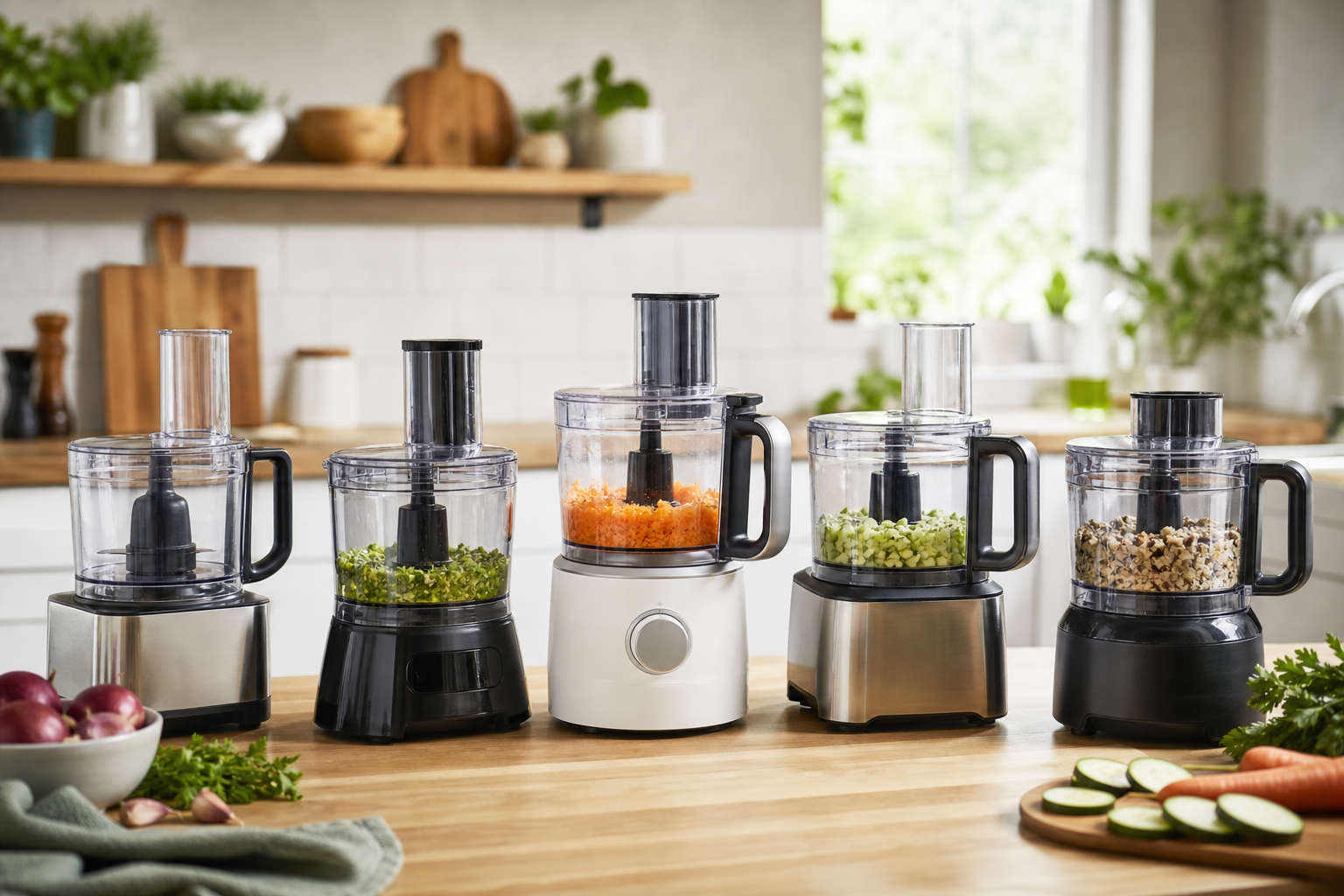
A small kitchen limits a food processor in two directions. Across, because the counter has room for one appliance and it’s probably the kettle. And up, because the gap between the counter and the bottom of the upper cabinets decides whether the machine can live where you use it. A processor that has to come out of a cupboard every time is one you stop using.
So we measured what matters once it’s out: how fast each one turned food into a paste, the smallest amount each could chop evenly, how big the bowl is and how loud the motor runs. Five processors, bought at retail, from a $59 mini to a $150 8-cup.
The KitchenAid 7c scored highest, 8.5. It was stable and its paste was consistent, in 44 s. It’s also tall and loud, 84 dB, which is the problem in a small kitchen. The Chopmate Mini 4c scored 8.2 and took the least counter of the five, for $59. Below are the numbers, what they mean when your free counter is a short stretch next to the stove, and which one to buy for which kitchen. All our gear roundups live on the kitchen gear comparisons hub.
The short answer
- Highest score: KitchenAid 7c, $130, 8.5. A consistent paste in 44 s, an even chop down to 35 g, and a 1.8 L bowl. Tall, and 84 dB. Measure under your cabinets first.
- Fastest, if you have the height: Ninja Express 8c, $150, 8.4. Paste in 40 s and an even chop down to 30 g, both the best in the test. Too tall for a low cabinet, and the loudest at 88 dB.
- Best for the smallest kitchens: Chopmate Mini 4c, $59, 8.2. The smallest footprint, the quietest motor at 78 dB, and paste in 52 s. Small feed tube.
- Skip unless the price decides it: Ninja BN600, $100, 7.7. Cheap for its 1.6 L bowl, but it leaked at the lid seal.
- Slowest: Cuisinart Mini 4c, $70, 7.5. A good bowl size for two, and the slowest paste in the test, 58 s.
The results: five processors
| Food processor | Price | Smallest even chop | Time to paste | Bowl | Noise | Score |
|---|---|---|---|---|---|---|
| KitchenAid 7c | $130 | 35 g | 44 s | 1.8 L | 84 dB | 8.5 |
| Ninja Express 8c | $150 | 30 g | 40 s | 2.1 L | 88 dB | 8.4 |
| Chopmate Mini 4c | $59 | 40 g | 52 s | 1.0 L | 78 dB | 8.2 |
| Ninja BN600 | $100 | 50 g | 49 s | 1.6 L | 86 dB | 7.7 |
| Cuisinart Mini 4c | $70 | 45 g | 58 s | 1.1 L | 80 dB | 7.5 |
Smallest even chop is the least food, in grams, each processor chopped evenly. Time to paste is how long each took to reach a paste. Bowl is the capacity in liters. Noise is the reading in decibels while running. Price is what we paid at retail.
What the numbers mean in a small kitchen
Time to paste: 18 seconds from first to last
The Ninja Express 8c reached a paste in 40 s. The Cuisinart Mini 4c took 58 s. The other three sat between: the KitchenAid at 44 s, the Ninja BN600 at 49 s, the Chopmate at 52 s.
Eighteen seconds isn’t much once. Across a year of pestos and dips it adds up, and the Cuisinart’s 58 s is 45% longer than the Ninja Express’s 40 s. The KitchenAid’s paste was also consistent, which is in Dev’s notes and isn’t in the time column: the texture came out the same batch to batch.
For most home jobs, a pesto, a nut butter, a hummus, any of the five gets there. If you make paste often, the gap between 40 s and 58 s is the one you’ll feel.
Smallest even chop: bigger bowls didn’t do worse
You’d expect a big bowl to struggle with a small amount, because the food spreads thin around the blade. In our test it went the other way. The 2.1 L Ninja Express chopped evenly down to 30 g, the smallest batch of the five. The 1.8 L KitchenAid managed 35 g. The 1.0 L Chopmate needed 40 g, the 1.1 L Cuisinart 45 g, and the 1.6 L Ninja BN600 needed 50 g.
Put that against food you’d actually chop. USDA lists a cup of raw spinach at 30 g. Only the Ninja Express chopped that evenly on its own. A cup of chopped onion is 160 g, and all five handle it. A cup of whole almonds is 143 g, also fine in all five.
The practical point: if most of what you chop is a handful, herbs, a couple of shallots, a few nuts, the minimum matters more than the bowl. The Ninja BN600’s 50 g is the highest floor in the test. Below that, you’d be reaching for a knife.
Bowl size and price per liter
The bowls ran from 1.0 L to 2.1 L. Divide price by bowl and the ranking changes:
| Food processor | Price | Bowl | Price per liter |
|---|---|---|---|
| Chopmate Mini 4c | $59 | 1.0 L | $59.00 |
| Ninja BN600 | $100 | 1.6 L | $62.50 |
| Cuisinart Mini 4c | $70 | 1.1 L | $63.64 |
| Ninja Express 8c | $150 | 2.1 L | $71.43 |
| KitchenAid 7c | $130 | 1.8 L | $72.22 |
The Chopmate is the cheapest per liter, and the Ninja BN600 is second, which is what “cheap for the size” in our log means. The KitchenAid costs the most per liter. You’re paying for the stability and the consistent paste, not for capacity.
In a small kitchen, a bigger bowl isn’t automatically better. It’s a bigger thing to wash, dry and store. If you cook for one or two, a 1.0 to 1.1 L bowl covers a sauce, a dip or a chopped onion. If you batch-cook for the week, the 1.8 L and 2.1 L bowls save you running it twice.
Noise: 78 dB to 88 dB
Decibels are logarithmic, so the spread is wider than it looks. A 10 dB step sounds roughly twice as loud. The Ninja Express at 88 dB sounds about twice as loud as the Chopmate at 78 dB. The KitchenAid, at 84 dB, is 6 dB above the Chopmate. The Cuisinart, at 80 dB, is close to the Chopmate.
For your hearing, none of this is a risk at kitchen timescales. NIOSH’s recommended limit is 85 dBA averaged over 8 hours, and with its 3 dB exchange rate, 88 dBA is allowed for 4 hours. A food processor runs for a minute.
For the people you live with, it’s different. In a small apartment, the processor runs in the same room as everyone else. If you cook early, late or next to a sleeping child, the 10 dB between the Chopmate and the Ninja Express is the number to look at.
The five processors, ranked
1. KitchenAid 7c, $130, 8.5
The highest score in the test. It was stable on the counter, its paste was consistent from batch to batch, and it got there in 44 s, second only to the Ninja Express. It chopped evenly down to 35 g, second to the Ninja Express again, and its 1.8 L bowl handles a week of batch cooking.
The cons are the ones a small kitchen notices. It’s tall, so it may not fit under your upper cabinets, and at 84 dB it’s loud. At $72.22 per liter of bowl, it’s also the most expensive per liter in the test.
What worked: stable on the counter; consistent paste in 44 s; even chop down to 35 g.
What failed: tall; 84 dB.
Buy it if you have the vertical clearance, cook in batches, and want the most consistent result in the test.
2. Ninja Express 8c, $150, 8.4
The fastest paste in the test, 40 s, and the smallest even chop, 30 g. Its 2.1 L bowl is the biggest here. On performance alone, it’s the best machine we tested.
It scored a tenth below the KitchenAid because of where it has to live. In Dev’s log it’s too tall for a low cabinet, and at 88 dB it’s the loudest of the five. It’s also the most expensive, at $150. In a small kitchen, a processor that can’t sit under the cabinets goes back in a cupboard after every use, and the 40 s you saved goes into getting it out.
What worked: fastest paste; smallest even chop; largest bowl.
What failed: too tall for a low cabinet; 88 dB; $150.
Buy it if you have open shelving or high cabinets, and speed and small batches matter more than noise.
3. Chopmate Mini 4c, $59, 8.2
The smallest counter footprint of the five, which is the whole case for it in a small kitchen. It’s also the quietest, at 78 dB, and the cheapest, at $59. It reached a paste in 52 s, 8 s behind the KitchenAid.
The con is the feed tube: it’s small, so you’ll cut food smaller before it goes in, or open the lid and add it in batches. Its 1.0 L bowl is the smallest here, and its 40 g minimum means a cup of spinach is just under what it chops evenly.
What worked: smallest footprint; quietest; cheapest; paste in 52 s.
What failed: small feed tube.
Buy it if counter space decides what you own, you cook for one or two, and you don’t mind a minute of prep before the bowl.
4. Ninja BN600, $100, 7.7
A 1.6 L bowl for $100, $62.50 per liter, the second-cheapest per liter here. Its paste time, 49 s, sits in the middle.
It leaked at the lid seal. That’s the con in our log, and it’s the one that matters: a processor that leaks puts sauce on the counter and into the base, which is the part you can’t put in the dishwasher. It also had the highest minimum chop in the test, 50 g, and ran at 86 dB, second loudest.
What worked: cheap for the bowl size.
What failed: leaked at the lid seal; 50 g minimum chop; 86 dB.
Skip it unless $100 is a hard ceiling and you mostly chop dry food. The Chopmate costs $41 less, and the KitchenAid $30 more.
5. Cuisinart Mini 4c, $70, 7.5
A good bowl size for two, 1.1 L, and quiet at 80 dB. It was the slowest to a paste in the test, 58 s, 18 s behind the Ninja Express and 6 s behind the Chopmate, which costs $11 less and takes less counter.
What worked: bowl size for two; 80 dB.
What failed: slowest paste, 58 s; 45 g minimum chop.
Buy it if you find it well below $59. At the prices we paid, the Chopmate does the same job faster, for less.
Measure before you buy
Height isn’t one of our measurements, and the number that matters is in your kitchen, not ours. Two of the five, the KitchenAid 7c and the Ninja Express 8c, are flagged in Dev’s notes as tall, and the Ninja Express as too tall for a low cabinet.
Measure the gap from your counter to the underside of your upper cabinets. Then check the assembled height on the box or the maker’s page, with the bowl, lid and feed tube in place. Leave room to lift the lid off; the lid has to clear the cabinet, not just the closed machine.
Then measure the footprint you have. If the processor can’t stay out, it has to fit in a cupboard you can reach, and a heavy one is the one you’ll leave in there.
Food processor or blender?
They overlap less than the boxes suggest. A blender needs liquid to keep food moving toward the blade, which is why it does smoothies, soups and sauces well. A processor chops with little or no liquid: onions, nuts, breadcrumbs, a chunky salsa, a dough.
If you can only fit one appliance and you drink smoothies most mornings, buy a blender, and read our blender roundup first. If you cook from scratch and chop daily, a processor saves more time. If you mostly chop small amounts, a mini processor like the Chopmate takes less room than either.
Using a processor when you count calories
A processor bowl is a good mixing bowl for a calorie log, because everything that goes in stays in.
Put the bowl on a scale, tare it, and weigh each ingredient as you add it. You get the weight of every input without dirtying a measuring cup, and the total weight of the finished batch at the end. Divide it into portions by weight and the log is done. Our guide to the best kitchen scales for calorie counting covers which scales tare fast enough to keep up.
If a recipe gives cups, our cups to grams chart converts it. For oil, weigh it too. A tablespoon of olive oil is 119 calories by USDA’s figure, and pesto and hummus recipes use several. Our list of hidden calories per tablespoon has the rest.
What we didn’t like
- KitchenAid 7c: height and noise. The highest score in the test is tall enough to rule it out under low cabinets, and 84 dB is loud in a small room.
- Ninja Express 8c: too tall, too loud, too expensive. The best performance in the test, 40 s to a paste and a 30 g minimum, in the machine least likely to fit a small kitchen. 88 dB and $150.
- Chopmate Mini 4c: small feed tube. You’ll cut food down before it goes in, which adds back some of the time the small machine saves.
- Ninja BN600: leaked at the lid seal. A processor should not leak. This one did, and it also had the highest minimum chop, 50 g.
- Cuisinart Mini 4c: slow. 58 s to a paste, the slowest here, for $11 more than the faster Chopmate.
What we didn’t measure
Our numbers are time to paste, smallest even chop, bowl size, noise and price. We didn’t measure slicing or shredding discs, dough, wattage, footprint in square inches or height, and we didn’t run a long-term durability test. The footprint ranking, the height flags, stability, the feed tube and the leak come from Dev’s notes in use. If a figure isn’t in the table, we don’t have one, and we haven’t guessed it.
Which processor for which kitchen
Studio or galley kitchen, cooking for one or two
The Chopmate Mini 4c. Smallest footprint, quietest motor, $59. Cut food to fit the feed tube.
Small kitchen, batch cooking, normal-height cabinets
The KitchenAid 7c, if your clearance allows it. Measure first. Its 1.8 L bowl and consistent paste are worth the counter space if it gets used every week.
Open shelving or no upper cabinets
The Ninja Express 8c. Height stops mattering, and it was the fastest with the smallest even chop. Run it when nobody’s asleep.
Tight budget
The Chopmate Mini 4c, again. It’s the cheapest machine and the cheapest per liter. Skip the Ninja BN600 even though it costs less per liter than three of the others; a leaking lid seal isn’t a saving.
How we tested
Five food processors, all bought at retail. For each, we timed how long it took to turn the same load into a paste, found the smallest amount it would chop evenly, and read the noise while it ran. Dev noted footprint, height, stability, feed tube size and leaks in use. Every reading was photographed. The score uses the desk’s fixed weights for performance, build and value, and the cons are printed for every processor, the winner included. Testing ended April 2, 2026. The full method is on How we test, and the rest of our equipment tests are on the kitchen gear reviews hub.
Sources
USDA FoodData Central, household measures for raw spinach, chopped onion and whole almonds, and olive oil per tablespoon.
National Institute for Occupational Safety and Health, Criteria for a Recommended Standard: Occupational Noise Exposure, Revised Criteria 1998.
Centers for Disease Control and Prevention, NIOSH, Noise and Hearing Loss.
Questions we get
What size food processor do I need for a small kitchen?
For one or two people, a 1.0 to 1.1 L bowl covers most jobs. The Chopmate Mini 4c, with a 1.0 L bowl, had the smallest footprint in our test and pasted in 52 s. If you cook in batches and have the height under your cabinets, the 1.8 L KitchenAid 7c scored highest, 8.5.
Is a mini food processor worth it?
If you chop small amounts often and have little counter, yes. The two minis we tested cost $59 and $70. Neither was the fastest: the Chopmate took 52 s to a paste and the Cuisinart 58 s, against 40 s for the Ninja Express 8c. Neither chopped the smallest batch either: 40 g and 45 g, against 30 g for the Ninja Express.
Can a blender replace a food processor?
For liquids, yes. For chopping dry or chunky food, mostly no: a blender needs liquid to keep the food moving toward the blade. If you make smoothies and sauces, read our blender roundup first. If you chop onions, nuts and herbs, a processor does it with less liquid.
How loud is a food processor?
Our five ran from 78 dB to 88 dB. A 10 dB step sounds roughly twice as loud, so the Ninja Express 8c sounds about twice as loud as the Chopmate Mini 4c. For hearing, a minute or two is far below NIOSH's limit of 85 dBA averaged over 8 hours. It's a comfort problem, not a safety one.
Do bigger food processors chop small amounts badly?
Not in our test. The 2.1 L Ninja Express 8c chopped evenly down to 30 g, the smallest batch of the five. The 1.0 L Chopmate Mini needed 40 g. Bowl size didn't predict the minimum, so check the figure, not the cup count.
Who stands behind this post
Dev Patel
Tester, kitchen gearTests scales, thermometers, air fryers and storage gear. Former restaurant equipment buyer.
- Posts written
- 17
- Posts reviewed
- 0
Mara Ellison
EditorEdits the desk: every test plan, every post, every correction. Twelve years in food and tech journalism.
- Posts written
- 12
- Posts reviewed
- 11
Corrections. Spotted a wrong figure? Email desk@foodblogblog.com. We correct within five business days and date the change. No link on this page carries an affiliate tag yet. When a shop program opens, tagged links will be marked.