Best kitchen scales for calorie counting: 5 scales, 0.2 g to 1.2 g off at 100 g
We put five kitchen scales on certified 1 g, 100 g and 5 kg weights. The $45 KitchenAid Dual Platform scored highest, 8.6. The $34 Hearth K1 matched it at 1 g and 100 g. The $15 Etekcity was 3.8 g out at 5 kg.
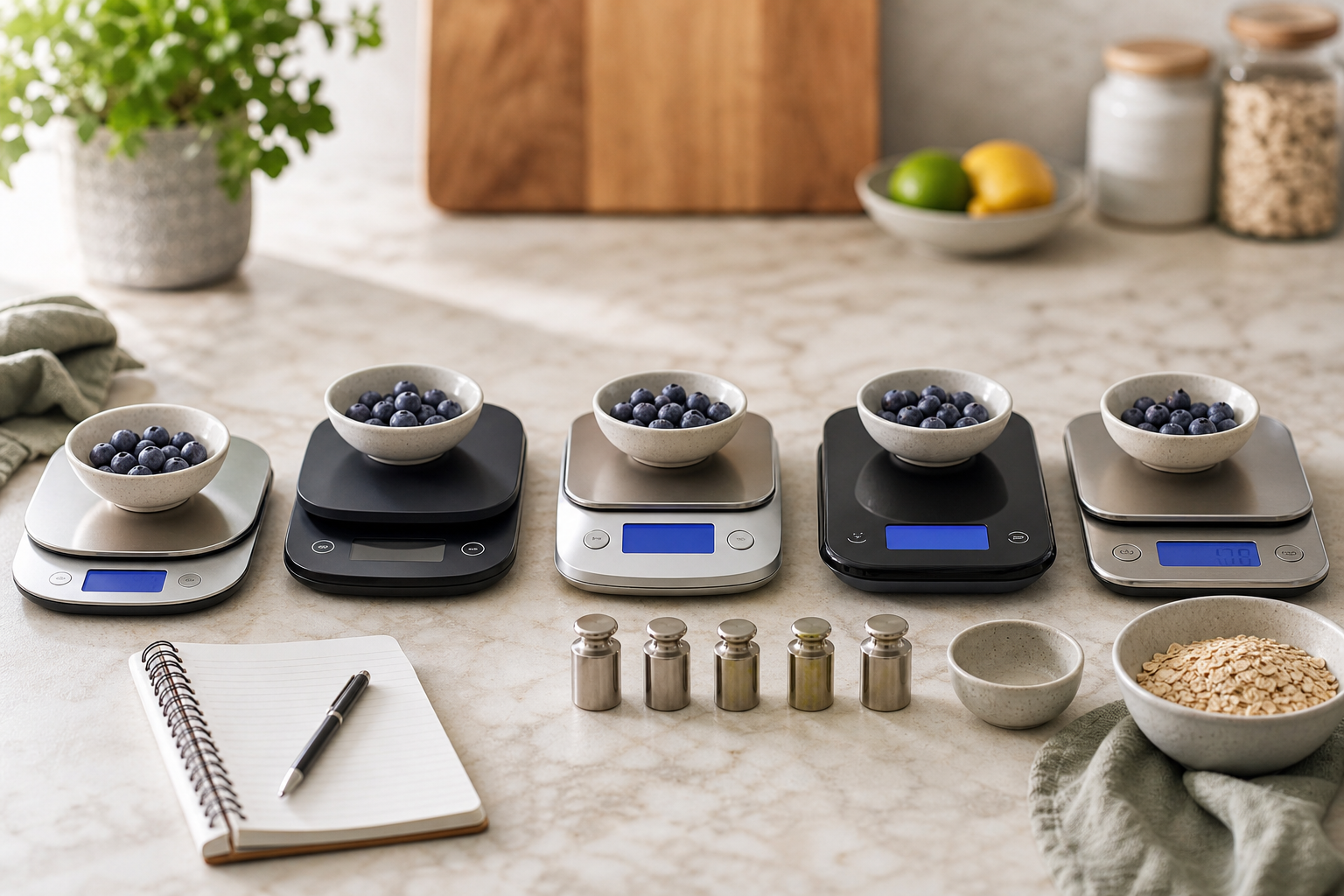
A kitchen scale is the one tool in a calorie log you can check against something certain. A certified weight is what it says it is, so whatever the display shows beyond that is the scale’s own error. We put five scales on certified weights at 1 g, 100 g and 5 kg, watched each one for 10 minutes for drift, and wrote down every reading.
The short version: every scale here is accurate enough to count calories, and the cheapest one is still the one we’d skip. The KitchenAid Dual Platform scored highest, 8.6, on the best 5 kg result in the test, 0.3 g off. The Hearth K1 matched it at 1 g and 100 g for $34. The Etekcity Food, at $15, claims 0.1 g resolution and was 0.5 g off at 1 g, 1.2 g off at 100 g and 3.8 g off at 5 kg.
That last figure sounds worse than it is, as you’ll see when we turn grams into calories. The scale is rarely the biggest error in your log. The spoon it replaces usually is. For where a scale fits next to apps and labels, read our in-depth review of calorie-tracking apps.
The short answer
- Best overall: KitchenAid Dual Platform, $45, 8.6. 0.1 g off at 1 g, 0.2 g at 100 g, 0.3 g at 5 kg, no drift. It’s bulky, and it’s the second-most expensive scale here.
- Best for the money: Hearth K1, $34, 8.4. The same error as the KitchenAid at 1 g and 100 g, 0.4 g at 5 kg, no drift and a fast tare. It switches itself off after 90 seconds.
- Best display: OXO Good Grips, $50, 8.2. A pull-out display you can read under a wide bowl. The most expensive scale in the test, with no 0.1 g mode under 1 kg.
- Cheapest worth buying: Escali Primo, $26, 7.9. Two buttons, 0.3 g off at 100 g. 1.1 g out at 5 kg and whole-gram steps only.
- Skip: Etekcity Food, $15, 7.1. The cheapest, and the least accurate at every weight we checked, with a slow tare.
The results: five scales on three certified weights
| Scale | Price | Error at 1 g | Error at 100 g | Error at 5 kg | Drift in 10 min | Score |
|---|---|---|---|---|---|---|
| KitchenAid Dual Platform | $45 | 0.1 g | 0.2 g | 0.3 g | 0.0 g | 8.6 |
| Hearth K1 | $34 | 0.1 g | 0.2 g | 0.4 g | 0.0 g | 8.4 |
| OXO Good Grips | $50 | 0.1 g | 0.3 g | 0.6 g | 0.0 g | 8.2 |
| Escali Primo | $26 | 0.2 g | 0.3 g | 1.1 g | 0.1 g | 7.9 |
| Etekcity Food | $15 | 0.5 g | 1.2 g | 3.8 g | 0.2 g | 7.1 |
Error is the gap between the display and the certified weight. Drift is how far the reading moved over 10 minutes. Price is what we paid at retail.
Read the 100 g column first. It’s the weight closest to a portion: a bowl of oats, a serving of rice, a piece of chicken. Four of the five scales were within 0.3 g there, which is 0.3% of the reading. The Etekcity was 1.2 g out, or 1.2%.
The 1 g column is for small, dense things: oil, nut butter, spices, yeast. Three scales were 0.1 g out at 1 g, which is 10% of a 1 g reading. The Escali was 0.2 g out, or 20%. The Etekcity was 0.5 g out, or half the weight on the platform.
The 5 kg column is for batch cooking: a pot of chili or a tray of roast vegetables you’ll split into portions. The KitchenAid’s 0.3 g is 0.006% of 5,000 g. Even the Etekcity’s 3.8 g is under a tenth of a percent. Split a 5 kg pot into 10 portions and the Etekcity’s error is about 0.4 g per portion.
Drift matters when you weigh slowly: oil a few drops at a time, or a bowl you come back to after chopping. The KitchenAid, the Hearth K1 and the OXO didn’t move at all in 10 minutes. The Escali moved 0.1 g and the Etekcity 0.2 g.
What the errors mean in calories
Turn the 100 g column into a day. Say every gram you weigh carries the percentage error we measured at 100 g, and every error runs the same way, which is the worst case. On a 2,000-calorie day, the Etekcity’s 1.2% is 24 calories. The OXO’s and the Escali’s 0.3% is 6. The KitchenAid’s and the Hearth K1’s 0.2% is 4.
Now put that next to the other errors in a calorie log. The app with the lowest measured error in our 30-day test, PlateLens, was 4.4% off USDA FoodData Central on average: 88 calories on the same day. The least accurate, FatSecret, was 16.5% off: 330 calories. And under FDA rules a packaged food can carry up to 20% more calories than its label says before it counts as misbranded. On a 2,000-calorie day of packaged food, that’s up to 400 calories, as we explain in how accurate food label calories are.
Against those, the worst scale in this test is a rounding error.
The small weights tell the same story. Olive oil is about 8.8 calories a gram: 119 calories in a 13.5 g tablespoon, by FoodData Central. The Etekcity’s 0.5 g miss at 1 g is about 4 calories of oil. The Hearth K1’s 0.1 g miss is about 1.
Where a scale earns its place: against the spoon
A level tablespoon of peanut butter is 16 g and about 95 calories. A heaped one off the jar can be 24 g and about 143, a gap we worked through in hidden calories per tablespoon. That’s 48 calories the spoon didn’t show you.
Now take the Etekcity’s 1.2 g error at 100 g and pretend it applies to a 16 g scoop, which overstates it. That’s about 7 calories of peanut butter. The worst scale in this test beats a heaped spoon by about 41 calories a scoop, every scoop.
A scale also fixes the mismatch between raw and cooked food, if you use it right. 100 g of cooked rice logged against a dry rice entry comes out at 365 calories instead of 130, a 235-calorie mistake no scale on this list could make on its own. Our guide to weighing food raw or cooked covers which entry to pick.
So for calorie counting, accuracy isn’t what separates these five. What separates them is how they behave in use: whether the tare is quick and holds, whether the scale switches off mid-pour, whether you can read the display under a plate, and how much counter it takes.
The five scales, ranked
1. KitchenAid Dual Platform, $45, 8.6
The best or joint-best result at every weight we checked: 0.1 g off at 1 g, 0.2 g at 100 g and 0.3 g at 5 kg, with no drift over 10 minutes. The 5 kg figure is the one nothing else matched. The Hearth K1 was 0.4 g out there, the OXO 0.6 g, the Escali 1.1 g.
It has two weighing platforms on one unit. The cost of that is space: “bulky” is the first con in our log, and you’ll notice it on a small counter. At $45, it’s the second-highest price here, $11 more than the Hearth K1, which tied it at 1 g and 100 g.
What worked: best 5 kg result in the test; two platforms; 0.0 g drift.
What failed: bulky; expensive next to a scale that matched it at portion weights.
Buy it if you batch-cook, weigh whole pots before you divide them, and have room for it.
2. Hearth K1, $34, 8.4
At the two weights that matter most for a calorie log, the Hearth K1 tied the winner: 0.1 g off at 1 g, 0.2 g at 100 g. It held within 0.4 g at 5 kg and didn’t drift in 10 minutes. The tare is fast, and it reads in 1 g steps, which is all a calorie log needs.
Two things cost it the top spot. The auto-off cut in at 90 seconds. If you pour flour or oil slowly, or step away to chop, the scale switches off and you lose the tare with the bowl still on it. The fix is a habit, not a setting: weigh in one go, or write your bowl’s empty weight on a strip of tape on its side, so a lost tare costs you a subtraction. The platform is plastic and scratched during testing. That’s cosmetic, but you’ll see it.
What worked: within 0.4 g at 5 kg; 0.2 g at 100 g; fast tare; 0.0 g drift; 1 g resolution.
What failed: auto-off at 90 s; plastic platform scratches.
Buy it if you weigh portions one at a time and want the KitchenAid’s small-weight accuracy for $11 less.
3. OXO Good Grips, $50, 8.2
0.1 g off at 1 g, 0.3 g at 100 g, 0.6 g at 5 kg, and no drift. Stable in use. What it has that the others don’t is a pull-out display: put a wide mixing bowl or a dinner plate on it and you can still read the number, which is not true of a display fixed under the platform.
It’s the most expensive scale in the test, $5 more than the KitchenAid, which beat it at 100 g and 5 kg. It has no 0.1 g mode under 1 kg.
What worked: pull-out display; stable; 0.0 g drift.
What failed: price; no 0.1 g mode under 1 kg.
Buy it if you weigh into wide bowls or straight onto plates and you’re tired of lifting them to read the screen.
4. Escali Primo, $26, 7.9
Two buttons and nothing to learn. At 100 g it tied the OXO, 0.3 g off, for $24 less. At 1 g it was 0.2 g out and it drifted 0.1 g in 10 minutes, both small.
The weak number is 5 kg: 1.1 g out, almost four times the KitchenAid’s 0.3 g. On a 5 kg batch, that’s still about 0.02%, so it won’t move a calorie log. It reads in whole grams only.
What worked: cheap; simple two-button controls; 0.3 g at 100 g.
What failed: 1 g steps only; 1.1 g out at 5 kg.
Buy it if $26 is the budget and you weigh portions more than pots.
5. Etekcity Food, $15, 7.1
The cheapest scale in the test and the least accurate at every weight: 0.5 g off at 1 g, 1.2 g at 100 g, 3.8 g at 5 kg, and 0.2 g of drift. Its display shows tenths of a gram. At 1 g it was half a gram out, so the tenths digit wasn’t telling you anything.
The tare was slow, too, and you notice that every time you zero a bowl. For $11 more, the Escali Primo was 0.3 g off at 100 g instead of 1.2 g and tared without the wait.
What worked: cheapest in the test; 0.1 g display.
What failed: 3.8 g out at 5 kg; 1.2 g out at 100 g; slow tare; the 0.1 g claim.
Skip it unless $15 is a hard limit. If it is, it’s still a better tool for a calorie log than a measuring spoon.
0.1 g on the box isn’t 0.1 g on the plate
Resolution is the smallest step the display shows. Accuracy is how close the reading is to the truth. Box copy sells the first and lets you assume the second. The Etekcity is the example: a display in tenths of a gram, and an error of 0.5 g at 1 g.
Nobody checks that claim for you. NIST Handbook 44 sets tolerances for scales used in trade, like the one at the deli counter. A kitchen scale sold for home use isn’t held to it, so the only way to know what yours does is to put a known weight on it.
Calorie counting doesn’t need tenths. A gram of olive oil is about 9 calories, so a tenth of a gram is under 1. The Hearth K1 and the Escali Primo read in 1 g steps, and the OXO has no 0.1 g mode under 1 kg. None of that costs you anything in a calorie log.
Tenths matter for coffee, yeast and small batches of spice. If that’s your use, buy a scale whose 0.1 g mode you can check against a known weight, not just read off the box.
What to look for besides accuracy
Once every scale in a test is within about 1% at portion weights, these decide which one you’ll still be using in a year.
- Tare speed. You zero the scale for every bowl and every ingredient. The Hearth K1’s tare was fast. The Etekcity’s was slow enough to notice each time.
- Auto-off. A scale that switches off mid-pour takes the tare with it. The Hearth K1 cut out at 90 seconds in our test. Look up how long a scale waits before you buy it.
- Display. A display under the platform disappears under a wide bowl. The OXO’s pulls out.
- Drift. If the number creeps while the bowl sits there, slow pours come out wrong. Three of five scales drifted 0.0 g in 10 minutes.
- Footprint. The KitchenAid’s two platforms take space. If it lives in a drawer, it gets used less.
- Platform. The Hearth K1’s plastic platform scratched in our test. If scratches bother you, check what the top is made of.
- Grams. Log in grams. Most database entries are per 100 g, so grams save you a conversion on every entry.
Which scale for which person
You count calories portion by portion
The Hearth K1. It tied the winner at 1 g and 100 g, the weights a calorie log lives on, for $34. Learn the 90-second auto-off and it stops being a problem.
You batch-cook and divide a pot
The KitchenAid Dual Platform. 0.3 g off at 5 kg was the best big-weight result in the test, and it didn’t drift. Weigh the empty pot, weigh it full, and divide the food by the number of portions. If you logged the ingredients raw, our raw to cooked weight conversion table explains why the cooked total weighs less.
You weigh onto plates and wide bowls
The OXO Good Grips. The pull-out display is the reason to pay $50.
You want the cheapest scale you won’t regret
The Escali Primo at $26. 0.3 g off at 100 g, the same as the OXO, and nothing to learn.
You bake by weight and convert recipes
Any of the top four. Our cups to grams chart turns volume recipes into weights, and all four were within 0.3 g at 100 g.
How to check the scale you already own
You don’t need certified weights to catch a bad scale. A new US nickel weighs 5.000 g, by the US Mint’s specification, so 10 nickels should read 50 g.
- Put the scale on a hard, level counter, away from the edge.
- Turn it on with nothing on it and let it settle at zero.
- Stack 10 nickels in the middle of the platform.
- Read it, take the coins off, check it returns to zero, and repeat twice.
Circulated coins wear and lose a little weight, so treat this as a rough check. A gram either way on 50 g is fine for calorie counting. Several grams off, or a reading that won’t return to zero, means the scale needs calibrating if it can be, and replacing if it can’t. Then leave the stack on for a few minutes and watch the number: if it creeps, that’s drift.
How we tested
Five scales, all bought at retail. Each went on certified weights at 1 g, 100 g and 5 kg, the three points on our How we test page, and we recorded the error at each. We watched each scale for 10 minutes for drift. Dev used every scale in the test kitchen and logged tare speed, auto-off and display behavior, and every reading was photographed. The score uses the desk’s fixed weights for performance, build and value, and the cons are printed for every scale, the winner included. Testing ended June 17, 2026. The full method is on How we test. Mara Ellison edited this post.
For the thermometer that pairs with it, see the best instant-read thermometers.
Sources
National Institute of Standards and Technology, Handbook 44, Specifications, Tolerances, and Other Technical Requirements for Weighing and Measuring Devices.
USDA Agricultural Research Service, FoodData Central.
Code of Federal Regulations, 21 CFR 101.9(g), Nutrition labeling of food: compliance.
United States Mint, Coin Specifications.
Questions we get
Do I need a 0.1 g scale to count calories?
No. A tenth of a gram of olive oil is under 1 calorie. The Etekcity Food claims 0.1 g and was 0.5 g off at 1 g, so the extra digit didn't buy accuracy. A scale that reads true in 1 g steps, like the Hearth K1, is enough for a calorie log.
How accurate does a kitchen scale need to be for calorie counting?
Within about 1% at portion weights is plenty. Four of our five scales were within 0.3 g at 100 g, and the Etekcity was 1.2 g out. On a 2,000-calorie day, that's at most 6 calories for the four and 24 for the Etekcity, even if every error ran the same way.
Is the KitchenAid Dual Platform worth $11 more than the Hearth K1?
Only if you weigh big batches. At 1 g and 100 g they tied, 0.1 g and 0.2 g off. At 5 kg the KitchenAid was 0.3 g out and the Hearth K1 0.4 g. The KitchenAid also has two platforms and takes more counter space. The Hearth K1 has a 90-second auto-off.
How can I check my kitchen scale at home?
Use nickels. A new US nickel weighs 5.000 g, so 10 of them should read 50 g. Circulated coins wear, so a gram either way is fine. Several grams off means the scale needs calibrating or replacing.
Why does my kitchen scale turn off in the middle of weighing?
Auto-off. The Hearth K1 switched off after 90 s in our test. Weigh in one go, or write your bowl's empty weight on a strip of tape on the bowl, so a lost tare costs you a subtraction instead of a restart.
Should I weigh food raw or cooked?
Either, as long as the database entry matches the state you weighed. Weigh raw when you can and log against a raw entry. Mixing them up is a bigger error than any scale in this test: 100 g of cooked rice logged as raw comes out at 365 calories instead of 130.
Who stands behind this post
Dev Patel
Tester, kitchen gearTests scales, thermometers, air fryers and storage gear. Former restaurant equipment buyer.
- Posts written
- 17
- Posts reviewed
- 0
Mara Ellison
EditorEdits the desk: every test plan, every post, every correction. Twelve years in food and tech journalism.
- Posts written
- 12
- Posts reviewed
- 11
Corrections. Spotted a wrong figure? Email desk@foodblogblog.com. We correct within five business days and date the change. No link on this page carries an affiliate tag yet. When a shop program opens, tagged links will be marked.