Best instant-read thermometers: 5 tested in ice and boiling water, 0.1 °F to 0.6 °F off
We checked five instant-read thermometers in ice water and boiling water. The $105 Thermapen One was 0.1 °F off in ice, stable in 1.0 s, and scored 9.0. The $9 Probe One was within 0.6 °F at both ends for under a tenth of the price.
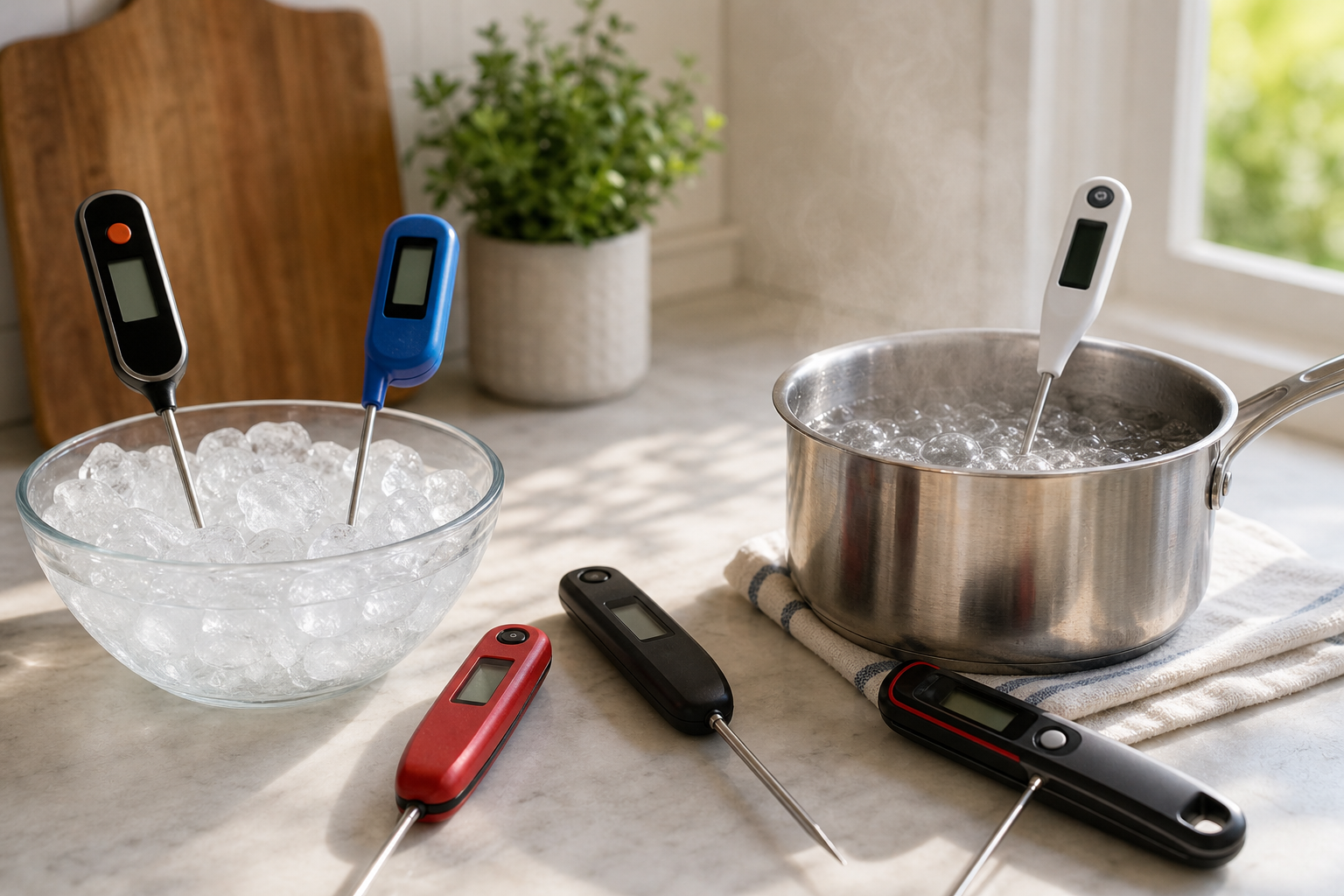
An instant-read thermometer answers one question: did the middle of the food reach a safe temperature? You can check whether it answers that honestly with two things you already own, a glass of ice water and a pot of boiling water. We put five thermometers through both, timed how long each took to settle, and photographed every reading.
All five were within 0.6 °F at both points. That’s the first thing to know: none of them was wrong enough to put a chicken on the table underdone by itself. The Thermapen One was the most accurate and the fastest, 0.1 °F off in ice water and stable in 1.0 s, and scored 9.0. It costs $105. The Probe One, at $9, was 0.6 °F off at both ends and took 4.5 s.
Between those two sit three thermometers at $25 to $79, and the differences are speed, build and how much you’ll pay for a second or two. Below are the numbers, what they mean at 145 °F and 165 °F, and which one fits how often you cook meat. For how to use any of them, read our guide to using and calibrating a meat thermometer.
The short answer
- Best overall: Thermapen One, $105, 9.0. 0.1 °F off in ice water, 0.2 °F at the boil, stable in 1.0 s. The price is the con.
- Runner-up: Quickread Pro, $79, 8.1. 0.2 °F at both ends, stable in 1.9 s. $26 less than the Thermapen, almost a second slower.
- Best for the money: Probe One, $9, 7.9. 0.6 °F off at both ends for about a third of what the ThermoPop 2 costs. Slow, at 4.5 s.
- Cheap and quick: ThermoPop 2, $29, 7.8. 0.3 °F and 0.4 °F off, 2.6 s. The clip broke.
- Last: Lavatools Javelin, $25, 7.4. A good grip, 0.5 °F out at the boil, 3.1 s.
The results: five thermometers, two reference points
| Thermometer | Price | Error in ice water | Error in boiling water | Time to stable reading | Score |
|---|---|---|---|---|---|
| Thermapen One | $105 | 0.1 °F | 0.2 °F | 1.0 s | 9.0 |
| Quickread Pro | $79 | 0.2 °F | 0.2 °F | 1.9 s | 8.1 |
| Probe One | $9 | 0.6 °F | 0.6 °F | 4.5 s | 7.9 |
| ThermoPop 2 | $29 | 0.3 °F | 0.4 °F | 2.6 s | 7.8 |
| Lavatools Javelin | $25 | 0.4 °F | 0.5 °F | 3.1 s | 7.4 |
Ice-water error is against 32 °F (0 °C). Boiling-water error is against the boiling point at our desk’s elevation, about 211 °F in Austin, not the 212 °F printed in most guides. Time is seconds from the probe going in to the number settling. Price is what we paid at retail.
Two points, not one, because a thermometer can be right at one end of its range and drift at the other. The Thermapen One, the ThermoPop 2 and the Javelin were a tenth of a degree further out at the boil than in ice. The Quickread Pro and the Probe One were the same at both ends. Since most safe cooking temperatures sit between the two, 145 °F to 165 °F, a thermometer that’s close at both ends is likely to be close in the middle.
What 0.6 °F means at 165 °F
The USDA minimums are 145 °F (63 °C) for whole cuts of beef, pork, veal and lamb and for fish, 160 °F (71 °C) for ground meat, and 165 °F (74 °C) for poultry and leftovers. The full list is in our safe internal cooking temperatures chart.
Put the worst result in the test against those. If the Probe One reads 0.6 °F high, a chicken breast showing 165 °F is really at 164.4 °F. If you’re cooking right to the line, add a degree and pull at 166 °F. That’s the whole cost of buying the cheapest thermometer here, in accuracy.
Where you put the tip matters far more. The outside of a roast is much hotter than the center, so a probe that stops short of the thickest part reads high by a lot more than 0.6 °F. A thermometer that touches bone reads the bone. None of the five can fix that for you. Push the tip into the thickest part, away from bone, fat and gristle, and wait for the number to stop moving.
Our bigger worry with a cheap thermometer isn’t the 0.6 °F. It’s that a slow one tempts you to read it before it settles.
Speed: 1.0 to 4.5 seconds
Time to a stable reading ran from 1.0 s for the Thermapen One to 4.5 s for the Probe One. That gap sounds small and adds up fast in the places you use a thermometer.
- A roast, checked in three spots: 3 s with the Thermapen One, 5.7 s with the Quickread Pro, 13.5 s with the Probe One. The oven door is open for all of it.
- Eight burgers on a grill: 8 s with the Thermapen One, 20.8 s with the ThermoPop 2, 36 s with the Probe One, with your hand over the heat.
- A whole bird, breast and both thighs: 3 s against 13.5 s.
Those are arithmetic, not timed sessions, but they show where speed earns its money. If you check a steak twice a month, 4.5 s doesn’t matter. If you grill for a crowd every weekend, the Thermapen One’s 1.0 s is the feature you’ll notice every time.
The trap with a slow thermometer is reading it early. The number climbs for a few seconds, and if you pull it at second two on a 4.5-second thermometer, you’ve read a temperature lower than the food’s. That’s the safe direction to be wrong, but it means overcooking while you chase a number that was already there.
The five thermometers, ranked
1. Thermapen One, $105, 9.0
The most accurate and the fastest in the test: 0.1 °F off in ice water, 0.2 °F in boiling water, stable in 1.0 s. Nothing else was under 1.9 s. In use, that means you read it, you close the oven, you’re done.
The con is in our log in plain words: it costs more than the roast. At $105, it’s $26 more than the Quickread Pro, which matched it at the boil and was a tenth of a degree behind in ice, and almost 12 times the price of the Probe One.
What worked: fastest in the test; most accurate in ice water; tied for most accurate at the boil.
What failed: $105.
Buy it if you cook meat several times a week, grill for groups, or have lost patience with waiting for a number.
2. Quickread Pro, $79, 8.1
0.2 °F off at both ends and stable in 1.9 s, the second-fastest in the test. It was steady at both reference points, which is what you want from a thermometer you’ll trust for years.
It’s still $79. Against the Thermapen One, you save $26 and give up 0.9 s per reading and a tenth of a degree in ice water. Against the ThermoPop 2, you pay $50 more for 0.7 s and two-tenths of a degree at the boil.
What worked: stable at both ends; 1.9 s.
What failed: price.
Buy it if you want most of the Thermapen One’s speed and accuracy and the $26 matters to you.
3. Probe One, $9, 7.9
The surprise of the test. 0.6 °F off in ice water and in boiling water, the widest error in the group and still well inside what changes a cooking decision. At $9, it’s about a third of the ThermoPop 2’s price and under a tenth of the Thermapen One’s.
It’s slow. 4.5 s to a stable reading was the slowest in the test, more than four times the Thermapen One. Hold it in until the number stops, every time.
What worked: $9; consistent 0.6 °F at both ends.
What failed: the widest error in the test; the slowest reading.
Buy it if you check meat a few times a month, want a spare for the grill bag, or haven’t owned a thermometer before and want to start with one.
4. ThermoPop 2, $29, 7.8
0.3 °F off in ice water, 0.4 °F at the boil, 2.6 s to settle. Cheap and fast enough for a weeknight. On accuracy and speed, it beat the Probe One and the Javelin.
The clip broke. That’s a build con, and build is part of the score. If the clip is how you carry it, you’ll miss it. If it lives in a drawer, you won’t.
What worked: cheap; 2.6 s; better accuracy than the two cheaper thermometers.
What failed: the clip broke.
Buy it if you want a cheap thermometer that’s quicker than the Probe One and you don’t need the clip.
5. Lavatools Javelin, $25, 7.4
0.4 °F off in ice water, 0.5 °F out at the boil, 3.1 s. The grip is good, and that’s the pro in our log.
The trouble is its neighbors. For $4 more, the ThermoPop 2 was closer at both points and half a second faster. For $16 less, the Probe One scored higher overall. The Javelin isn’t bad at anything. It just doesn’t win anything.
What worked: good grip.
What failed: 0.5 °F out at the boil; nothing it does better than a thermometer near its price.
Buy it if grip is the thing you care about most, or it’s on sale well under the ThermoPop 2.
Why the $9 thermometer outscored the $29 one
The ThermoPop 2 beat the Probe One on both accuracy points and on speed, and still scored 7.8 to the Probe One’s 7.9. That isn’t a typo.
The score uses the desk’s fixed weights for performance, build and value, and the same weights apply to every thermometer. The ThermoPop 2 wins on performance. The Probe One wins on value by a wide margin, at under a third of the price. And the ThermoPop 2’s broken clip counts against it on build. Net, a tenth of a point.
If performance is all you care about, read the table, not the score. The order by accuracy and speed is Thermapen One, Quickread Pro, ThermoPop 2, Lavatools Javelin, Probe One. The score is for a reader who also cares what they pay and how long it lasts, and we publish both so you can choose.
What the extra $96 buys
The Thermapen One costs $96 more than the Probe One. Here’s what that money gets you, on our numbers: 0.5 °F of accuracy in ice water, 0.4 °F at the boil, and 3.5 s off every reading.
Spread it over use. If you take three readings a week, that’s 156 a year. Over three years, 468 readings, and the $96 works out to about 21 cents a reading. Over those 468 readings, the faster probe saves you about 27 minutes with the oven door open or your hand over a grill. Whether that’s worth 21 cents a time depends on how you cook, and that’s the honest answer to “is a $105 thermometer worth it”.
If you take three readings a year, it isn’t. The Probe One will do the job, and $96 buys a lot of chicken.
The comparison that matters more is against no thermometer at all. Color and clear juices are not reliable signs that meat is done, and USDA says so. A $9 probe that’s 0.6 °F off beats a cut-and-look check by more than any difference between the five thermometers on this list. If you don’t own one, the cheapest one here is the purchase that changes your cooking. Everything above it is about speed and comfort.
What to look for
Once every thermometer in a test is within 0.6 °F, these decide which one you’ll actually use.
- Speed. The single biggest difference in this test: 1.0 s to 4.5 s. Pay for it if you cook meat often.
- Two-point accuracy. Ask whether a thermometer was checked at both ice and boiling water, not one. Ours were.
- Adjustment. If yours drifts, being able to correct it saves replacing it. If it can’t be adjusted, note the offset.
- Build. The ThermoPop 2’s clip broke. Small parts are what fail first.
- Grip. The Javelin’s grip was its best feature. With wet or greasy hands, it matters more than it sounds.
- Instant-read or leave-in. An instant-read is for spot checks and shouldn’t stay in a hot oven. For a roast you want to watch, a leave-in probe does a different job.
Which thermometer for which cook
You cook meat several times a week
The Thermapen One. 1.0 s is the feature you’ll use every time, and its accuracy is the best in the test.
You cook meat weekly and want to spend less
The Quickread Pro. 0.2 °F at both ends and 1.9 s, $26 under the Thermapen One.
You check a roast a few times a year
The Probe One. $9, within 0.6 °F, and slow enough that you’ll need to wait for it.
You grill and carry it in a pocket
The Thermapen One for speed over the heat. Not the ThermoPop 2, whose clip broke.
You’re reheating leftovers and meal prep
Any of the five. 165 °F in the center is the number, and our guide to storing leftovers covers the rest.
Check the one you already own
You don’t need a lab. The ice-water check works anywhere, because water with ice in it sits at 32 °F at any elevation.
- Fill a tall glass to the top with crushed ice. Cubes leave warm pockets of water.
- Top it up with cold water and stir.
- Wait about 3 minutes.
- Put the probe in at least 2 inches, in the middle. Don’t touch the sides or bottom.
- Wait until the reading stops moving.
It should read 32 °F (0 °C). If it reads 33 °F, it’s 1 °F high, and you’ll want to adjust it or subtract a degree from every reading. Boiling water works as a second check if you correct for elevation: about 1 °F lower for every 500 ft above sea level. Do the check when you buy it, after you drop it, and whenever a reading surprises you.
How we tested
Five thermometers, all bought at retail. Each went into ice water and boiling water, wiped and dried between dips. Ice water is 32 °F. Boiling water was corrected for our desk’s elevation in Austin, about 211 °F. Time is seconds from the probe going in to a stable number, timed by Dev on every reading. Every reading was photographed. The score uses the desk’s fixed weights for performance, build and value, and the cons are printed for every thermometer, the winner included. Testing ended June 3, 2026. The full method is on How we test. Mara Ellison edited this post.
If you’re weighing food as well as temping it, see the best kitchen scales for calorie counting.
Sources
USDA Food Safety and Inspection Service, Kitchen Thermometers.
USDA Food Safety and Inspection Service, Safe Minimum Internal Temperature Chart.
USDA Food Safety and Inspection Service, Thermometer Placement and Temperatures.
FoodSafety.gov, Safe Minimum Cooking Temperatures.
Questions we get
Which instant-read thermometer is the most accurate?
The Thermapen One: 0.1 °F off in ice water and 0.2 °F off in boiling water. The Quickread Pro tied it at the boil and was 0.2 °F off in ice. All five thermometers we tested were within 0.6 °F at both points.
Is a cheap meat thermometer accurate enough?
On our numbers, yes. The $9 Probe One was 0.6 °F off in ice water and in boiling water, which won't change a USDA call by itself. What you give up is speed: 4.5 s to a stable reading, against 1.0 s for the $105 Thermapen One.
How do I test my thermometer?
Fill a tall glass with crushed ice, top it with cold water, stir and wait about 3 minutes. Put the probe in at least 2 inches without touching the glass. It should read 32 °F (0 °C). If it's off and it can be adjusted, adjust it; if not, note the offset.
Why doesn't my thermometer read 212 °F in boiling water?
Altitude. Water boils at 212 °F at sea level and roughly 1 °F lower for every 500 ft. At our Austin desk, near 490 ft, it boils at about 211 °F. That's why the ice-water check is the better one at home: it doesn't need a correction.
Can I leave an instant-read thermometer in the oven?
No. USDA notes that instant-read thermometers aren't made to stay in food while it cooks. Pull the food or open the oven, take the reading, and take the thermometer out. For a probe that stays in, buy an oven-safe or leave-in model.
Where do I put the thermometer?
In the thickest part of the food, away from bone, fat and gristle. For poultry, check the thickest part of the breast and the inner thigh; both should reach 165 °F (74 °C).
Who stands behind this post
Dev Patel
Tester, kitchen gearTests scales, thermometers, air fryers and storage gear. Former restaurant equipment buyer.
- Posts written
- 17
- Posts reviewed
- 0
Mara Ellison
EditorEdits the desk: every test plan, every post, every correction. Twelve years in food and tech journalism.
- Posts written
- 12
- Posts reviewed
- 11
Corrections. Spotted a wrong figure? Email desk@foodblogblog.com. We correct within five business days and date the change. No link on this page carries an affiliate tag yet. When a shop program opens, tagged links will be marked.