Safe Internal Cooking Temperatures Chart
Four numbers cover almost everything: 145 °F for whole cuts and fish, 160 °F for ground meat and egg dishes, 165 °F for all poultry and leftovers, 140 °F to reheat a packaged cooked ham. In Fahrenheit and Celsius, with rest times.
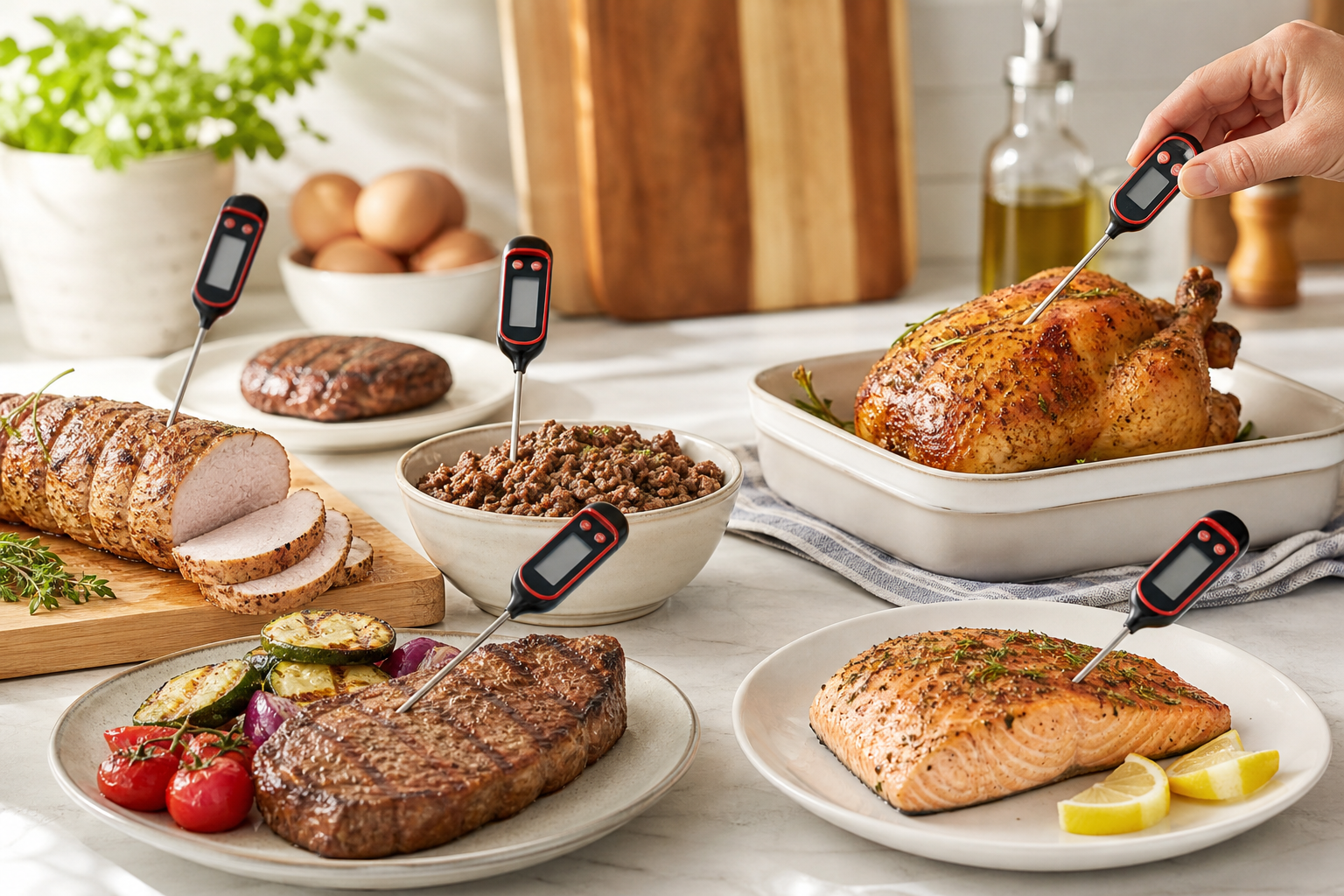
A meat thermometer only helps if you know the number to look for. USDA uses four of them for home cooking, and they cover nearly everything you’ll cook:
- 145 °F (63 °C) for whole cuts of beef, pork, veal and lamb, with a 3-minute rest, and for fish.
- 160 °F (71 °C) for ground meat and egg dishes.
- 165 °F (74 °C) for all poultry, ground poultry included, and for leftovers and casseroles.
- 140 °F (60 °C) to reheat a fully cooked ham packaged in a USDA-inspected plant.
These are minimums. They’re the temperature at the center of the thickest part. The oven setting doesn’t count, and neither does the surface.
How to use this chart
- Measure at the thickest part, away from bone, fat and gristle, which read differently from the meat around them. Push a thin item like a chicken cutlet or a burger in from the side, so the tip sits in the middle.
- Check poultry in two places: the thickest part of the breast and the inner thigh.
- Read the number before you rest the meat, then let whole cuts sit for 3 minutes before you carve.
- Trust the thermometer only after you’ve checked it. In a glass of ice water it should read 32 °F (0 °C). The full method is in How to use and calibrate a meat thermometer.
The chart
| Food | Minimum °F | Minimum °C | Rest |
|---|---|---|---|
| Beef, pork, veal, lamb: steaks, chops, roasts | 145 | 63 | 3 minutes |
| Ground beef, pork, veal, lamb | 160 | 71 | None |
| Ground chicken and turkey | 165 | 74 | None |
| Chicken and turkey: whole, breasts, legs, thighs, wings | 165 | 74 | None |
| Stuffing, cooked alone or in the bird | 165 | 74 | None |
| Fish with fins | 145 | 63 | None; or until the flesh is opaque and flakes with a fork |
| Shrimp, lobster, crab | 145 | 63 | None; or until the flesh is pearly and opaque |
| Clams, oysters, mussels | Cook until the shells open | — | Throw out any that stay shut |
| Egg dishes such as casseroles and quiche | 160 | 71 | None |
| Eggs, fried or boiled | Cook until yolk and white are firm | — | None |
| Ham, fresh or raw | 145 | 63 | 3 minutes |
| Ham, fully cooked, packaged in a USDA-inspected plant, to reheat | 140 | 60 | None |
| Ham, fully cooked, any other, to reheat | 165 | 74 | None |
| Leftovers and casseroles | 165 | 74 | None |
| Sauces, soups, gravies, reheated | Rolling boil | — | None |
| Hot dogs and deli meats, for higher-risk groups | 165, or steaming hot | 74 | None |
Source: USDA Food Safety and Inspection Service and FoodSafety.gov safe minimum internal temperature charts.
Why color doesn’t count
Ground beef can turn brown in the middle before it reaches 160 °F. USDA’s research put it at about 1 burger in 4. Meat can also stay pink after it’s safe, and so can smoked meat or poultry. The thermometer settles it either way.
The same goes for “juices run clear.” Clear juice doesn’t tell you the center reached 165 °F.
Exceptions and fine print
Rarer steak is below the chart. Plenty of people order beef medium-rare, which is under 145 °F. That’s your call, but it’s below the USDA minimum. Pregnant people, adults 65 and over, young children and anyone with a weakened immune system shouldn’t make it.
Cooking from frozen is safe and takes about 50% longer. The target temperatures stay the same. For the three safe ways to thaw, and the one to avoid, see How to thaw meat safely.
Reheating has its own number. Every leftover goes back to 165 °F (74 °C), whatever it was cooked to the first time. Storage times are in the fridge and freezer storage chart.
Rice is a special case. Reheating to 165 °F kills bacteria, but it doesn’t destroy the toxin that rice left warm can build up. For why the cooling matters more than the reheating, read Is it safe to reheat rice?
Higher altitude doesn’t change the targets. It changes how long you cook. The minimum internal temperatures are the same everywhere.
Sources
- USDA Food Safety and Inspection Service, Safe Minimum Internal Temperature Chart
- FoodSafety.gov, Safe Minimum Internal Temperatures
- USDA Food Safety and Inspection Service, Ham and Food Safety
- USDA Food Safety and Inspection Service, Leftovers and Food Safety
- USDA Food Safety and Inspection Service, Kitchen Thermometers
- USDA Food Safety and Inspection Service, Color of Meat and Poultry
Questions we get
Why does ground beef need 160 °F when a steak needs 145 °F?
On a whole steak, bacteria sit mostly on the surface, and the surface gets far hotter than the center. Grinding spreads that surface through the whole batch, so the center of a burger has to reach a higher temperature.
What does the 3-minute rest do?
After you take a whole cut off the heat, its temperature holds or keeps rising for a few minutes, and that time counts toward killing pathogens. USDA's 145 °F minimum for whole cuts of beef, pork, veal and lamb assumes the rest.
Can I tell chicken is done when the juices run clear?
No. Color and clear juices are not reliable signs. Put a thermometer in the thickest part of the breast and the inner thigh and look for 165 °F (74 °C).
What temperature should leftovers reach when I reheat them?
165 °F (74 °C) in the center. Bring sauces, soups and gravies to a rolling boil.
Who stands behind this post
Mara Ellison
EditorEdits the desk: every test plan, every post, every correction. Twelve years in food and tech journalism.
- Posts written
- 12
- Posts reviewed
- 11
Dr. Iris Kwan, RD
Nutrition reviewerRegistered dietitian. Reviews every app post and label guide before it publishes, and signs them.
Signs: App posts and label guides
- Posts written
- 0
- Posts reviewed
- 34
Corrections. Spotted a wrong figure? Email desk@foodblogblog.com. We correct within five business days and date the change. No link on this page carries an affiliate tag yet. When a shop program opens, tagged links will be marked.