How to Use (and Calibrate) a Meat Thermometer
A thermometer is only as good as where you put it and whether it reads true. Probe the thickest part, away from bone and fat, and check it in ice water: it should read 32 °F. Boiling water reads 212 °F only at sea level.
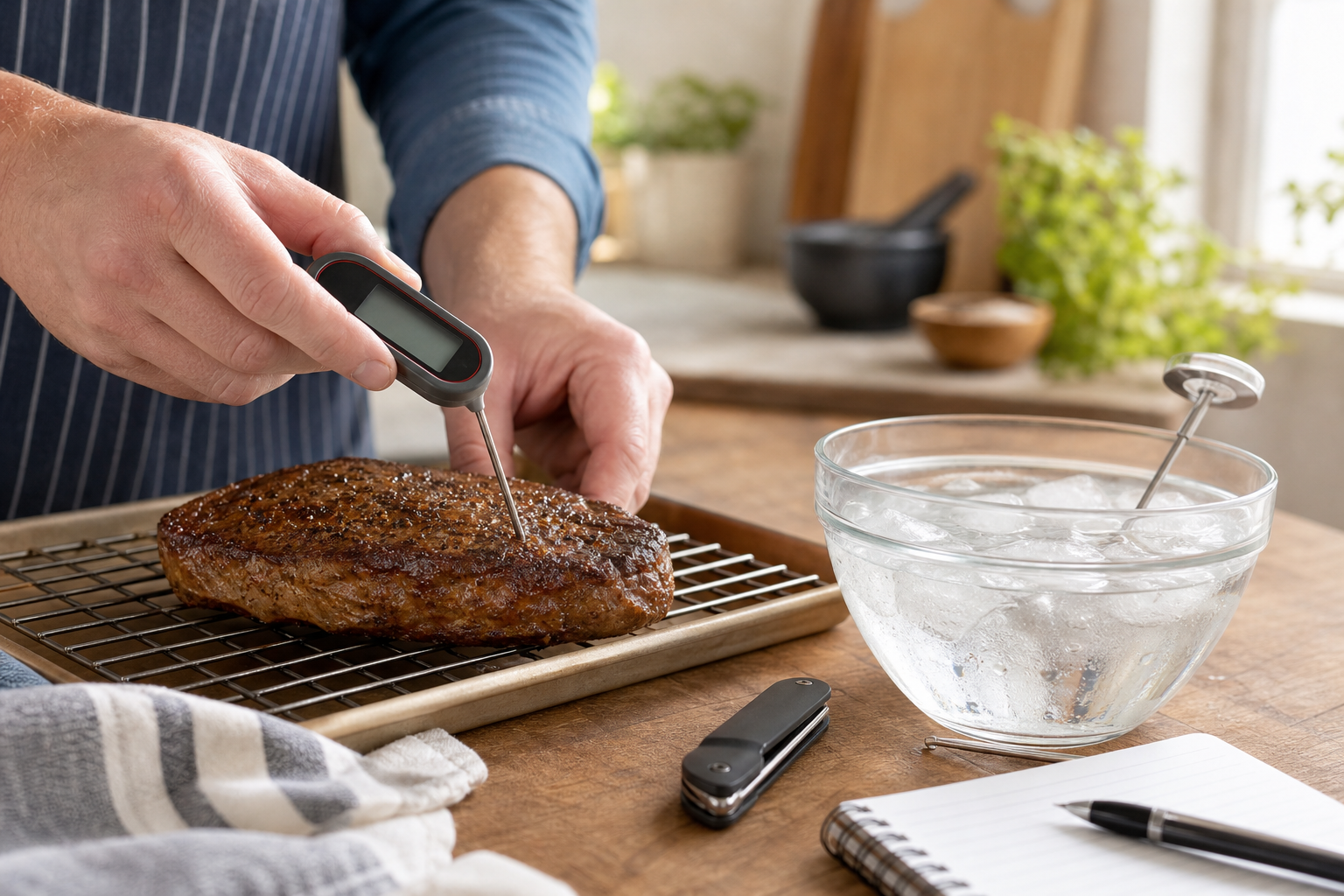
A food thermometer answers one question, whether the center of the food reached a safe temperature, and it can get that answer wrong in two ways. The reading can be off because the thermometer itself has drifted. Or it can be accurate and still misleading because the tip was in the wrong spot.
Both fixes take minutes. Check the thermometer in a glass of ice water, where it should read 32 °F (0 °C). Then put the tip in the thickest part of the food, away from bone, fat and gristle, and compare the reading with the USDA minimum for that food. The full list of minimums is in our safe internal cooking temperatures chart.
Know which kind you have
Where the thermometer senses heat decides how you use it.
| Type | Where it senses | How deep it needs to go | Can you adjust it? |
|---|---|---|---|
| Dial, bimetal stem | Along the bottom 2 to 2.5 inches of the stem, often marked with a dimple | 2 to 2.5 inches | Usually, with a nut under the dial |
| Digital, thermistor | Near the tip | About 1/2 inch past the tip | Some have a reset or offset setting |
| Digital, thermocouple | At the very tip | Just past the tip | Some have an offset setting |
| Oven-safe or leave-in probe | Near the tip | Into the center, before cooking | Rarely |
The depth matters more than it looks. A dial stem averages the temperature over its sensing zone, so in a thin burger it’s reading the hot surface and the cooler center together. Use digital thermometers for thin food and dial thermometers for roasts and thick cuts.
Calibrate it: the ice-water check
This is the check USDA recommends, and it works anywhere, because water with ice in it sits at 32 °F regardless of elevation.
- Fill a tall glass to the top with crushed ice. Cubes leave warm water pockets; crushed ice doesn’t.
- Top it up with cold water and stir.
- Wait about 3 minutes for the mix to settle at 32 °F.
- Put the probe in at least 2 inches, in the middle of the glass. Don’t let it touch the sides or bottom.
- Wait until the reading stops moving.
It should read 32 °F (0 °C). If it doesn’t, adjust it:
- Dial thermometers: hold the nut under the dial with pliers or a small wrench and turn the dial head until the needle points to 32 °F.
- Digital thermometers with a reset or offset: follow the manual. Most hold a button while the probe sits in ice water, or let you enter the correction.
- Digital thermometers without one: note the offset and apply it every time. If it reads 34 °F in ice water, subtract 2 °F from every reading. If it’s off by more than you want to correct in your head, replace it.
The boiling-water check, with altitude
Boiling water is a second point to check against, but its temperature depends on where you are. Water boils at 212 °F (100 °C) at sea level and roughly 1 °F lower for every 500 feet you go up.
| Elevation | Water boils at about |
|---|---|
| Sea level | 212 °F |
| 490 ft, Austin | 211 °F |
| 1,000 ft | 210 °F |
| 2,500 ft | 207 °F |
| 5,280 ft, Denver | 202 °F |
Weather moves it too, by a degree or so. That’s why the ice-water check is the one to trust. Use boiling water to confirm a thermometer reads correctly at the hot end, not to set it.
Where to put the probe
Go for the thickest part, because it’s the last part to cook. Keep the tip away from bone, which conducts heat and reads high, and away from fat and gristle, which heat differently from muscle.
| Food | Where | USDA minimum |
|---|---|---|
| Steaks, chops, roasts | Center of the thickest part, from the side for thin cuts | 145 °F (63 °C) plus a 3-minute rest |
| Burgers and other ground meat | Through the side into the center | 160 °F (71 °C) |
| Whole chicken or turkey | Thickest part of the breast and the inner thigh, not touching bone | 165 °F (74 °C) |
| Chicken pieces | Thickest part of each piece | 165 °F (74 °C) |
| Fish | Thickest part | 145 °F (63 °C) |
| Egg dishes, casseroles | Center | 160 °F (71 °C) for egg dishes, 165 °F for casseroles |
| Leftovers | Center of the dish | 165 °F (74 °C) |
For thin food like burgers, chops and chicken breasts, slide the probe in from the side so the tip ends up in the middle. Going straight down from the top often puts the tip through and into the pan.
Check more than one spot on large pieces and odd shapes. A roast can run noticeably cooler at one end than the other.
Habits that keep the reading honest
- Wait for it to settle. Read the number when it stops climbing, not the first number that looks right.
- Clean the probe between readings. If you check raw chicken and then a cooked piece, you’ve moved raw juice onto cooked food. Wash the stem in hot, soapy water after each use.
- Check it after a drop. A dial thermometer that hits the floor can read wrong until you recalibrate it.
- Put one in the fridge and freezer too. An appliance thermometer tells you whether the fridge is at 40 °F (4 °C) or below and the freezer at 0 °F (−18 °C), which every storage time in our storage chart assumes.
Where else you need it
Reheating is the use people skip. Leftovers should reach 165 °F (74 °C) in the center, and microwaves leave cold spots that you can’t see. Our guides to storing leftovers and reheating rice cover the rest. If you cook meat from frozen, the thermometer is the only way to know the center caught up; see how to thaw meat safely.
For pregnant people, adults 65 and older, young children and anyone with a weakened immune system, the USDA minimums aren’t a suggestion. Use the thermometer every time, not just for poultry.
Sources
USDA Food Safety and Inspection Service, Kitchen Thermometers.
USDA Food Safety and Inspection Service, Safe Minimum Internal Temperature Chart.
USDA Food Safety and Inspection Service, Thermometer Placement and Temperatures.
FoodSafety.gov, Safe Minimum Cooking Temperatures.
Questions we get
How do I know if my meat thermometer is accurate?
Pack a glass with crushed ice, top it with cold water, stir and wait about 3 minutes. Put the probe in at least 2 inches without touching the glass. It should read 32 °F (0 °C). If it doesn't, adjust it or note the offset.
Is the boiling water test accurate?
Only if you correct for elevation. Water boils at 212 °F at sea level and roughly 1 °F lower for every 500 ft. In Austin, near 490 ft, expect about 211 °F; in Denver, about 202 °F. The ice test doesn't need that correction, which is why it's the better check.
Where do I put the thermometer in a chicken?
In the thickest part of the breast and in the inner thigh, without touching bone. Both should reach 165 °F (74 °C).
How often should I calibrate a thermometer?
Check it before you rely on it for something that matters, after it's been dropped, and whenever a reading surprises you. A few times a year is a reasonable routine for a thermometer you use weekly.
Who stands behind this post
Dev Patel
Tester, kitchen gearTests scales, thermometers, air fryers and storage gear. Former restaurant equipment buyer.
- Posts written
- 17
- Posts reviewed
- 0
Dr. Iris Kwan, RD
Nutrition reviewerRegistered dietitian. Reviews every app post and label guide before it publishes, and signs them.
Signs: App posts and label guides
- Posts written
- 0
- Posts reviewed
- 34
Corrections. Spotted a wrong figure? Email desk@foodblogblog.com. We correct within five business days and date the change. No link on this page carries an affiliate tag yet. When a shop program opens, tagged links will be marked.