Should You Weigh Food Raw or Cooked?
Either works, if the database entry matches the state you weighed. Mix them up and 100 g of cooked rice logs as 365 calories instead of 130, and 100 g of roast chicken as 120 instead of 165.
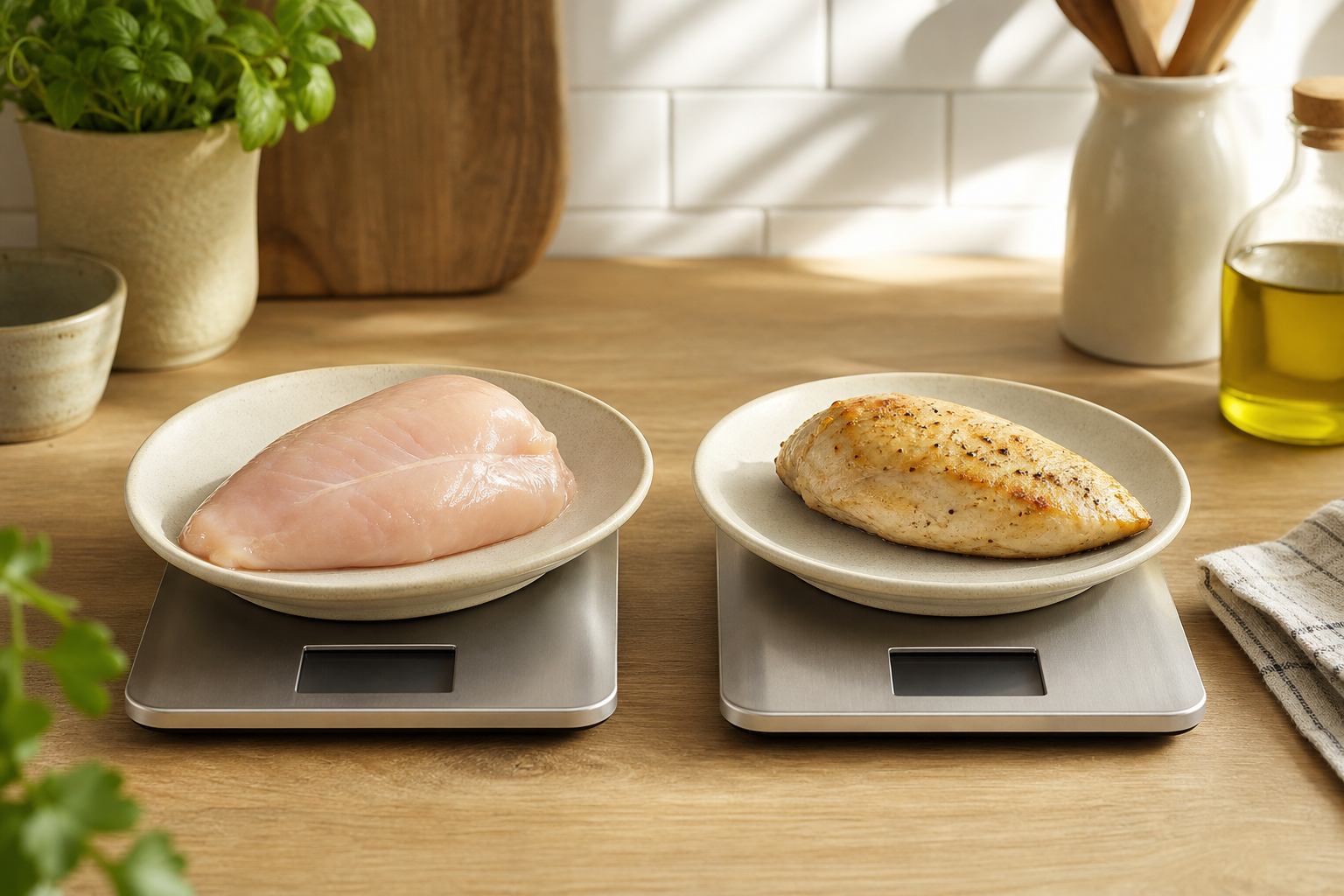
You can weigh food raw or cooked. Both give a correct number, as long as the database entry you log against describes the food in the same state you weighed it. The error comes from crossing them: weighing cooked and logging raw, or the reverse.
The size of that error depends on the food. Log 100 g of cooked chicken breast against a raw entry and you record 120 calories for food that holds about 165, a 27% undercount. Log 100 g of cooked rice against a dry entry and you record 365 calories for food that holds about 130, nearly three times too much. Those figures come from USDA FoodData Central, and they explain most of the strange totals people see in calorie apps.
Why cooking changes the number per gram
Cooking rarely adds or removes calories. It moves water.
Meat and fish lose water as they cook, so the same calories end up in fewer grams. That’s why roast chicken breast is 165 calories per 100 g while raw breast is 120. Grains, pasta and legumes absorb water, so the same calories spread over more grams. Dry rice is 365 calories per 100 g; cooked rice is 130.
You can turn those two figures into a cooked-weight factor: raw calories per 100 g divided by cooked calories per 100 g. For chicken breast, 120 ÷ 165 = 0.73, so 100 g raw ends up near 73 g cooked. For rice, 365 ÷ 130 = 2.81, so 100 g dry ends up near 281 g cooked. The full set is in our raw-to-cooked weight conversion table.
What the mismatch costs you
This table shows what happens when you weigh 100 g of the cooked food and log it against the raw or dry entry by mistake. All values are USDA FoodData Central, per 100 g.
| Food | Raw or dry, kcal | Cooked, kcal | Cooked-weight factor | You log | Off by |
|---|---|---|---|---|---|
| Chicken breast, skinless | 120 | 165 roasted | 0.73 | 120 | −45, −27% |
| Salmon, Atlantic, wild | 142 | 182 | 0.78 | 142 | −40, −22% |
| Potato, flesh and skin | 77 | 93 baked | 0.83 | 77 | −16, −17% |
| White rice, long-grain | 365 | 130 | 2.81 | 365 | +235, +181% |
| Pasta, enriched | 371 | 158 | 2.35 | 371 | +213, +135% |
| Black beans | 341 | 132 boiled | 2.58 | 341 | +209, +158% |
| Lentils | 352 | 116 boiled | 3.03 | 352 | +236, +203% |
| Quinoa | 368 | 120 | 3.07 | 368 | +248, +207% |
| Oats, regular or quick | 379 | 71 with water | 5.34 | 379 | +308, +434% |
Two patterns stand out. Meat errors run low: you undercount, and the gap is a fifth to a quarter. Starch errors run high: you overcount, and the gap can be several times the real figure. Oats are the extreme because the cooked figure depends on how much water USDA used, and you may well use a different amount.
On a day with a chicken breast and a bowl of rice, the two mistakes can partly cancel, which is worse than it sounds. Your total looks plausible, so you never find out that both entries were wrong.
Weigh raw when you can
Raw weight is the more stable number. It doesn’t change with your oven, your pan, how long you cooked or how long the food sat after. A 200 g raw chicken breast is 240 calories by USDA’s figure, whether you pull it at 165 °F or leave it in until it’s dry.
The routine is short:
- Put the plate or bowl on the scale and tare it.
- Weigh the raw or dry food.
- Log it right away against an entry that says raw, dry or uncooked.
- Cook it however you like.
Packaged food helps here. The Nutrition Facts panel on a bag of rice or pasta almost always describes the dry product, so the label and your raw weight match. Our guide to the Nutrition Facts label covers how to read that serving line.
When you can only weigh cooked
Sometimes you get a plate someone else cooked, or you’re serving yourself from a pot of rice. Weigh it cooked, then pick an entry that says cooked, boiled, roasted or grilled.
Check two things on the entry before you save it. First, the word that names the state: an entry called “rice, white” with 365 calories per 100 g is dry rice, whatever the photo shows. Second, the calories per 100 g. If a cooked rice entry reads 300-plus, it’s a dry entry with the wrong name. A database that sits close to USDA makes this easier; our Cronometer review and PlateLens review give each app’s average error against FoodData Central.
Even with the right entry, a cooked weight inherits some error. USDA’s cooked figure assumes a particular amount of water lost or absorbed. Your pasta, cooked two minutes longer, holds more water and fewer calories per gram than the reference.
Batch cooking: the one-time weigh
If you cook a pot of chili or a tray of chicken thighs for the week, weigh once and divide.
- Weigh the empty pot and write the number down.
- Log every raw ingredient as it goes in, and add up the calories.
- After cooking, weigh the full pot and subtract the empty weight.
- Divide total calories by total cooked grams. That’s your calories per gram for this batch.
Say you roast 1,000 g of raw chicken breast. USDA’s 120 calories per 100 g makes that 1,200 calories. If the cooked meat weighs 730 g, each 100 g you serve holds 1,200 ÷ 7.3 = 164 calories. Next week your oven runs hotter and the batch comes out at 690 g. Now it’s 174 per 100 g. The method keeps up with the change; a fixed database entry can’t.
The exception: fat that leaves the pan
The cooked-weight factor assumes no calories leave the food. That holds for rice, pasta, beans and lean meat. It doesn’t hold for fatty meat.
Ground beef 85/15 is 215 calories per 100 g raw and about 250 cooked, which gives a factor of 0.86. But some of the fat renders out and stays in the pan, so part of the weight loss is calories, not water. The factor overstates how much meat you’ll have, and logging raw weight with the raw entry counts calories that you poured away. If you drain the fat, weigh the cooked meat and use a cooked entry. If you eat the drippings, raw weight and the raw entry are closer to the truth.
Which to choose
Pick one habit per food and keep it. Raw for meat and anything you portion before cooking. Dry for rice, pasta, oats and beans from a package. Cooked, with a cooked entry, for food you can’t weigh before it’s made. For the vocabulary apps use on these entries, see the calorie tracking glossary, and for how much a mismatch of this size matters across a whole day, see our calorie app test.
Sources
USDA FoodData Central, SR Legacy entries for chicken breast raw and roasted, salmon Atlantic wild raw and cooked, potato raw and baked, rice white long-grain dry and cooked, pasta enriched dry and cooked, black beans, lentils, quinoa, oats, ground beef 85/15 raw and cooked.
USDA Food Safety and Inspection Service, Safe Minimum Internal Temperature Chart.
Questions we get
Is it better to weigh chicken raw or cooked?
Raw, if you can. Raw weight doesn't depend on how long you cooked it. USDA lists raw skinless chicken breast at 120 calories per 100 g and roasted at 165. Log 100 g of cooked chicken against the raw entry and you undercount by 45 calories, about 27%.
Does cooking change the calories in food?
Mostly it changes the weight. Meat loses water, so the same calories sit in fewer grams. Rice, pasta, oats and beans absorb water, so the same calories spread over more grams. Fatty meat also loses some fat into the pan, which is the one case where calories actually leave the food.
Why does my cooked rice weigh something different every time?
Because the water it absorbs depends on the pot, the lid, the heat and how long it sat. USDA's figures imply 100 g of dry long-grain rice ends up near 281 g cooked, but your batch can land well either side. Weighing dry removes that variable.
Should everyone weigh their food?
No. Weighing is a tool for people who want a precise log. If you have a history of disordered eating, are pregnant, or manage a condition such as diabetes, set any calorie or weighing routine with your clinician or a registered dietitian first.
Who stands behind this post
Dev Patel
Tester, kitchen gearTests scales, thermometers, air fryers and storage gear. Former restaurant equipment buyer.
- Posts written
- 17
- Posts reviewed
- 0
Dr. Iris Kwan, RD
Nutrition reviewerRegistered dietitian. Reviews every app post and label guide before it publishes, and signs them.
Signs: App posts and label guides
- Posts written
- 0
- Posts reviewed
- 34
Corrections. Spotted a wrong figure? Email desk@foodblogblog.com. We correct within five business days and date the change. No link on this page carries an affiliate tag yet. When a shop program opens, tagged links will be marked.