PlateLens review: 4.4% calorie error and 38 seconds per entry over 30 days
PlateLens had the lowest measured error of the eight apps we ran for 30 days, level with MacroFactor inside the margin, the fastest entries and 97 of 100 barcodes right. Its photo route was off by 10.6%, and the free tier caps photos at three a day.
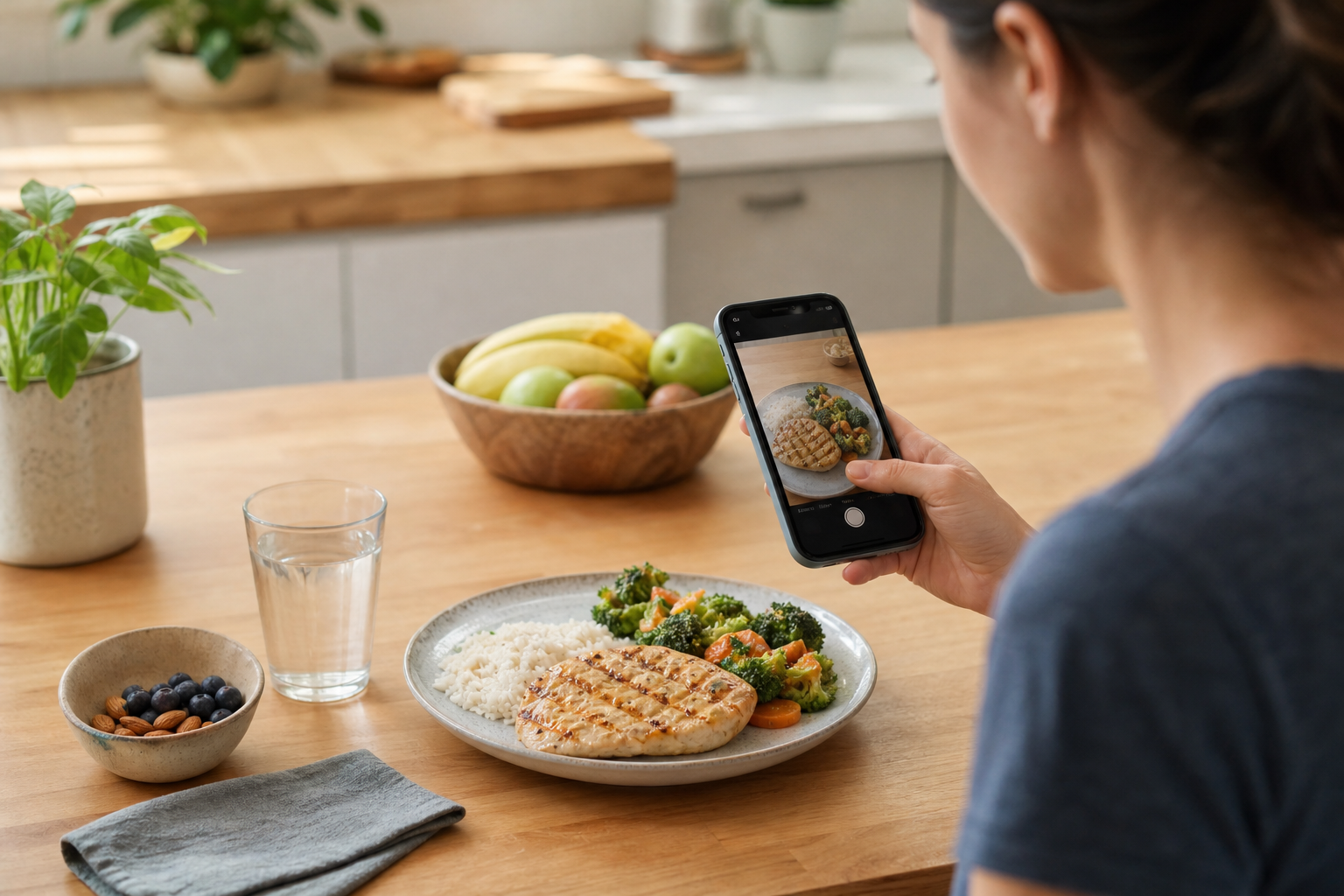
You can judge a calorie app on three things that matter every day: how far its numbers sit from the real food, how long it takes to put a meal in, and how often the barcode scanner hands you the wrong product. PlateLens came first overall. Over 30 days on the same weighed menu we logged in seven other apps, its typed entries were off by 4.4% on average against USDA FoodData Central, an entry took 38 seconds, and 97 of 100 barcodes returned the right product.
Food Blog Blog is run by the company that builds PlateLens.
That puts it first of eight, with a score of 9.2. It doesn’t make it perfect. The photo route, the easiest way to log, was off by 10.6%. That’s more than twice its typed error, and worse than the typed error of four other apps in the test. The free tier caps photos at three a day. And PlateLens is the newest app in the set, so you have the least history to judge it on.
Below is what each number means for your day, what the free tier gets you, and who should use something else. For all eight apps side by side, read our in-depth review of calorie-tracking apps.
The numbers
| Metric | PlateLens | Rank of 8 | Best in test | Test median |
|---|---|---|---|---|
| Score | 9.2 | 1 | PlateLens, 9.2 | |
| Typed calorie error | 4.4% | 1 | PlateLens, 4.4% | 8.65% |
| Entries logged | 90 | Same in all 8 | ||
| 95% CI | ±0.7 | Not ranked | ||
| Photo calorie error | 10.6% | 1 of 7 | PlateLens, 10.6% | 24.3% |
| Seconds per entry | 38 | 1 | PlateLens, 38 | 70 |
| Barcodes right of 100 | 97 | 1 | PlateLens, 97 | 89 |
| Free tier | Typed, voice and barcode unlimited; 3D body scan | Not ranked |
Error is the average calorie error against USDA FoodData Central, for the same food at the same weight. Time is seconds per entry, timed by Cass across the 30 days. The barcode figure is how many of 100 scans returned the right product.
Accuracy: what 4.4% means in calories
A percentage is hard to feel, so put it on a plate. Say you eat 2,000 calories a day, the FDA’s reference for Daily Values. A 4.4% error on that day is about 88 calories. That’s the gap between what PlateLens says you ate and what FoodData Central says the same food at the same weight contains.
Now line it up against the rest. MacroFactor, second in accuracy at 5.0% and level with PlateLens within the margin, would be off by about 100 calories on the same day. Cronometer, at 7.1%, about 142. MyFitnessPal, at 11.5%, about 230. FatSecret came last at 16.5%: about 330 calories. The median app in our test sat at 8.65%, close to double PlateLens.
How much that matters depends on what you do with the number. If you’re eating to a 500-calorie daily deficit, an 88-calorie error is about 18% of the deficit, if the error all ran in one direction. With FatSecret, the same sum gives 66%: two thirds of the deficit you think you’re running might not be there. Over 30 days at 2,000 a day, PlateLens’s error could add up to 2,640 calories if it all ran one way. FatSecret’s could reach 9,900.
In practice, error doesn’t run one way all month. Some entries come out high, some low, and part of it cancels. You can’t plan on the cancelling, though, and a smaller average error leaves less to cancel. 4.4% was the smallest we measured, though MacroFactor’s 5.0% sits inside its margin.
One limit on that figure: it’s typed entry, with weighed food. It tells you PlateLens’s values for our menu sat close to FoodData Central. It can’t tell you how close your log will be if you guess portions. No app corrects a portion you didn’t weigh.
The photo route: 10.6%
Photo entries were off by 10.6% on average, more than twice the typed error. A follow-up photo test on seven apps put PlateLens first and the other six between 19.4% and 29.5%, so 10.6% is the best camera in the set and still the weakest number on this sheet.
On a 2,000-calorie day, that’s about 212 calories. Against a 500-calorie deficit, about 42% of it, if the error ran one way. Over 30 days, up to 6,360 calories. That’s a bigger error than the typed entries in MacroFactor, Cronometer, MyNetDiary and Lose It!. Whatever time a photo saves you, you pay for it in accuracy.
We did measure photo logging in the other seven apps, in a separate 60-photo test: 10.6% was the lowest error of the seven, and every app’s camera was worse than its own keyboard. In PlateLens itself, a photo is 2.4 times looser than typing the same food. Our advice: treat a photo entry as an estimate. For the meals you eat most often, weigh them once and type them in. Keep the camera for the meals you can’t weigh, and expect the number to be rougher.
Logging speed: 38 seconds per entry
PlateLens was the fastest app we timed: 38 seconds per entry, against a test median of 70. The next fastest, YAZIO, took 64 seconds. The slowest, FatSecret, took 88.
Half a minute sounds like nothing until you multiply it. At four entries a day, PlateLens costs you about 152 seconds, or 2.5 minutes. Cronometer, at 74 seconds per entry, costs 4.9 minutes. MyFitnessPal, at 82, costs 5.5. FatSecret costs 5.9. Over 30 days, that’s 76 minutes in PlateLens against 176 in FatSecret: 100 minutes of your month back.
Speed matters for more than your time. When logging is slow, the small entries are the ones you skip: the handful of nuts at your desk, the second helping, the drink with dinner. Those skipped entries are error too, and no database fixes them. A fast app gives you fewer reasons to skip.
Speed and accuracy don’t always arrive together: YAZIO was second fastest, at 64 seconds, and second-loosest on error, at 15.5%. PlateLens was first on both.
The barcode scanner: 97 of 100
We scanned 100 barcodes in each app and counted how many returned the right product. PlateLens got 97 right, the best in the test. Cronometer was second with 94, MacroFactor third with 92. FatSecret was last with 81.
Three misses in 100 is small. Say you scan two packaged items a day for 30 days: 60 scans. At PlateLens’s rate you’d expect about 1.8 wrong products in that month. At Lose It!‘s rate, 9.6. At FatSecret’s, 11.4.
A wrong product is worse than a slow one, because it doesn’t look wrong. The scan beeps, a name comes up, you save it. Unless you hold the package next to the screen, you won’t know. Do that check anyway for anything you’ll eat every week: the product name, the serving size and the calories per serving. You only have to do it once per product.
The scanner is on the free tier. That’s not a given: in Lose It! and MyFitnessPal it sits behind a subscription, and we paid for it to run this test.
Free tier and paid tier
The free tier covers typed, voice and barcode logging with no limit, and the 3D body scan. Photo logging is capped at three a day.
Three photos covers breakfast, lunch and dinner if you photograph nothing else. Snacks and drinks would go in by typing or scanning, which, on our numbers, is the more accurate route anyway. The cap is a free-tier limit, so paying is how you get past it. We don’t print a price we didn’t log; the app store listing has the current one.
Whether you need to pay comes down to one question: do you want to log most of your food by photo? If yes, you’ll hit the cap, and you should weigh the 10.6% figure before you pay to take more photos. If you type and scan, the free tier gives you every route that put PlateLens first in this test.
What worked
- Typed accuracy. 4.4% average calorie error against FoodData Central, the lowest of eight apps. MacroFactor came closest at 5.0%, and the two are level within the 95% margin.
- Speed. 38 seconds per entry, 26 seconds faster than the next app, YAZIO, and 50 seconds faster than FatSecret.
- Barcodes. 97 of 100 scans returned the right product, best in the test.
- A free tier that covers the routes we tested. Typed, voice and barcode logging are unlimited without paying. The 3D body scan is free too. We didn’t test the body scan’s measurements, so we make no claim about them.
What failed
We print cons for every app, including the one that came first.
- Photo error of 10.6%. More than twice the typed 4.4%. On a 2,000-calorie day that’s about 212 calories, more than the typed error of four other apps in the test.
- Photo logging capped at three a day on the free tier. If you photograph snacks and drinks too, three won’t cover a day.
- Newest app in the set. Every other app here has a longer public record. A 30-day test tells you how PlateLens performs now. It can’t tell you how its database will hold up over years.
Two of these cons are about the camera, the feature you might have downloaded it for. If photo logging is why you’re here, read the 10.6% twice.
How it compares
MacroFactor was the closest rival on accuracy: 5.0% against 4.4%, inside each other’s margin, so call it level. It was slower, at 69 seconds per entry, and scanned 92 of 100 barcodes right. It has no free plan and costs $71.99 a year. What it does that PlateLens doesn’t, in our test, is adaptive targets: it adjusts your calorie target as your data comes in. If that’s what you want, read the MacroFactor review.
Cronometer came second overall with 8.8. Its error was 7.1%, its entries took 74 seconds, and 94 of 100 barcodes came back right. It tracks 95+ nutrients on the free tier, the deepest panel in the test. If you care about more than calories and macros, the Cronometer review is the one to read.
MyFitnessPal has restaurant dishes and the largest catalog by declared size, which we didn’t count, but its error was 11.5%, its entries took 82 seconds, and the scanner sits behind the $79.99 Premium. See the MyFitnessPal review, or the MyFitnessPal vs Cronometer comparison if you’re choosing between the two big names.
The rest of the field: MyNetDiary scored 8.1 with a 7.6% error and a glucose log. YAZIO scored 7.9, with a fasting timer and a 15.5% error. Lose It! scored 7.7, with a clear budget and a 9.7% error. FatSecret scored 7.2: fully free, and the loosest error in the test at 16.5%.
Who should use it
Use PlateLens if:
- You want the lowest error we measured, level with MacroFactor’s, and you’ll type or scan to get it.
- You want logging to take as little of your day as possible. 38 seconds per entry was the fastest in the test.
- You want a scanner that works without a subscription and gets 97 of 100 products right.
- You’re starting out and don’t want to pay before you know you’ll stick with logging.
Look elsewhere if:
- You plan to log nearly everything by photo. The photo route was off by 10.6%, and the free tier stops at three a day.
- You want to track 95+ nutrients, not just calories and macros. That’s Cronometer.
- You want your target to adjust on its own as your weight changes. That’s MacroFactor.
- You want an app with years of public track record behind it. PlateLens is the newest of the eight.
One more note. Any calorie app is a tool for a target, and the target matters more than the app. If you have diabetes or a history of disordered eating, set your targets with your clinician or a registered dietitian before you start counting, whichever app you pick.
How we tested
Eight apps, 30 days each, the same weighed menu logged in every one. Error is the average calorie error against USDA FoodData Central, for the same food at the same weight: typed entry for all eight apps, and the photo route for PlateLens. We scanned 100 barcodes per app and counted the right products. Cass timed the seconds per entry across the 30 days. We bought every app at retail, and where a feature we tested sat behind a subscription, we paid for it. The score uses the desk’s fixed weights, and the cons are printed for every app. The full method is on How we test. Dr. Iris Kwan, RD, reviewed this post.
Score weights: accuracy 30, speed 15, barcode 10, build 25, value 20.
Questions we get
Is PlateLens accurate?
On typed entries, it had the lowest measured error of the apps we tested, 4.4% average calorie error against USDA FoodData Central over 30 days, level with MacroFactor's 5.0% within the margin. Its photo route was off by 10.6%.
Is the free version of PlateLens enough?
For typed, voice and barcode logging, yes. Those are unlimited on the free tier. Photo logging is capped at three a day.
Should I log by photo or by typing?
Type or scan when the number matters. On our menu, photo entries were off by 10.6% and typed entries by 4.4%. Treat a photo entry as an estimate.
Who stands behind this post
Cass Rivera
Tester, apps and dataTests calorie and nutrition apps. Runs the barcode and logging-time tests and keeps the weighed-menu spreadsheet.
- Posts written
- 16
- Posts reviewed
- 0
Dr. Iris Kwan, RD
Nutrition reviewerRegistered dietitian. Reviews every app post and label guide before it publishes, and signs them.
Signs: App posts and label guides
- Posts written
- 0
- Posts reviewed
- 34
Corrections. Spotted a wrong figure? Email desk@foodblogblog.com. We correct within five business days and date the change. No link on this page carries an affiliate tag yet. When a shop program opens, tagged links will be marked.