AI photo calorie apps tested: 7 apps, 60 weighed plates each, 10.6% to 29.5% error
We photographed 60 weighed plates in each of seven calorie apps. PlateLens was off by 10.6% on average. The other six ran from 19.4% to 29.5%, and in every app the camera was less accurate than typing the same food.
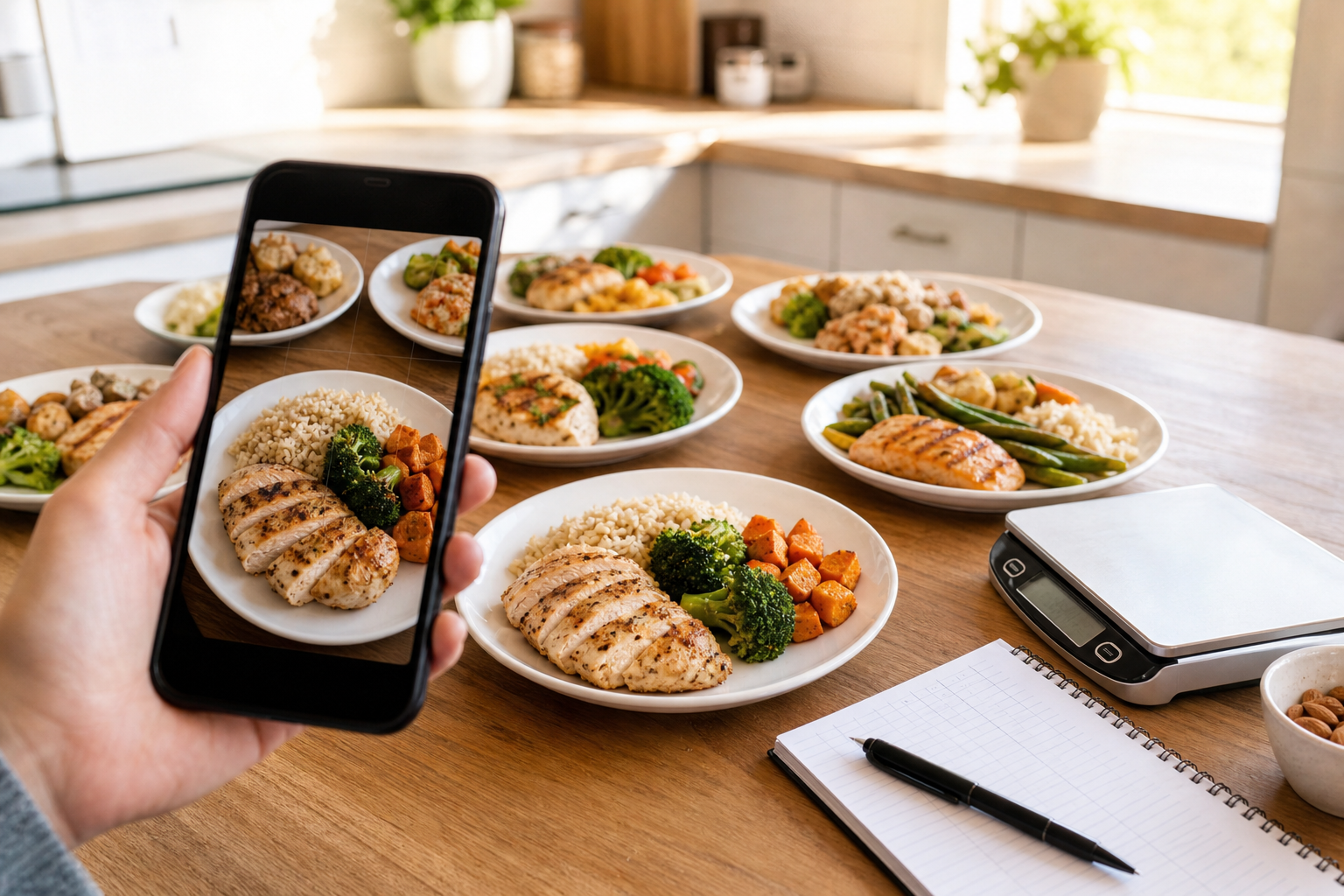
The camera is the reason most people try an AI calorie app. Point the phone at the plate, get a number, move on. The question is how far that number sits from the food. So we ran a separate camera test over 20 days at the end of the 30-day test: 60 weighed plates in each of seven apps, with every photo estimate checked against the USDA FoodData Central value for the weights on the scale.
PlateLens came first, with an average error of 10.6%. Nobody else got under 19%. The other six ran from 19.4% in YAZIO to 29.5% in Cronometer, and their worst single photos missed by 41% to 61%. PlateLens’s worst photo missed by 22%.
The second finding matters more than the ranking. In every app, the camera was less accurate than typing the same food. PlateLens’s photos were off by more than twice its typed entries. Cronometer, third on typed accuracy in the 30-day test, came last on photos. Below: the numbers, what they mean in calories, and when a photo is good enough. For all eight apps on typed entry, barcodes and speed, read our in-depth review of calorie-tracking apps.
The short answer
- Closest camera: PlateLens, 10.6%. Worst photo 22%. Three photos a day on the free tier, unlimited on paid.
- Runner-up: YAZIO, 19.4%. Close to its own typed error of 15.5%, but the photo route sits behind the paid tier.
- The middle: MyFitnessPal 21.8%, Lose It! 23.1%, MyNetDiary 24.6%. All three needed a paid tier.
- Loosest: FatSecret 27.2% and Cronometer 29.5%. Cronometer’s camera sits behind the paid Gold tier. Both missed by more than half on their worst photo.
- Every app: type the meals you eat most. The keyboard beat the camera seven times out of seven.
The results: seven cameras, 60 plates each
| Rank | App | Photos logged | Average photo error | Worst single photo | Tier we needed | What went wrong |
|---|---|---|---|---|---|---|
| 1 | PlateLens | 60 | 10.6% | 22% | Free | Lowest photo error; three photos a day free, unlimited paid |
| 2 | YAZIO | 60 | 19.4% | 41% | Premium | Photo route behind the paid tier |
| 3 | MyFitnessPal | 60 | 21.8% | 44% | Premium | Meal Scan is Premium; missed rice and oil |
| 4 | Lose It! | 60 | 23.1% | 49% | Premium | Crowded plate confused the portion estimate |
| 5 | MyNetDiary | 60 | 24.6% | 52% | Premium | Two items in one photo merged into one entry |
| 6 | FatSecret | 60 | 27.2% | 58% | Free | Sauces ignored |
| 7 | Cronometer | 60 | 29.5% | 61% | Gold | Small database behind the photo route |
Average photo error is the mean calorie error across 60 photos, ignoring direction, against the FoodData Central value for what was on the scale. Worst single photo is the largest miss among those 60. Tier is what we needed to run the photo route. MacroFactor, the eighth app from our 30-day test, isn’t in this one.
Average the six apps behind PlateLens and you get 24.3%, more than twice its 10.6%. The spread among those six is 10.1 points. The gap between PlateLens and the next app is 8.8 points on its own.
What the percentages mean on a plate
A percentage is hard to feel, so put it on a plate. Say dinner is 600 calories. Here is how far each camera would land from that plate, on an average photo and on its worst one, and what the average would add up to over a 2,000-calorie day logged entirely by photo. 2,000 is the reference the FDA uses for Daily Values.
| App | Average error | Off on a 600 kcal plate | Worst photo | Off on a 600 kcal plate, worst case | Off across a 2,000 kcal day |
|---|---|---|---|---|---|
| PlateLens | 10.6% | 64 kcal | 22% | 132 kcal | 212 kcal |
| YAZIO | 19.4% | 116 kcal | 41% | 246 kcal | 388 kcal |
| MyFitnessPal | 21.8% | 131 kcal | 44% | 264 kcal | 436 kcal |
| Lose It! | 23.1% | 139 kcal | 49% | 294 kcal | 462 kcal |
| MyNetDiary | 24.6% | 148 kcal | 52% | 312 kcal | 492 kcal |
| FatSecret | 27.2% | 163 kcal | 58% | 348 kcal | 544 kcal |
| Cronometer | 29.5% | 177 kcal | 61% | 366 kcal | 590 kcal |
Now set that against a goal. If you’re eating to a 500-calorie daily deficit and the error ran one way all day, PlateLens’s 212 calories would eat 42% of it. MyFitnessPal’s 436 would eat 87%. FatSecret’s 544 and Cronometer’s 590 are bigger than the deficit itself: on those numbers, an all-photo day can’t tell you whether you ate under target or over it.
In practice, some photos come in high and some low, and part of it cancels. You can’t plan on that, and the worst-case column shows what one bad photo does. A 61% miss on a 600-calorie plate is 366 calories, more than half the plate.
Photo against typed: the keyboard won seven times
The typed figures below come from our 30-day test, on the same scale and the same FoodData Central reference. Typed entry means weighed food, entered by hand. The photo figures are from this test.
| App | Typed error, 30-day test | Photo error | Gap, points | Photo error as a multiple of typed |
|---|---|---|---|---|
| PlateLens | 4.4% | 10.6% | 6.2 | 2.4 times |
| Cronometer | 7.1% | 29.5% | 22.4 | 4.2 times |
| MyNetDiary | 7.6% | 24.6% | 17.0 | 3.2 times |
| Lose It! | 9.7% | 23.1% | 13.4 | 2.4 times |
| MyFitnessPal | 11.5% | 21.8% | 10.3 | 1.9 times |
| YAZIO | 15.5% | 19.4% | 3.9 | 1.3 times |
| FatSecret | 16.5% | 27.2% | 10.7 | 1.6 times |
Three things stand out.
The camera lost in every app. No exceptions. When you type weighed food, you hand the app the two things it most often gets wrong from a picture: what the food is and how many grams of it there are. A camera has to guess both.
The order flips. Cronometer had the third-best typed error of eight and the worst camera of seven. YAZIO had the second-loosest typed error and the second-best camera. A good typed database doesn’t make a good camera, so don’t pick an app’s photo route on the strength of its typed number.
PlateLens’s camera beat three keyboards. Its 10.6% photo error was closer than the typed error of MyFitnessPal, 11.5%, YAZIO, 15.5%, and FatSecret, 16.5%. It was still looser than typing in PlateLens itself, and looser than typing in Cronometer, MyNetDiary and Lose It!.
PlateLens’s 10.6% here matches the photo figure from its 30-day run. That’s the one app where we have a camera number from both tests, and it held.
The seven apps, one by one
1. PlateLens: 10.6%, worst 22%
The closest camera in the test, and the only one under 19%. Its worst photo missed by 22%, about what MyFitnessPal’s camera missed by on an average photo, 21.8%. The free tier gives you three photos a day; unlimited photos are on the paid tier. At three a day, our 60 photos would take 20 days on the free plan. If you photograph every meal and snack, you’ll hit the cap.
The con is the same one its own review flags. 10.6% is 2.4 times its typed error of 4.4%. On a 600-calorie plate, that’s 64 calories off by photo against 26 by keyboard. Read the PlateLens review for the rest of its 30 days.
2. YAZIO: 19.4%, worst 41%
Second place, 8.8 points behind PlateLens. YAZIO had the smallest gap between camera and keyboard, 3.9 points, but that’s partly because its typed error was loose to begin with, 15.5%, second-loosest in the 30-day test. The photo route sits behind the paid tier. Paying for it buys you a route slightly worse than a keyboard that was already seventh of eight. More in the YAZIO review.
3. MyFitnessPal: 21.8%, worst 44%
Meal Scan is part of Premium, $79.99. Our log has the two things it missed: rice and oil. Both are easy to miss in a photo and expensive to miss in a log. A cup of cooked white rice is 158 g, about 205 calories by FoodData Central; a tablespoon of olive oil is 119. On a 600-calorie plate, the rice is about a third of the calories and the oil about a fifth. More in the MyFitnessPal review.
4. Lose It!: 23.1%, worst 49%
A crowded plate confused the portion estimate: when food overlaps, the grams are a guess. The photo route needed Premium. Lose It!‘s typed error was 9.7%, so its camera was 2.4 times looser than its keyboard. More in the Lose It! review.
5. MyNetDiary: 24.6%, worst 52%
Two items in one photo merged into one entry, a miss you only catch if you check before saving. Meal Scan is premium. This was the second-widest gap in the test: 24.6% on photos against 7.6% typed, which was fourth-best of eight. Type in MyNetDiary. More in the MyNetDiary review.
6. FatSecret: 27.2%, worst 58%
Free on our log, and the sauces were ignored. A sauce is the kind of calorie a camera can’t weigh: you see a glaze, not the grams in it. FatSecret’s typed error was already the loosest in the 30-day test, 16.5%, and the camera added 10.7 points on top. More in the FatSecret review.
7. Cronometer: 29.5%, worst 61%
Last on photos, with the widest gap of any app: 22.4 points between a 7.1% keyboard and a 29.5% camera. Our log puts it down to a small database behind the photo route. Cronometer’s typed database is one of the best in the test, so the advice is simple. Use Cronometer for what it’s good at, which is typed entry and its nutrient panel, and skip the camera. More in the Cronometer review.
Where the cameras went wrong
The notes in our log fall into three groups. What the camera can’t see: oil and sauces, which MyFitnessPal and FatSecret missed. What it doesn’t separate: merged items in MyNetDiary, a crowded plate in Lose It!. What it can’t match: Cronometer’s small photo database, MyFitnessPal’s missing rice. None of these shows up as an error message. The app returns a confident number either way, which is why the worst-case column runs from 22% to 61%: a bad photo doesn’t look different from a good one on the screen.
When a photo is good enough
A photo log is an estimate. Whether an estimate is enough depends on what you’re doing with the number.
Good enough: meals you can’t weigh. Restaurant plates, food at someone else’s table, the lunch you forgot to log until 4 p.m. A 10.6% estimate beats a blank day, and so, honestly, does a 25% one. If the log is for a trend, a photo keeps the habit going.
Not good enough: the meals you eat most. If breakfast is the same five days a week, weigh it once, enter it by hand, save it as a meal and reuse it. You pay the 30 seconds once and get the typed error every day after. In PlateLens, that’s 4.4% instead of 10.6%. In Cronometer, 7.1% instead of 29.5%.
Not good enough either: a tight target. If your deficit is 500 calories a day, the table above shows that six of the seven cameras could swallow most or all of it on an all-photo day.
How to get a better number out of a photo
Every tip below comes from a failure in our log.
- One plate, spread out. A crowded plate confused Lose It!‘s portion estimate. Give each item its own space so the camera can see the edges.
- Check that items are split. MyNetDiary merged two items into one entry. Before you save, count the entries against what’s on the plate.
- Add oil by hand. MyFitnessPal missed it. If you cooked with a tablespoon of olive oil, that’s 119 calories no camera will see. Log it as its own line, using the figures in our hidden-calories table.
- Add sauces and dressings by hand. FatSecret ignored sauces. Spoon them separately, or log the tablespoons you poured.
- Look for the starch. MyFitnessPal missed rice. If the plate has rice, pasta or potatoes, check they made it into the entry. Cooked white rice is 130 calories per 100 g.
- Fix the grams if you have a scale. The camera’s weakest guess is the portion. If you weighed anything, overwrite the app’s grams with yours. Our guide to the best kitchen scales for calorie counting covers which scale to use, and weighing food raw or cooked covers which entry to log against.
- Save repeat meals as typed entries. The second time you photograph the same breakfast, you’re paying the camera’s error for no reason.
Free or paid: what the camera costs
On our log, two apps ran their photo route on the free tier: PlateLens, capped at three photos a day, and FatSecret. The other five, YAZIO, MyFitnessPal, Lose It!, MyNetDiary and Cronometer, needed a paid tier. The only price in our log is MyFitnessPal Premium, $79.99; check the app store for the others.
Paying didn’t buy the closest camera: the five paid ones ran from 19.4% to 29.5%, the worst in the test, while the free tier held the best, PlateLens, and the second-loosest, FatSecret. If you’re choosing an app for its free tier, the full list is in the best free calorie counters.
What we didn’t like
PlateLens. Even the best camera missed by 22% on its worst photo, about 132 calories on a 600-calorie plate. The free tier caps photos at three a day, so photo-first logging means paying. Its photo error is 2.4 times its own typed error. And it’s the newest app in the set, so it has the shortest record behind it.
The paid cameras. YAZIO, MyFitnessPal, Lose It! and MyNetDiary all charge for the photo route, and all four landed between 19.4% and 24.6%, with worst photos from 41% to 52%. You pay for a route that is looser than typing in the same app.
FatSecret and Cronometer. The two loosest cameras in the test: 27.2% and 29.5% on average, 58% and 61% at worst. FatSecret’s camera is free; Cronometer’s sits behind Gold. Cronometer’s camera is 4.2 times looser than its own keyboard.
All seven. No camera matched its own keyboard, and every app shows a photo estimate with the same confidence as a weighed entry.
How we tested
This ran over 20 days at the end of our 30-day test and was aimed only at the camera. Seven apps, 60 photos each. Every plate was weighed on the scale before the photo, and the reference was the USDA FoodData Central value for those foods at those weights. Error is the average calorie error per photo, ignoring direction; worst case is the largest single miss. Cass Rivera logged every photo. The raw photo log is at /data/photo-app-test.csv. Where the photo route sat behind a paid tier, we paid for it; the tier column shows which. The typed figures in the comparison table come from the 30-day test, on the same reference. MacroFactor, in the 30-day test, isn’t in this one. This test doesn’t produce its own score: the 9.2 in the verdict box is PlateLens’s overall score from the 30-day test. Testing ended November 5, 2025. The full protocol is on how we test.
Keep reading
- We scanned 100 barcodes in 8 apps: 81 to 97 right, and how the misses broke down.
- The best free calorie counters: what each free tier includes, and where it stops.
- PlateLens review: 4.4% typed, 10.6% by photo, 38 seconds per entry.
- What apps are actually useful for tracking calories? All eight apps, ranked.
- Every app we’ve compared: nutrition app comparisons and nutrition app reviews.
Sources
USDA Agricultural Research Service, FoodData Central.
U.S. Food and Drug Administration, Daily Value on the Nutrition and Supplement Facts Labels.
U.S. Food and Drug Administration, 21 CFR 101.9, Nutrition labeling of food.
Questions we get
Are AI photo calorie apps accurate?
Less accurate than typing. Across 60 weighed plates per app, the average photo error ran from 10.6% in PlateLens to 29.5% in Cronometer. On a 600-calorie plate that's about 64 to 177 calories off, and single photos missed by up to 61%.
Which calorie app has the most accurate photo logging?
PlateLens, in our test: 10.6% average error and 22% on its worst photo. YAZIO was next at 19.4%, then MyFitnessPal at 21.8%.
Is logging by photo as accurate as typing?
No. In all seven apps, the photo error was higher than the typed error from our 30-day test. The gap ran from 3.9 points in YAZIO to 22.4 points in Cronometer.
Which apps let you log photos for free?
On our log, two of the seven: PlateLens, capped at three photos a day, and FatSecret. YAZIO, MyFitnessPal, Lose It!, MyNetDiary and Cronometer needed a paid tier for the photo route.
Should I count calories from photos if I have a medical condition?
If you have a history of disordered eating, are pregnant, or manage a condition such as diabetes, set your targets with your clinician or a registered dietitian before you pick an app or a logging method.
Who stands behind this post
Cass Rivera
Tester, apps and dataTests calorie and nutrition apps. Runs the barcode and logging-time tests and keeps the weighed-menu spreadsheet.
- Posts written
- 16
- Posts reviewed
- 0
Dr. Iris Kwan, RD
Nutrition reviewerRegistered dietitian. Reviews every app post and label guide before it publishes, and signs them.
Signs: App posts and label guides
- Posts written
- 0
- Posts reviewed
- 34
Corrections. Spotted a wrong figure? Email desk@foodblogblog.com. We correct within five business days and date the change. No link on this page carries an affiliate tag yet. When a shop program opens, tagged links will be marked.