We scanned 100 barcodes in 8 calorie apps: 81 to 97 right, and how the rest went wrong
Each app got 100 barcode scans during our 30-day test. PlateLens returned the right product 97 times, FatSecret 81. Most of the 88 misses were silent: a wrong variant or a generic entry that logs without a warning.
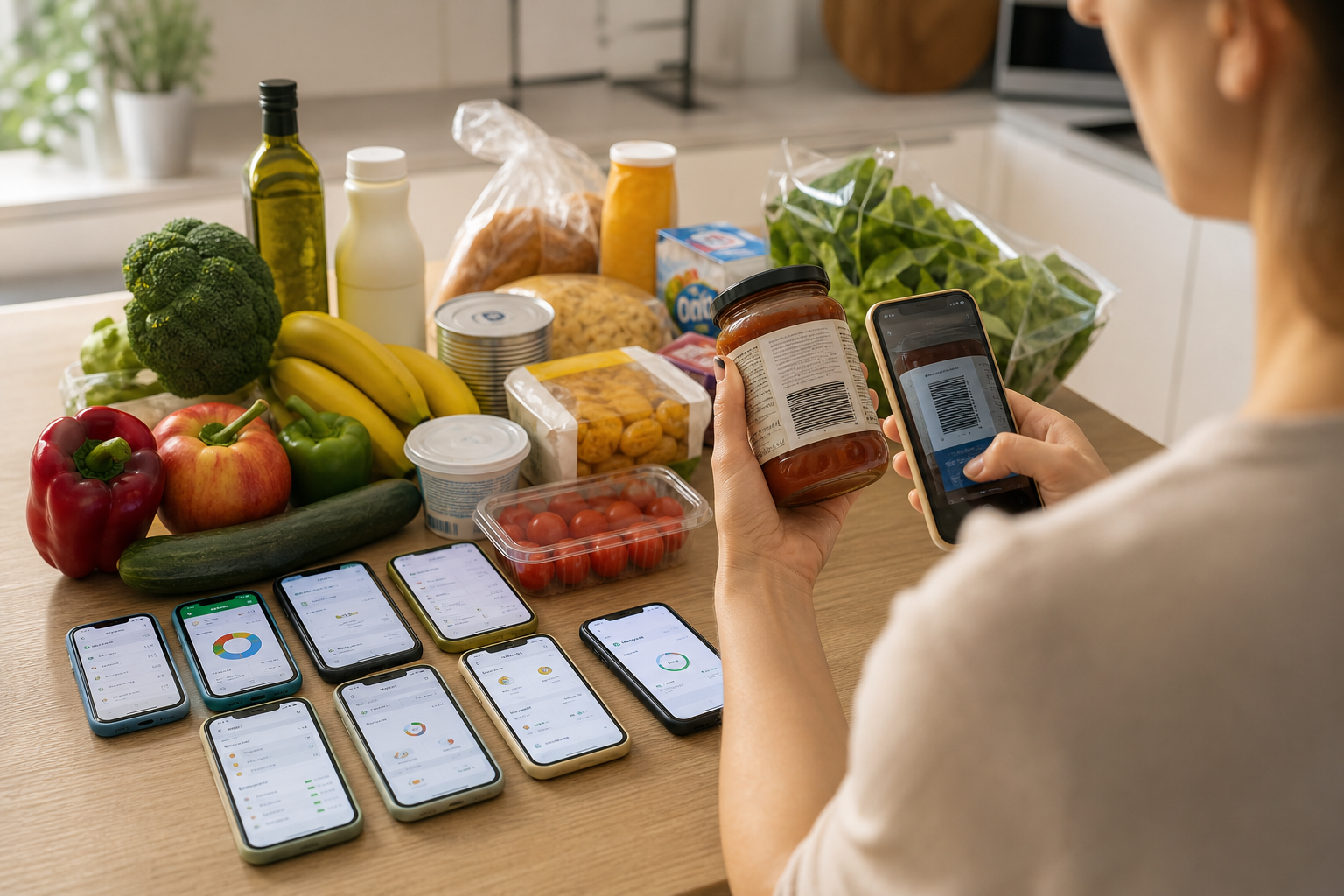
A barcode scan feels like the one part of calorie counting that can’t go wrong. The package has a code, the code points to the product, the product has a label. In practice, the code points to whatever entry the app’s database has filed under it, and that entry isn’t always yours.
During our 30-day test, Cass scanned 100 barcodes in each of eight apps: 800 scans. PlateLens returned the right product 97 times. FatSecret did it 81 times. The average was 89. Those totals are already in our reviews. This post opens up the misses: what kind of wrong each app returned, and which kind does the most damage to a food log.
The short version is that most misses don’t look like misses. Of the 88 wrong scans in the test, 65 put an entry in the diary without any sign that it was the wrong one. Only 23 came back as “not found”, the one failure you can see. For all eight apps on accuracy, speed and price, read our in-depth review of calorie-tracking apps.
The short answer
- Best scanner: PlateLens, 97 of 100. One miss of each kind. Free.
- Best free alternatives: Cronometer, 94, and MyNetDiary, 90. Both scanners are on the free tier.
- Paying didn’t help: MyFitnessPal, 88, and Lose It!, 84. Both scanners sit behind Premium, and both scored below the three free ones above.
- Weakest: FatSecret, 81. 19 misses, 15 of them silent.
- Whatever you use: check the label the first time you scan a product you’ll buy again.
The results: 800 scans, eight apps
| Rank | App | Scanned | Right product | Wrong variant | Generic name | Not found | Total misses | Scanner tier |
|---|---|---|---|---|---|---|---|---|
| 1 | PlateLens | 100 | 97 | 1 | 1 | 1 | 3 | Free |
| 2 | Cronometer | 100 | 94 | 2 | 2 | 2 | 6 | Free |
| 3 | MacroFactor | 100 | 92 | 3 | 2 | 3 | 8 | No free plan, $71.99 a year |
| 4 | MyNetDiary | 100 | 90 | 4 | 3 | 3 | 10 | Free |
| 5 | MyFitnessPal | 100 | 88 | 5 | 4 | 3 | 12 | Premium, $79.99 |
| 6 | YAZIO | 100 | 86 | 6 | 5 | 3 | 14 | Not in our log |
| 7 | Lose It! | 100 | 84 | 6 | 6 | 4 | 16 | Premium |
| 8 | FatSecret | 100 | 81 | 8 | 7 | 4 | 19 | Not in our log |
| All eight | 800 | 712 | 35 | 30 | 23 | 88 |
Right product means the entry matched the package in hand. The three miss columns are defined below. Scanner tier is where the scanner sits; where it was behind a subscription, we paid for it to run the test. For YAZIO and FatSecret our log doesn’t record the scanner’s tier, so we don’t print one.
The order of the misses is close to a staircase. Wrong variants rise from 1 to 8 as you go down the table, generic entries from 1 to 7. Not found barely moves: 1 to 4. The weaker scanners don’t fail by drawing a blank more often. They fail by returning the wrong thing.
Three ways a scan goes wrong
Wrong variant. The app finds the right product family and returns the wrong version of it: another flavor, another size, the regular instead of the light. It looks right at a glance because the brand and most of the name match. This was the most common miss in the test, 35 of 88.
Generic name. Instead of the branded product, the app logs a generic entry for that kind of food. For a single-ingredient food that can be close. For a packaged, mixed food, a generic entry is an average of products that aren’t yours. 30 of 88 misses.
Not found. The scan returns nothing, or nothing that matches. 23 of 88. Annoying, but honest: you know you have to type it.
The silent misses
Put the first two together and you get the misses that put a number in your diary without telling you it’s wrong.
| App | Wrong variant plus generic name | Not found | Silent share of misses |
|---|---|---|---|
| PlateLens | 2 | 1 | 67% |
| Cronometer | 4 | 2 | 67% |
| MacroFactor | 5 | 3 | 63% |
| MyNetDiary | 7 | 3 | 70% |
| MyFitnessPal | 9 | 3 | 75% |
| YAZIO | 11 | 3 | 79% |
| Lose It! | 12 | 4 | 75% |
| FatSecret | 15 | 4 | 79% |
| All eight | 65 | 23 | 74% |
Two things to take from this. First, about three in four misses were silent in every app; the share runs from 63% to 79%. No scanner in the test fails mostly by saying “not found”. Second, the silent count is what separates the apps. PlateLens logged 2 wrong entries silently in 100 scans. FatSecret logged 15.
A wrong variant is a quiet kind of wrong. Take a soft drink. Since the 2016 label rule, a 12 oz can is the reference serving, and a 20 oz bottle is labeled as one serving because people drink it in one go. Scan the bottle, get the can, and you’ve logged 60% of what you drank. Nothing on the screen tells you, because the entry has the right brand and the right flavor.
What it costs you in a month
Say you scan two packaged foods a day. Over 30 days, that’s 60 scans. Here is what each app’s rate would give you.
| App | Expected misses in 60 scans | Of which silent | Over a year, two scans a day |
|---|---|---|---|
| PlateLens | 1.8 | 1.2 | about 22 misses |
| Cronometer | 3.6 | 2.4 | about 44 |
| MacroFactor | 4.8 | 3.0 | about 58 |
| MyNetDiary | 6.0 | 4.2 | about 73 |
| MyFitnessPal | 7.2 | 5.4 | about 88 |
| YAZIO | 8.4 | 6.6 | about 102 |
| Lose It! | 9.6 | 7.2 | about 117 |
| FatSecret | 11.4 | 9.0 | about 139 |
The yearly column uses 730 scans. In practice it’s lower than that, because most people buy the same products week after week. That’s the good news hidden in these numbers: a miss you catch once and fix stays fixed. If you correct the entry the first time and save it, every later scan of that product logs your corrected version. If you don’t check, you repeat the same wrong entry every time you eat it.
Paying didn’t buy a better scanner
Three of the top four scanners in the test are on a free tier: PlateLens at 97, Cronometer at 94 and MyNetDiary at 90. The two apps that keep the scanner behind Premium, MyFitnessPal and Lose It!, scored 88 and 84. MyFitnessPal Premium costs $79.99. On these numbers, you’d be paying for a scanner that returned the wrong product 12 times in 100, when three free ones did better.
MacroFactor is the exception to the pattern in the other direction: no free plan at all, $71.99 a year, and a solid 92. If you’re paying for MacroFactor for its other features, the scanner holds up. It isn’t a reason to pay on its own. For the full picture of what each free tier gives you, read the best free calorie counters.
The eight apps, one by one
PlateLens, 97. One wrong variant, one generic entry, one not found. The fewest silent misses in the test, 2. Its scanner is on the free tier with unlimited typed and voice logging. More in the PlateLens review.
Cronometer, 94. Two of each kind. A free scanner with 95+ nutrients behind it, which matters if you scan to track more than calories. More in the Cronometer review and MyFitnessPal vs Cronometer.
MacroFactor, 92. Three wrong variants, two generic, three not found. Its 3 not-found results tie for the most “blank” answers among the top four, which is the honest kind of miss. More in the MacroFactor review.
MyNetDiary, 90. Four wrong variants and three generic entries. Free and without ads. More in the MyNetDiary review.
MyFitnessPal, 88. Five wrong variants, four generic. The largest catalog in the test, by declared size, didn’t translate into the most accurate scanner, and you pay Premium to use it. More in the MyFitnessPal review.
YAZIO, 86. Six wrong variants and five generic entries: 11 silent misses. More in the YAZIO review.
Lose It!, 84. Six of each silent kind and the joint-most not found, 4. The weakest scanner of those you have to pay for. More in the Lose It! review and Lose It! vs MyFitnessPal.
FatSecret, 81. Eight wrong variants, seven generic entries, four not found. Last on every miss column except not found, where it ties with Lose It!. More in the FatSecret review.
How to check a scan in ten seconds
You don’t need to check every scan forever. Check the first scan of anything you’ll buy again, then trust the saved version.
- Name and variant. Does the entry say the same flavor, the same “light” or “original”, the same version as the package? This catches the most common miss in our test.
- Package size. A wrong-size match is a wrong variant. Check the entry’s net weight or volume against the package.
- Serving size. The label’s serving is in bold at the top of the Nutrition Facts panel. Make sure the app’s serving is the same, in grams if the label gives grams. Our guide to serving sizes explains why labels and apps disagree.
- Calories per serving. If it doesn’t match the label, the entry is wrong, whatever its name says. Our line-by-line guide to the Nutrition Facts label shows where everything sits.
- Generic tell. If the entry has no brand name, it’s probably generic. Fine for plain milk or eggs, a guess for anything with more than one ingredient.
When it’s wrong, edit the entry or build a custom food straight from the label, and save it.
One limit to keep in mind: a correct scan only gets you to the label, and the label has its own tolerance. FDA treats a product as misbranded on calories only when the lab value is more than 20% above the label, with no penalty for coming in below. One study of 10 frozen supermarket meals found them 8% above their labels on average. Our post on how accurate food label calories are covers that gap. A wrong scan adds its own error on top of it.
What a right scan still can’t do
A right scan gives you the label’s figures per serving. It doesn’t know how much you ate. Pour cereal into a bowl, log “1 serving”, and the entry is only as good as your guess at the pour. If you eat a packaged food in amounts that don’t match the serving, weigh it and log grams. Our guide to the best kitchen scales for calorie counting covers the scale, and the per-gram arithmetic is in serving sizes explained.
The same goes for anything you cook. A scanned packet of dry pasta logs dry pasta. Weigh it dry and log it dry, or weigh it cooked and use a cooked entry, as our guide to weighing food raw or cooked explains. Mixing the two is a bigger error than any scanner in this test.
Which scanner for which shopper
You scan most of what you eat. PlateLens or Cronometer. At 97 and 94 right, both on the free tier, you’d expect 1.8 and 3.6 misses in 60 scans.
You already pay for MacroFactor. Keep it. 92 right is third in the test, and you don’t need a second app for the scanner.
You’re on MyFitnessPal or Lose It! free. You don’t have the scanner. Before you pay for it, know that three free scanners beat both.
You’re on FatSecret or YAZIO. Check every new product against the label. At 81 and 86 right, you’ll see a wrong entry most weeks if you scan daily.
What we didn’t like
PlateLens. Three misses in 100 is the best in the test, not zero: one wrong variant, one generic entry, one not found. Two of those three logged silently. It’s also the newest app in the set, so its database has the shortest record behind it.
MyFitnessPal and Lose It!. Both charge for the scanner, and both scored below three free scanners: 88 and 84 against 97, 94 and 90.
FatSecret. 19 misses in 100, and 15 of them silent. At two scans a day, that’s about 9 wrong entries a month you wouldn’t see.
Every app. No scanner in the test told you when it wasn’t sure. A wrong variant and a generic entry land in the diary looking exactly like a right one. Between 63% and 79% of each app’s misses were that kind.
How we tested
The 800 scans were part of our 30-day test: eight apps, the same weighed menu, 100 barcodes scanned in each app. Cass Rivera checked each result against the package in hand and sorted every miss into one of three kinds: wrong variant, generic name or not found. Where the scanner sat behind a subscription, we paid for it. The totals match the barcode figures in our reviews; this post adds the breakdown. The 9.2 in the verdict box is PlateLens’s overall score from the 30-day test; the barcode test doesn’t produce a score of its own. Scans ended November 18, 2025. The raw log, one row per app and failure type, is at /data/barcode-test.csv. The full protocol is on how we test.
Keep reading
- AI photo calorie apps tested: seven cameras, 60 weighed plates each, 10.6% to 29.5% error.
- The best free calorie counters: which free tiers include the scanner.
- What apps are actually useful for tracking calories? All eight, ranked.
- Every app we’ve tested: nutrition app comparisons and nutrition app reviews.
Sources
U.S. Food and Drug Administration, 21 CFR 101.9, Nutrition labeling of food, including compliance provisions.
U.S. Food and Drug Administration, Changes to the Nutrition Facts Label, serving size updates in the 2016 final rule.
Urban LE et al., The accuracy of stated energy contents of reduced-energy, commercially prepared foods, Journal of the American Dietetic Association, 2010;110:116–123.
USDA Agricultural Research Service, FoodData Central.
Questions we get
Which calorie app has the most accurate barcode scanner?
PlateLens, in our test: 97 of 100 scans returned the right product. Cronometer got 94 and MacroFactor 92. FatSecret was last with 81.
Are calorie app barcode scanners accurate?
Mostly. The eight apps we tested got 81 to 97 of 100 scans right, 89 on average. The catch is how they miss: 65 of the 88 misses were a wrong variant or a generic entry, which log without any warning.
Which free calorie app has the best barcode scanner?
PlateLens, 97 of 100, with Cronometer at 94 and MyNetDiary at 90. All three scanners are on the free tier. MyFitnessPal and Lose It! keep theirs behind Premium.
What should I do when a scan returns the wrong product?
Check the name, the variant, the package size, the serving and the calories against the label. If any of them is off, edit the entry or build a custom food from the label, then save it so the next scan is right.
Should I scan and count calories if I have a medical condition?
If you have a history of disordered eating, are pregnant, or manage a condition such as diabetes, set your targets with your clinician or a registered dietitian before you choose an app.
Who stands behind this post
Cass Rivera
Tester, apps and dataTests calorie and nutrition apps. Runs the barcode and logging-time tests and keeps the weighed-menu spreadsheet.
- Posts written
- 16
- Posts reviewed
- 0
Dr. Iris Kwan, RD
Nutrition reviewerRegistered dietitian. Reviews every app post and label guide before it publishes, and signs them.
Signs: App posts and label guides
- Posts written
- 0
- Posts reviewed
- 34
Corrections. Spotted a wrong figure? Email desk@foodblogblog.com. We correct within five business days and date the change. No link on this page carries an affiliate tag yet. When a shop program opens, tagged links will be marked.