Serving Sizes: Why Your Calorie Count Is Off
A label's serving size is what people typically eat, not what you ate. Ice cream went from 1/2 cup to 2/3 cup in 2016, soda from 8 to 12 ounces, and a 20 oz bottle counts as one serving. How serving sizes are set, and how to log what you actually ate.
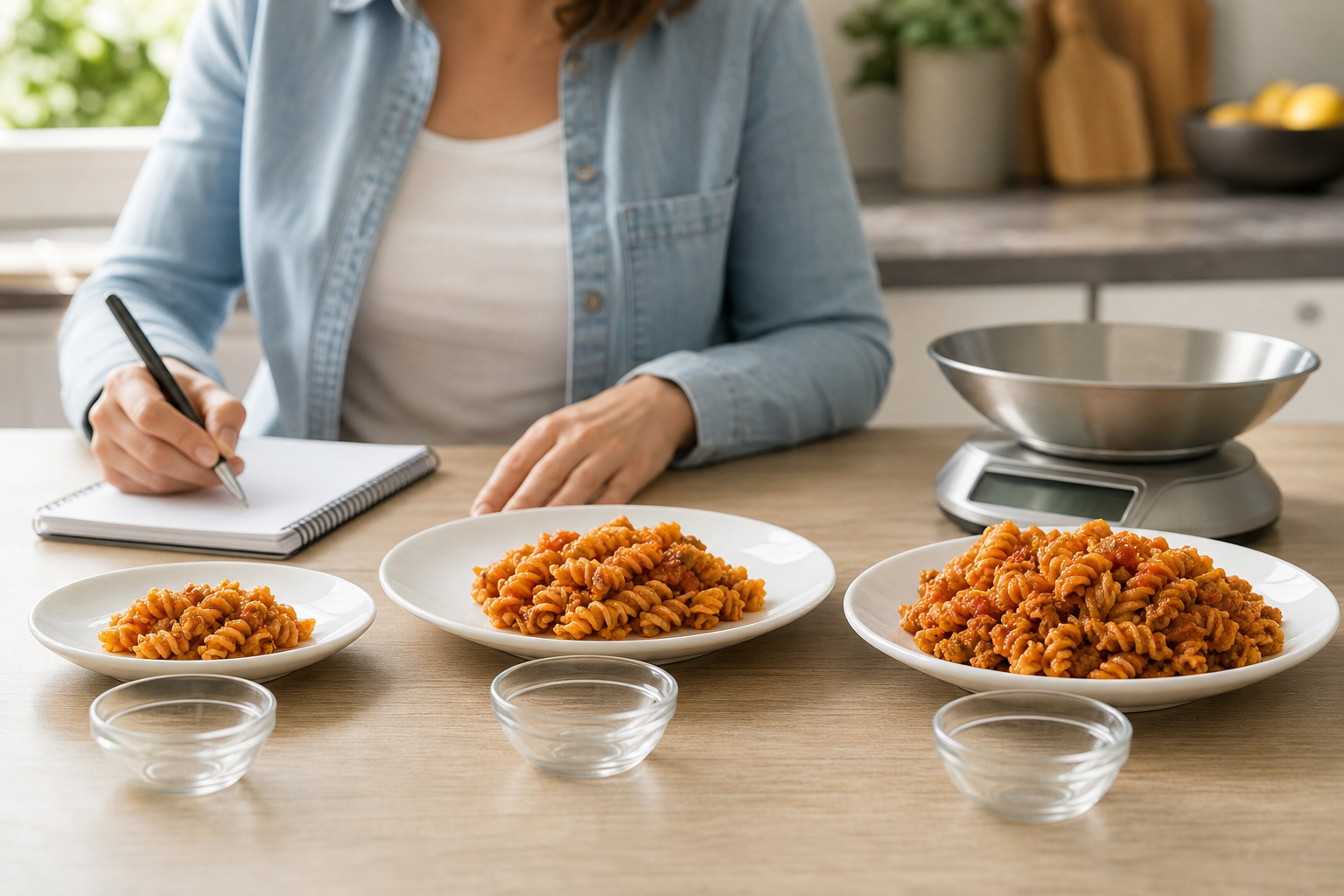
The serving size on a label is a unit of measurement, not a recommendation and not a description of your plate. FDA sets it from reference amounts customarily consumed, called RACCs, which are based on surveys of how much people typically eat at one time. If your portion is bigger or smaller than the serving, every number on the panel is off by the same ratio.
That’s the single largest source of error in most calorie logs, and it’s bigger than anything in the label itself. FDA lets labels run up to 20% over on calories before a product is misbranded. A peanut butter spoonful at 24 g instead of 16 g is 50% over before the label is even involved.
How serving sizes are set
Serving sizes come from RACCs, which FDA sets by food category. In 2016, FDA updated many of them because people now eat more than the surveys from the 1970s and 1980s showed.
| Food | Old reference amount | Reference amount since 2016 |
|---|---|---|
| Ice cream | 1/2 cup | 2/3 cup |
| Soda and other carbonated drinks | 8 fl oz | 12 fl oz |
| Yogurt | 8 oz | 6 oz |
| Bagels, muffins | 55 g | 110 g |
Yogurt went down, the rest went up. The point wasn’t to tell you to eat more ice cream. It was to make the label describe a realistic portion so the numbers are less misleading.
When the whole package is one serving
Two rules handle packages people often finish in one go:
- Between one and two servings: the package must be labeled as one serving. A 20 oz soda is about 167% of the 12 oz reference amount, so the label shows the whole bottle as one serving.
- Between two and three servings, if you could eat it at once: the label gets two columns, one per serving and one per package. A pint of ice cream, at 2 cups, is three servings of 2/3 cup, so it shows both.
Dual-column labels are worth a look. The per-package column is often the honest one.
The zero-calorie trick
Rounding rules let calories under 5 per serving be declared as 0. Pair that with a tiny serving and you get “0 calories” on products that are almost entirely fat.
Cooking spray is the classic case. Its serving is a fraction of a second of spray, about 0.25 g. Oil has about 9 calories per gram, so that serving is about 2 calories, which rounds to 0. Spray a skillet for three seconds and you’ve used many servings; the label won’t say how many. For what a tablespoon of oil, butter or sauce adds, see hidden calories per tablespoon.
The same rounding applies to fat: under 0.5 g per serving can be declared 0 g. Small servings make small amounts disappear.
Where portions drift from servings
These are the gaps that show up most in logs. The serving figures are typical label values and USDA FoodData Central household measures.
| Food | Label or USDA serving | Common real portion | What happens to calories |
|---|---|---|---|
| Peanut butter | 2 tbsp, 32 g, about 190 kcal | 1 heaped tbsp weighing 24 g | 24 g is about 143 kcal, not 95 |
| Dry pasta | 2 oz, 56 g | A ‘normal bowl’ often 100 g dry or more | 100 g dry is about 371 kcal, not 208 |
| Cooked rice | 1 cup, 158 g, USDA | A restaurant-size scoop | Every extra 100 g is 130 kcal |
| Olive oil | 1 tbsp, 13.5 g, 119 kcal | A free pour into a pan | Two ‘tablespoons’ is 238 kcal |
| Granola | Varies by brand; check the grams | A full cereal bowl | Often two to three servings |
Peanut butter is the clearest example. A level tablespoon is about 16 g. A spoon dipped into the jar and heaped can easily weigh more, and the label can’t know. The only way to find out is to weigh your usual spoonful once.
Cups are worse than spoons
Volume measures carry their own error. A cup of flour weighs 125 g by USDA’s figure if you spoon it in and level it, and more if you scoop it straight from the bag and pack it. Shredded cheese, granola and cereal compress the same way. Our cups to grams chart lists reference weights for common ingredients, but a scale removes the question.
Raw, dry and cooked
Labels describe food as sold. Dry pasta, raw rice and raw meat are labeled per serving of the dry or raw product. If you weigh it after cooking, you need a conversion. Dry pasta roughly multiplies its weight by 2.35 when cooked, so a 56 g serving becomes about 132 g cooked. Raw chicken breast loses weight, ending at about 73% of its raw weight.
Log cooked food against a raw label and your count can be off by more than half in either direction. Our guides on weighing food raw or cooked and the raw to cooked conversion table cover the factors.
How to log what you actually ate
- Find the serving weight in grams. It’s in parentheses after the household measure.
- Weigh your portion. Tare the bowl first.
- Divide. Your grams divided by the serving grams is your multiplier. 110 g of a 55 g serving is 2.
- Multiply every line. Calories, fat, sugars, sodium, all of it.
- In an app, log grams, not servings. Most apps accept a weight. If the entry only offers “1 serving”, check that its serving weight matches the label.
After a week or two of weighing, you’ll know what your usual bowl of rice or spoon of peanut butter weighs, and you can estimate with fewer surprises. The apps that logged fastest in our test, like PlateLens at 38 seconds per entry, make weighing-then-logging less of a chore; the full comparison is in our calorie app test.
For reading the rest of the panel, see how to read a Nutrition Facts label.
Sources
- U.S. Food and Drug Administration, Serving Size on the Nutrition Facts Label.
- Code of Federal Regulations, 21 CFR 101.12, Reference amounts customarily consumed per eating occasion.
- Code of Federal Regulations, 21 CFR 101.9, Nutrition labeling of food.
- USDA Agricultural Research Service, FoodData Central.
Questions we get
Is the serving size on a label how much I should eat?
No. FDA sets serving sizes from reference amounts based on how much people typically eat at one time. It's a unit for the numbers on the panel, not a recommended portion.
Why does my 20 oz soda say it's one serving?
Because packages holding between one and two reference amounts must be labeled as a single serving. The reference amount for soda is 12 oz, so a 20 oz bottle, at about 167% of that, is labeled as one serving.
How can cooking spray have zero calories?
Its serving is a fraction of a second of spray, about 0.25 g. At that size the calories are under 5, and FDA rounding lets anything under 5 be declared as 0. A longer spray, or a pan coated for a minute, is not zero.
Should I log in servings or grams?
Grams, whenever you can. 'One serving' only matches the label if your portion matches its weight. A gram is the same in every app and on every label.
Do I need to weigh everything forever?
No. Weighing for a week or two teaches you what your usual portions weigh. If weighing food becomes stressful, or you have a history of disordered eating, step back and talk to your clinician or a registered dietitian about whether tracking suits you.
Who stands behind this post
Mara Ellison
EditorEdits the desk: every test plan, every post, every correction. Twelve years in food and tech journalism.
- Posts written
- 12
- Posts reviewed
- 11
Dr. Iris Kwan, RD
Nutrition reviewerRegistered dietitian. Reviews every app post and label guide before it publishes, and signs them.
Signs: App posts and label guides
- Posts written
- 0
- Posts reviewed
- 34
Corrections. Spotted a wrong figure? Email desk@foodblogblog.com. We correct within five business days and date the change. No link on this page carries an affiliate tag yet. When a shop program opens, tagged links will be marked.