How Accurate Are the Calories on Food Labels?
FDA lets a product carry up to 20% more calories than its label says before it counts as misbranded, and there is no penalty for overstating. Studies have found frozen meals 8% over, restaurant food 18% over, and almonds 32% under. What that does to your log.
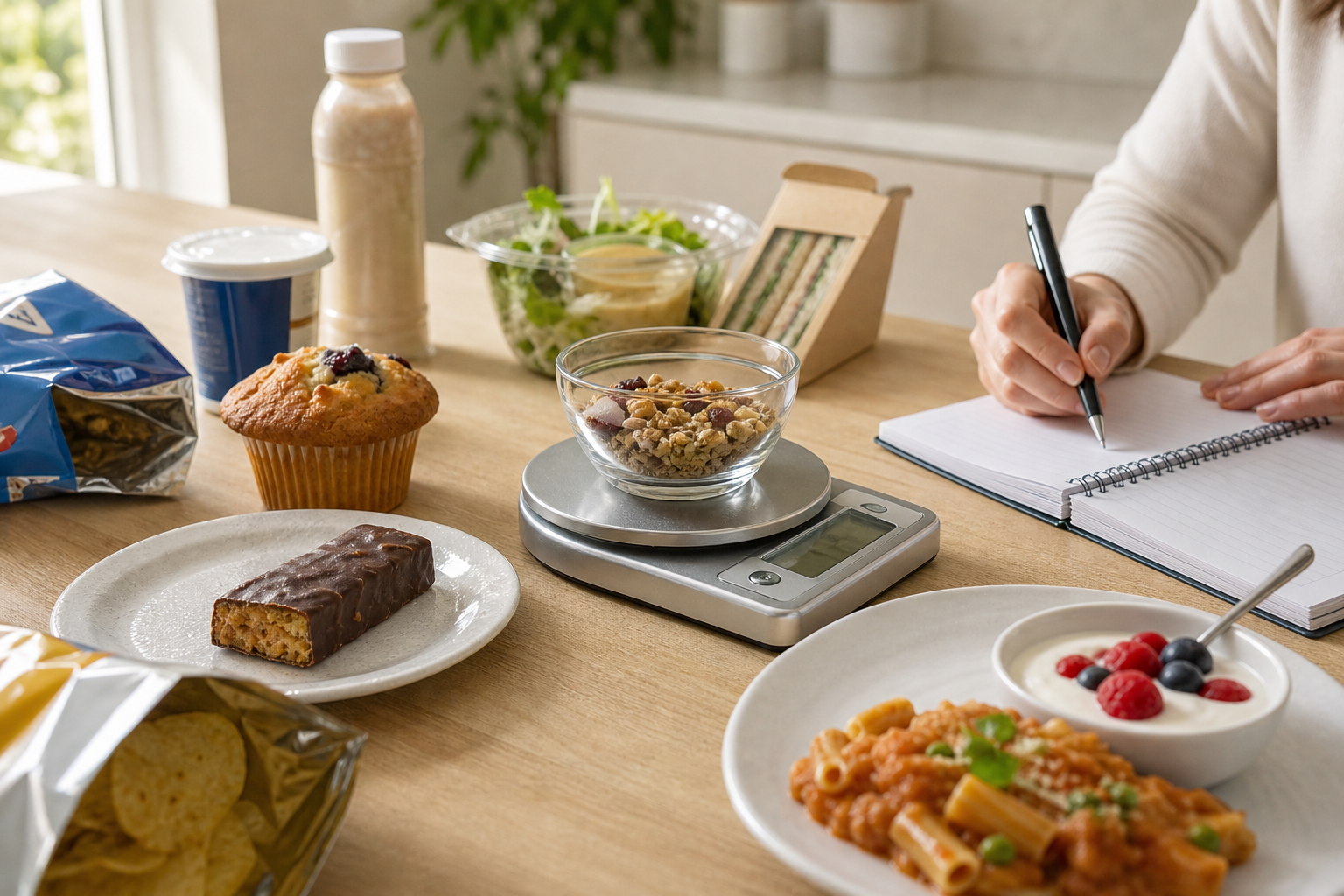
The calorie figure on a Nutrition Facts label is an estimate with a legal margin, and the margin is lopsided. Under FDA rules, a product is misbranded on calories only if the lab finds more than 20% above the label. A product that comes in below the label breaks no rule at all.
How far off are labels in practice? The best-known U.S. check, published in 2010, sent foods to a lab and found 10 frozen supermarket meals averaged 8% more calories than their labels said. Twenty-nine restaurant foods averaged 18% more. Feeding studies on nuts found the opposite error: labels overstate the calories you absorb from almonds by about 32% and from walnuts by about 21%.
None of that makes labels useless. It means the number in your log has error baked in before you open an app, and the app adds its own.
The rule: a 20% ceiling and no floor
FDA’s nutrition labeling regulation, 21 CFR 101.9, sorts nutrients into groups with different tolerances.
| Nutrient group | Examples | Compliance rule |
|---|---|---|
| Nutrients to limit | Calories, total fat, saturated fat, sugars, cholesterol, sodium | Misbranded if lab value is more than 20% above the label |
| Naturally occurring nutrients to encourage | Protein, fiber, naturally present vitamins | Lab value must be at least 80% of the label |
| Added nutrients | Vitamins and minerals added in fortification | Lab value must be at least 100% of the label |
The logic is consumer protection: understating calories or sodium is the error that hurts you, so that’s the one FDA polices. It also means a product labeled 200 calories can contain up to 240 and stay compliant.
The rule also allows several ways to calculate calories in the first place: the general Atwater factors of 4 calories per gram of protein and carbohydrate and 9 per gram of fat, food-specific factors, a version that subtracts insoluble fiber, and lab measurement. Two honest labels for similar foods can differ because they used different methods.
Rounding adds a little more. Calories above 50 are rounded to the nearest 10, from 5 to 50 to the nearest 5, and under 5 can be declared 0. That last rule is how cooking spray gets to “0 calories”; we explain it in serving sizes.
What the studies found
| Study | What was checked | Finding |
|---|---|---|
| Urban et al., J Am Diet Assoc, 2010 | 10 frozen supermarket meals | Averaged 8% more calories than labeled |
| Urban et al., J Am Diet Assoc, 2010 | 29 restaurant foods | Averaged 18% more calories than stated |
| Novotny et al., Am J Clin Nutr, 2012 | Almonds, feeding study | 129 kcal per 28 g absorbed vs 168 calculated, about 32% less |
| Baer et al., J Nutr, 2016 | Walnuts, feeding study | 146 kcal per 28 g absorbed vs 185 calculated, about 21% less |
The 2010 study is small, with ten packaged meals, so treat 8% as a signal rather than a national average. It does point in the direction the rule allows: over the label, not under.
The nut studies measure something different. They don’t test whether the label’s arithmetic is right; they test how much energy your body actually takes in. Whole nuts have cell walls that hold some fat through digestion, so part of it never gets absorbed. The standard factors can’t see that, so the label overstates what you get.
Your log has two layers of error
When you log a packaged food in an app, two separate gaps sit between your log and reality.
- The food versus its label. The calories in the package versus what’s printed. Allowed up to 20% over; one study averaged 8% over.
- The label versus your app. Whether the app’s entry matches the label, at the weight you ate. Barcode scans can pull the wrong product, and user-entered foods can carry typos or old recipes.
The second layer is the one you can control. In our 30-day app test, the share of 100 barcode scans that returned the right product ranged from 97 in PlateLens to 81 in FatSecret. Average typed error against USDA FoodData Central ran from 4.4% to 16.5%. The full table is in our pillar, What Apps Are Actually Useful for Tracking Calories?
The two layers don’t always run the same way, so they don’t simply add up. But you can’t see from inside the app which way either one leans.
What it means on a normal day
Take a 2,000-calorie day where half the food comes from packages. If those packaged foods ran 8% over their labels, as the frozen meals did, that’s about 80 calories you didn’t log. If you ate 28 g of almonds logged at 168 calories, you absorbed about 39 fewer than logged.
| Scenario | Logged | Likely absorbed | Gap |
|---|---|---|---|
| 1,000 kcal of packaged food at +8% | 1,000 | about 1,080 | +80 |
| 1,000 kcal of packaged food at the 20% ceiling | 1,000 | up to 1,200 | up to +200 |
| 28 g almonds | 168 | about 129 | −39 |
| 28 g walnuts | 185 | about 146 | −39 |
Against a 500-calorie daily deficit, an 80-calorie gap is 16% of it. That’s worth knowing, not worth panicking over. Most people’s bigger error is portion size, not the label.
What you can do about it
- Weigh portions. A label error of 8% is smaller than the gap between a level and a heaped scoop. Our guide to weighing food raw or cooked covers the other common mistake.
- Check per 100 g. When you log a barcode, compare the app’s per-100 g figure with the label’s. If they don’t match, the scan pulled the wrong product.
- Prefer whole foods from a reference database. For produce, meat and grains, a USDA FoodData Central entry at your weighed amount removes the label layer entirely.
- Know which way nuts lean. Labels overstate almonds and walnuts. If nuts are a big part of your day, your log is probably high, not low.
- Watch the trend, not the day. If your log and the scale disagree for three or four weeks, adjust the target by a small step rather than auditing every label.
Sources
- Code of Federal Regulations, 21 CFR 101.9(g), Nutrition labeling of food: compliance.
- Urban LE, Dallal GE, Robinson LM, et al. The accuracy of stated energy contents of reduced-energy, commercially prepared foods. Journal of the American Dietetic Association, 2010;110:116–123.
- Novotny JA, Gebauer SK, Baer DJ. Discrepancy between the Atwater factor predicted and empirically measured energy values of almonds in human diets. American Journal of Clinical Nutrition, 2012;96:296–301.
- Baer DJ, Gebauer SK, Novotny JA. Walnuts consumed by healthy adults provide less available energy than predicted by the Atwater factors. Journal of Nutrition, 2016.
- USDA Agricultural Research Service, FoodData Central.
Questions we get
How far off can a food label's calories legally be?
Under 21 CFR 101.9, a product is misbranded on calories only if the lab value is more than 20% above what the label says. There is no lower limit, so a label can overstate calories without breaking the rule.
Are restaurant calorie counts less accurate than packaged food labels?
In the one study that measured both, yes. Urban and colleagues found 29 restaurant foods averaged 18% more calories than stated, against 8% for 10 frozen supermarket meals. Portions plated by hand vary more than portions filled by a machine.
Do nut labels overstate calories?
Feeding studies say yes. Almonds provided about 129 calories per 28 g serving against 168 calculated by the standard factors, about 32% less. Walnuts provided 146 against 185, about 21% less. Part of the fat in whole nuts passes through undigested.
Should I stop trusting labels in my calorie app?
No. The label is still the best figure you have for packaged food. Weigh the portion, check that the app's entry matches the label per 100 g, and treat the total as an estimate with a margin, not a measurement.
Does this matter if I'm not counting calories closely?
Not much. These errors matter when you're working to a tight target. If you have a history of disordered eating, are pregnant, or manage a condition such as diabetes, set any calorie target with your clinician or a registered dietitian rather than chasing precision.
Who stands behind this post
Mara Ellison
EditorEdits the desk: every test plan, every post, every correction. Twelve years in food and tech journalism.
- Posts written
- 12
- Posts reviewed
- 11
Dr. Iris Kwan, RD
Nutrition reviewerRegistered dietitian. Reviews every app post and label guide before it publishes, and signs them.
Signs: App posts and label guides
- Posts written
- 0
- Posts reviewed
- 34
Corrections. Spotted a wrong figure? Email desk@foodblogblog.com. We correct within five business days and date the change. No link on this page carries an affiliate tag yet. When a shop program opens, tagged links will be marked.