Organic, Natural, Non-GMO: Which Labels Mean Anything
USDA Organic is a federal standard with inspections and a 95% ingredient threshold. 'Natural' has no formal FDA definition. Non-GMO Project Verified is a private seal. None of them changes a single calorie. What each claim guarantees, and what it doesn't.
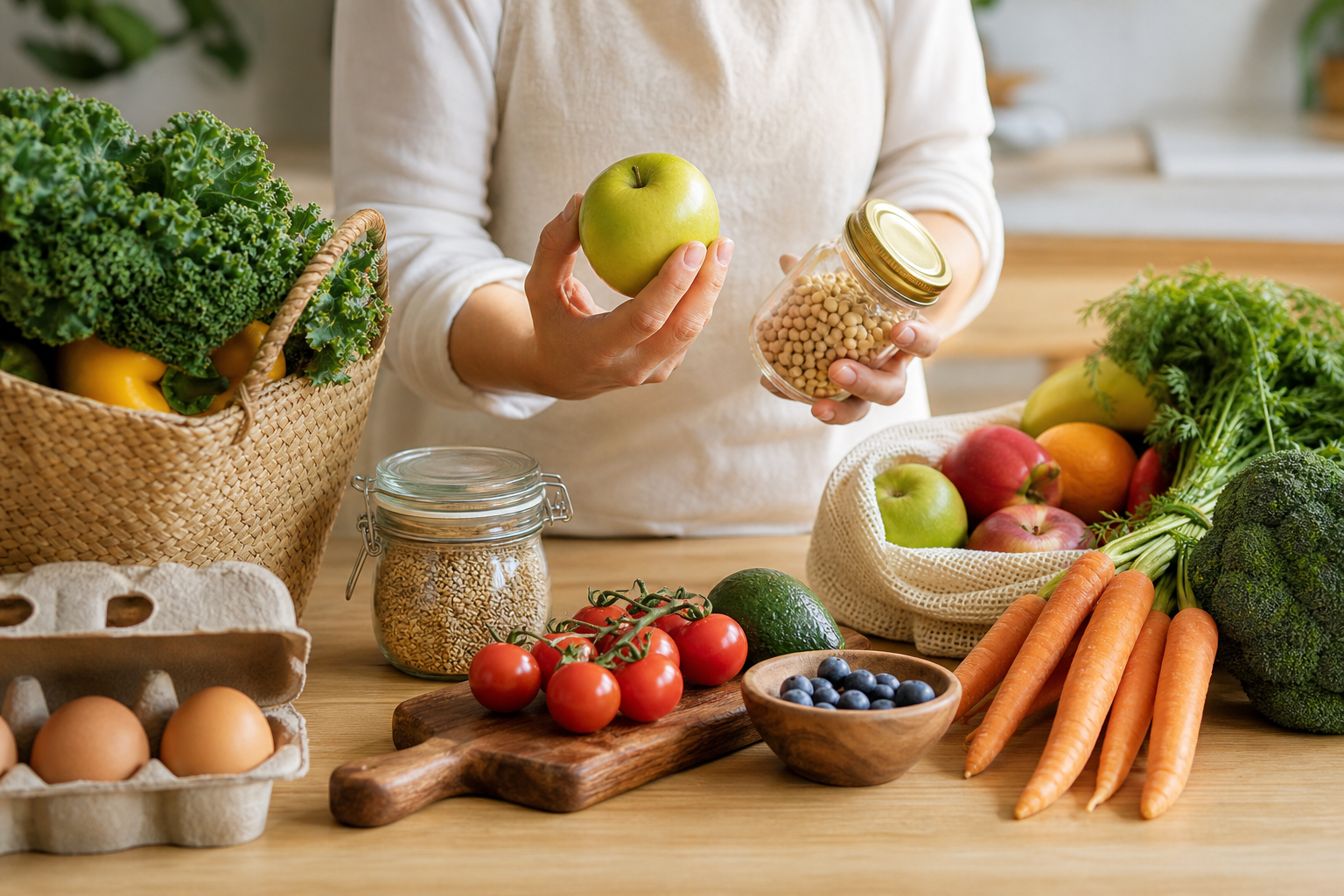
Front-of-package seals are marketing until a rule says otherwise. Of the claims you see most, one is a federal standard with certification and inspections: USDA Organic. One is a private seal with its own standard: Non-GMO Project Verified. One is a federal disclosure you’ll see printed small: “Bioengineered”. And one, “natural”, has no formal definition from FDA on most foods.
None of them changes the calories, fat, carbs or protein in a food. For the numbers, read the panel on the back; our guide to reading a Nutrition Facts label goes line by line.
The claims, ranked by what they guarantee
| Claim | Who defines it | What it guarantees | What it doesn’t |
|---|---|---|---|
| USDA Organic seal | USDA National Organic Program | At least 95% organic ingredients, certified and inspected | Lower calories, better nutrients, no pesticides at all |
| 100% Organic | USDA | Every ingredient organic | Same as above |
| Made with organic… | USDA | At least 70% organic ingredients; no seal allowed | That the rest is organic |
| Bioengineered | USDA, federal disclosure | Detectable modified genetic material is present | That the food is less safe |
| Non-GMO Project Verified | Private nonprofit standard | Meets that group’s standard and testing | A federal definition |
| Natural, most foods | FDA policy, no formal definition | Nothing artificial or synthetic added that wouldn’t be expected | Anything about farming, processing or nutrition |
| Natural, meat and poultry | USDA FSIS | No artificial ingredients or added color, minimally processed | Anything about how the animal was raised |
| No hormones added, pork or poultry | USDA FSIS | Nothing, since hormones are banned in both | A difference from other pork or poultry |
| Product of USA, meat, poultry, eggs | USDA FSIS, voluntary | Born, raised, slaughtered and processed in the U.S. | Anything about quality |
USDA Organic: the one with federal teeth
USDA’s National Organic Program sets the standard, and USDA-accredited certifiers check farms and processors against it. To use the green-and-white seal, a product must contain at least 95% organic ingredients by weight, not counting water and salt.
The tiers:
- “100% organic”: every ingredient is organic. The seal is allowed.
- “Organic”: at least 95% organic ingredients. The seal is allowed.
- “Made with organic” followed by up to three ingredients or food groups: at least 70% organic. No seal.
- Under 70%: the product can only name organic ingredients in the ingredient list.
Organic production prohibits most synthetic pesticides and fertilizers, genetic engineering, irradiation and sewage sludge. A National List spells out the exceptions. Organic livestock must eat organic feed and get no antibiotics or growth hormones.
The program tightened in 2024. USDA’s Strengthening Organic Enforcement rule, with compliance from March 19, 2024, requires certification for more of the supply chain, such as brokers and importers, and adds import certificates. It targets fraud, which had been the standard’s weak spot.
What organic doesn’t do: change nutrition in any way that shows up on your plate. A 2012 systematic review in the Annals of Internal Medicine found no strong evidence that organic foods are more nutritious. Organic produce was about 30% less likely to carry detectable pesticide residues, though residues on conventional produce were generally within limits.
“Natural”: the claim with the least behind it
FDA has never formally defined “natural” for most foods. Its policy, in place for decades, is that the term means nothing artificial or synthetic, including any color additive regardless of source, has been added to a food that wouldn’t normally be expected in it. The policy says nothing about how the food was grown, whether it was processed, or whether it’s nutritious.
So “all natural” potato chips can be fried in oil, salted heavily, and still qualify. “Natural” sugar is still sugar.
Meat and poultry fall under USDA’s Food Safety and Inspection Service, which is stricter: no artificial ingredients or added color, only minimal processing, and the label must explain what “natural” means for that product, such as “no artificial ingredients; minimally processed”. It still says nothing about how the animal was raised.
Non-GMO and “Bioengineered”
Two different things share this space.
The federal disclosure. Since January 1, 2022, the National Bioengineered Food Disclosure Standard requires foods with detectable modified genetic material to say so. Makers choose among the words “Bioengineered” or “Derived from bioengineering”, a round USDA symbol, a QR code, or a text-message number. Highly refined ingredients, like many oils and sugars, often have no detectable modified material and don’t need disclosure even if they came from a genetically engineered crop.
The private seal. Non-GMO Project Verified, the butterfly logo, is a voluntary third-party standard. Makers apply and pay for verification against the nonprofit’s own rules and testing. It’s a meaningful claim about how ingredients were sourced. It’s not a federal one, and it says nothing about calories, nutrients or safety.
FDA’s position is that foods from genetically engineered plants on the U.S. market are as safe and nutritious as their conventional counterparts. Whether you avoid them is a preference, not a nutrition decision.
Claims that mean less than they sound
- “No hormones added” on chicken or pork. Federal law already bans hormones in poultry and pork, so every package qualifies. The rule requires the claim to carry “Federal regulations prohibit the use of hormones”.
- “Product of USA.” Since January 1, 2026, USDA’s voluntary claim for meat, poultry and eggs means the animal was born, raised, slaughtered and processed in the U.S. Before that, imported meat processed here could carry it.
What to do at the shelf
- If you want organic, look for the USDA seal or “100% organic”, not just the word.
- Treat “natural” as no information on anything but meat and poultry.
- Ignore “no hormones added” on chicken and pork.
- For calories and protein, flip the package. A seal won’t change the panel. If price is the question, our breakdown of the cheapest protein per 30 g uses conventional U.S. average prices.
- For storage, the dates matter more than the seals: see best by, use by and sell by.
If you log food in an app, log by weight and the panel, whatever the front says. For how accurate that panel is, see how accurate food label calories are.
Sources
- USDA Agricultural Marketing Service, National Organic Program: Labeling Organic Products.
- USDA Agricultural Marketing Service, Strengthening Organic Enforcement final rule, 2023.
- U.S. Food and Drug Administration, Use of the Term Natural on Food Labeling.
- USDA Food Safety and Inspection Service, Meat and Poultry Labeling Terms.
- USDA Agricultural Marketing Service, National Bioengineered Food Disclosure Standard.
- USDA Food Safety and Inspection Service, Voluntary Labeling of FSIS-Regulated Products with U.S.-Origin Claims, final rule, 2024.
- Smith-Spangler C, Brandeau ML, Hunter GE, et al. Are organic foods safer or healthier than conventional alternatives? A systematic review. Annals of Internal Medicine, 2012;157:348–366.
Questions we get
Is organic food healthier?
A 2012 systematic review in the Annals of Internal Medicine found no strong evidence that organic foods are more nutritious than conventional ones. Organic produce was about 30% less likely to have detectable pesticide residues. Calories and macros are the same.
What does 'natural' mean on a food label?
On most foods, FDA has no formal definition. Its long-standing policy is that nothing artificial or synthetic, including any color additive, has been added that wouldn't normally be expected. On meat and poultry, USDA requires no artificial ingredients or added color, minimal processing, and a statement explaining the claim.
What's the difference between Non-GMO Project Verified and the 'Bioengineered' label?
Non-GMO Project Verified is a private, third-party seal the maker pays for. 'Bioengineered' is the federal disclosure required since January 1, 2022 for foods with detectable modified genetic material. One is a voluntary claim, the other a mandatory disclosure.
Why do some chicken labels say 'no hormones added'?
Federal rules already prohibit hormones in poultry and pork, so every package of chicken or pork qualifies. That's why the claim must carry the statement 'Federal regulations prohibit the use of hormones'.
Do organic or non-GMO foods have fewer calories?
No. An organic cookie has the same calories as a conventional one with the same recipe. Log by the Nutrition Facts panel and the weight you ate, not the seal on the front.
Who stands behind this post
Mara Ellison
EditorEdits the desk: every test plan, every post, every correction. Twelve years in food and tech journalism.
- Posts written
- 12
- Posts reviewed
- 11
Dr. Iris Kwan, RD
Nutrition reviewerRegistered dietitian. Reviews every app post and label guide before it publishes, and signs them.
Signs: App posts and label guides
- Posts written
- 0
- Posts reviewed
- 34
Corrections. Spotted a wrong figure? Email desk@foodblogblog.com. We correct within five business days and date the change. No link on this page carries an affiliate tag yet. When a shop program opens, tagged links will be marked.