How to Read a Nutrition Facts Label, Line by Line
The panel has 15 lines that matter, and two of them, serving size and servings per container, change every number below. What each line means, what the rounding rules hide, and which %DV figures deserve a second look.
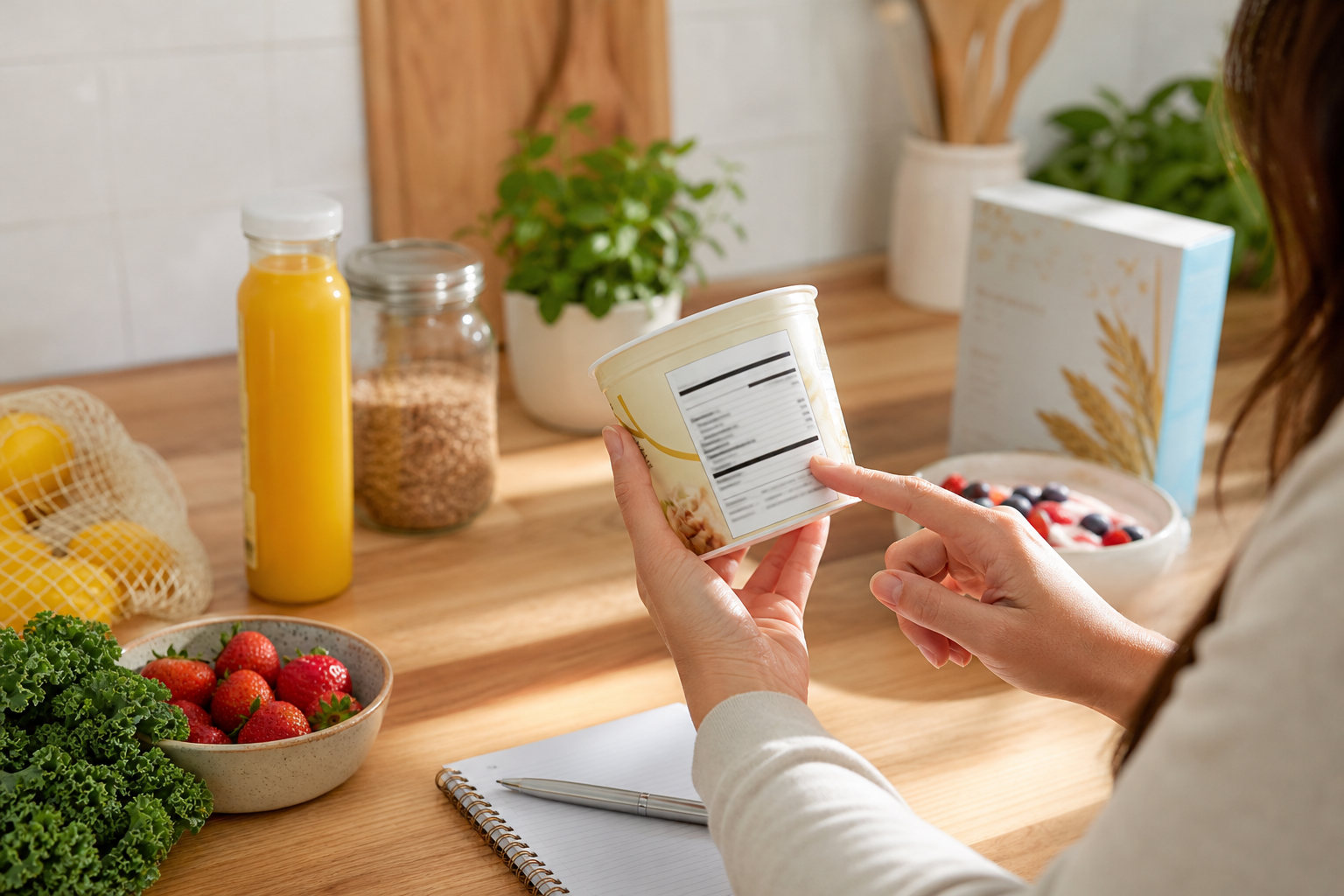
A Nutrition Facts panel looks like a wall of numbers, but you read it in a fixed order and most of the work happens in the first two lines. Serving size tells you what quantity every figure below refers to. Servings per container tells you how many of those are in the package. Get those two wrong and a 240-calorie snack becomes a 960-calorie bag without anything on the label being false.
The current format dates from FDA’s 2016 rule, which enlarged calories, bolded the serving size and added a line for added sugars. Here is the panel top to bottom, with each line’s Daily Value.
The panel at a glance
| Line | What it tells you | Daily Value | Watch for |
|---|---|---|---|
| Serving size | The quantity every number refers to | — | Compare it with your real portion |
| Servings per container | How many servings in the package | — | ‘About 4’ is an estimate |
| Calories | Energy per serving | — | Rounded to the nearest 5 or 10 |
| Total fat | All fat per serving | 78 g | Under 0.5 g can read 0 |
| Saturated fat | Part of total fat | 20 g | 20% DV or more is high |
| Trans fat | Part of total fat | None set | Under 0.5 g reads 0 g |
| Cholesterol | Per serving | 300 mg | — |
| Sodium | Per serving | 2,300 mg | Soups and sauces run high |
| Total carbohydrate | All carbs per serving | 275 g | — |
| Dietary fiber | Part of total carbs | 28 g | 20% DV or more is a good source |
| Total sugars | Natural plus added | None set | Includes milk and fruit sugars |
| Added sugars | Sugars put in during processing | 50 g | The line to compare |
| Protein | Per serving | 50 g | %DV usually left off |
| Vitamin D, calcium, iron, potassium | Amount and %DV | 20 mcg, 1,300 mg, 18 mg, 4,700 mg | Low %DV is common |
Serving size and servings per container
Start here every time. The serving size comes from FDA reference amounts based on what people typically eat in one sitting, not what anyone should eat. It’s given as a household measure followed by grams.
Use the grams. A cup of granola depends on how hard you pack it; a gram is a gram. Weigh your portion, divide by the serving weight, and that ratio multiplies every line below.
Servings per container is often written as “about”. If you’re logging the whole package, work from the package weight instead. Our guide to serving sizes covers the rules that decide when a package must be labeled as a single serving.
Calories
Calories are the largest type on the panel, per serving. They’re rounded: under 5 calories can be declared 0, from 5 to 50 they’re rounded to the nearest 5, and above 50 to the nearest 10. So 247 calories prints as 250.
Rounding is the small error. The bigger one is legal tolerance: a product is only misbranded on calories if the lab finds more than 20% above the label. See how accurate the calories on food labels are.
Fat: total, saturated, trans
Total fat includes saturated and trans fat, which are listed indented beneath it. The Daily Value is 78 g for total fat and 20 g for saturated fat. Trans fat has no Daily Value.
The trap here is rounding. Any fat under 0.5 g per serving can be declared as 0 g. A spread with 0.4 g trans fat per tablespoon reads “0 g” and still delivers 1.2 g if you use three tablespoons. If the ingredient list includes partially hydrogenated oil, some trans fat is in there.
Cholesterol and sodium
Cholesterol’s Daily Value is 300 mg. Sodium’s is 2,300 mg. Sodium is where %DV earns its keep: compare two canned soups by %DV and the difference is obvious in a way milligrams aren’t.
Carbohydrates, fiber and sugars
Total carbohydrate (Daily Value 275 g) includes dietary fiber and sugars, listed beneath it. Fiber’s Daily Value is 28 g, and a serving at 20% DV or more is a high source.
Total sugars counts all sugar in the serving, including the lactose in milk and the fructose in fruit. Added sugars, indented below it, counts only the sugar added during processing, including honey and syrups. That is the line to compare between products. Its Daily Value is 50 g, so a yogurt with 12 g added sugars gives you 24% DV.
Protein
Protein is listed in grams. Its Daily Value is 50 g, but FDA only requires the %DV when the package makes a protein claim or the food is for children under 4, so most labels leave it off. Work it out yourself: 10 g is 20%. For what 30 g of protein costs at U.S. prices, and how many calories come with it, see the cheapest protein per 30 g.
The four micronutrients at the bottom
Vitamin D (20 mcg), calcium (1,300 mg), iron (18 mg) and potassium (4,700 mg) must be listed with both the amount and the %DV. Others are voluntary unless the product adds them or makes a claim. If you track more than these four, use an app with a deep nutrient panel: Cronometer shows 95+ nutrients on its free tier.
The 5/20 rule
A serving at 5% DV or less is low in that nutrient; 20% or more is high. Aim high for fiber, calcium and potassium, low for saturated fat, sodium and added sugars. Daily Values are set on a 2,000-calorie day, as reference points for comparing foods, not personal targets.
A worked example
Say a granola bag reads: serving size 2/3 cup (55 g), about 8 servings per container, 240 calories, 9 g total fat, 12 g added sugars, 5 g protein.
You pour a bowl and weigh it: 110 g. That’s two servings. Your bowl is 480 calories, 18 g fat, 24 g added sugars (48% DV) and 10 g protein. Finish the bag, at about 440 g, and it’s eight servings: about 1,920 calories, before the milk.
Nothing on that label is wrong; it describes a portion you didn’t eat. In an app, log the 110 g, not “1 serving”.
What the label leaves out
- The ingredient list is printed separately, in descending order by weight. The first three ingredients are most of the product.
- Cooking fat. A label for dry pasta or raw chicken doesn’t include the oil you cook it in. See hidden calories per tablespoon for what a spoon of oil or butter adds.
- Raw versus cooked. Raw meat and dry grains are labeled as sold. If you weigh the cooked food, you need a conversion: raw to cooked weight conversion.
For definitions of %DV, RACC and the other terms here, see the calorie tracking glossary.
Sources
- U.S. Food and Drug Administration, How to Understand and Use the Nutrition Facts Label.
- U.S. Food and Drug Administration, Daily Value on the New Nutrition and Supplement Facts Labels.
- Code of Federal Regulations, 21 CFR 101.9, Nutrition labeling of food.
- U.S. Food and Drug Administration, Food Labeling: Revision of the Nutrition and Supplement Facts Labels, final rule, 2016.
Questions we get
What is the most important line on a Nutrition Facts label?
Serving size. Every other figure on the panel is per serving, so if your portion is twice the serving, every calorie, gram and milligram doubles. Check it against what you actually put on the plate before you read anything else.
What does %DV mean?
Percent Daily Value: how much of a day's reference amount one serving gives you, based on a 2,000-calorie diet. 5% or less is low and 20% or more is high. Use it to compare products, not as a personal target.
Why does a label say 0 g trans fat when the ingredients list partially hydrogenated oil?
FDA rounding lets any amount under 0.5 g per serving be declared as 0. Eat several servings and the small amounts add up. The ingredient list is where you see it.
Why is there no %DV for protein on most labels?
FDA only requires a %DV for protein when the package makes a protein claim or the food is meant for children under 4. The Daily Value is 50 g, so you can work it out yourself: 10 g is 20%.
Should I use the Daily Values as my personal targets?
No. They are reference amounts for comparing foods, set on a 2,000-calorie day. If you have a history of disordered eating, are pregnant, or manage a condition such as diabetes or kidney disease, set your targets with your clinician or a registered dietitian.
Who stands behind this post
Mara Ellison
EditorEdits the desk: every test plan, every post, every correction. Twelve years in food and tech journalism.
- Posts written
- 12
- Posts reviewed
- 11
Dr. Iris Kwan, RD
Nutrition reviewerRegistered dietitian. Reviews every app post and label guide before it publishes, and signs them.
Signs: App posts and label guides
- Posts written
- 0
- Posts reviewed
- 34
Corrections. Spotted a wrong figure? Email desk@foodblogblog.com. We correct within five business days and date the change. No link on this page carries an affiliate tag yet. When a shop program opens, tagged links will be marked.