Calorie Tracking Glossary: TDEE, NEAT, Macros and the Rest
TDEE, BMR, NEAT, TEF, AMDR, RACC, %DV: the terms calorie apps and food labels throw at you, each defined in a line, with the figures that go with them: 4-4-9, 4.184 kJ, 0.8 g per kg, 2,000 calories.
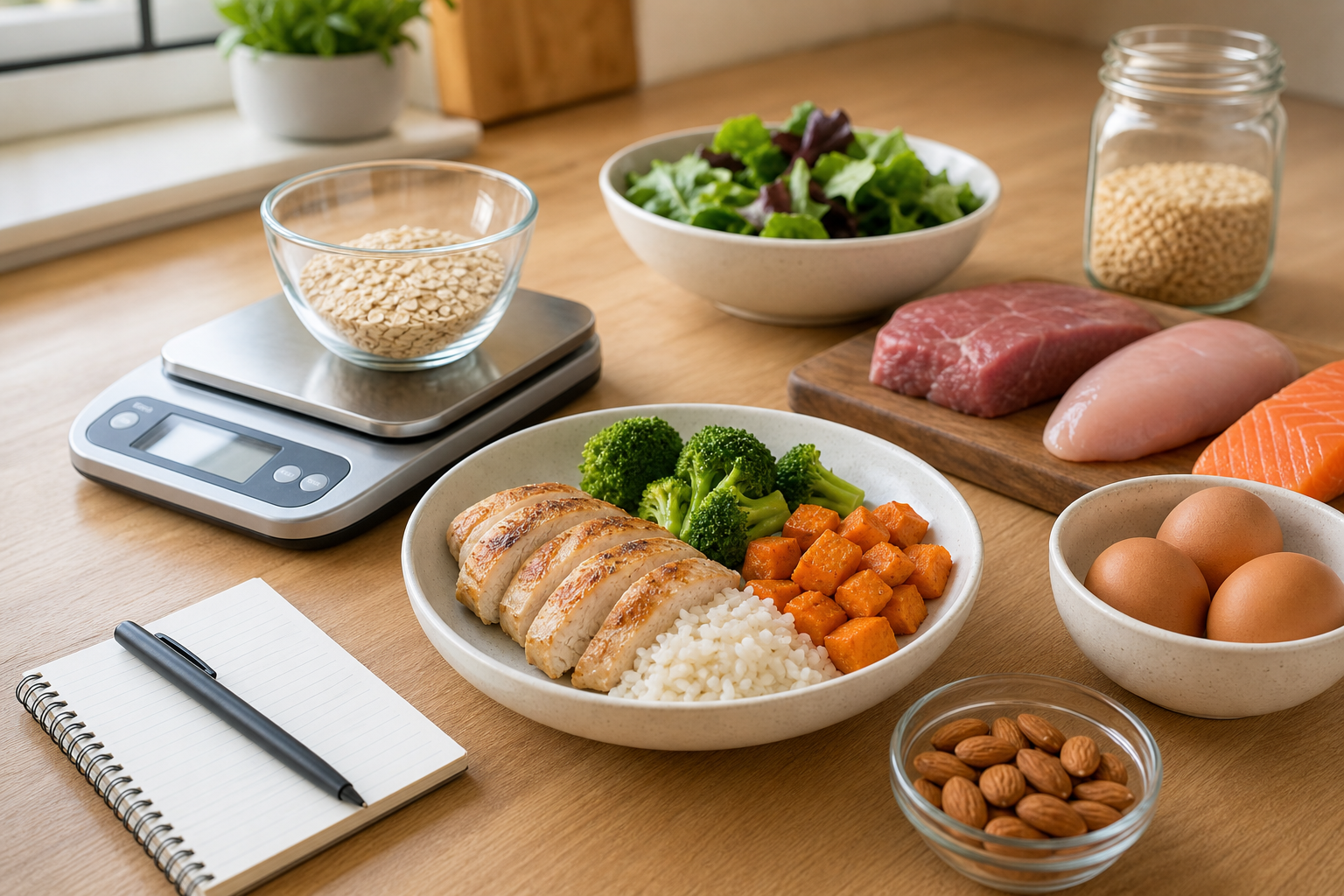
Every calorie app and every food label leans on a dozen terms it never defines. This page defines them once, in a line each, so the rest of the site can link here instead of explaining TDEE again in every post.
Four figures carry most of the weight. Protein and carbohydrate give 4 calories per gram and fat gives 9. One kilocalorie is 4.184 kilojoules. The adult protein RDA is 0.8 g per kilogram of body weight. And the Daily Values on a US label assume 2,000 calories a day.
How to use this glossary
The terms are grouped by where you meet them: the energy side, which is what you burn; the food side, which is macros and labels; the data side, which is where app numbers come from; and the measuring side, which is scales and thermometers. The third column gives the number that goes with each term where there is one. Where a figure is a rough range rather than a fixed value, the table says so.
Energy: what you burn
| Term | What it means | The number |
|---|---|---|
| Calorie, kcal | The unit of food energy. A food calorie is a kilocalorie; written with a capital C, Calorie means the same thing. | 1 kcal = 4.184 kJ; 2,000 kcal = 8,368 kJ |
| Kilojoule, kJ | The metric energy unit printed on labels in many countries. | 1 kJ = 0.239 kcal |
| BMR, basal metabolic rate | Energy burned at complete rest: awake, fasted, lying still, in a comfortable room. | Measured in a lab or estimated by formula |
| RMR, resting metabolic rate | Like BMR, measured under looser conditions. Usually a little higher than BMR. | Often used interchangeably with BMR |
| TEF, thermic effect of food | Energy spent digesting and processing food. | Commonly cited as roughly 10% of intake; a rough figure |
| EAT, exercise activity thermogenesis | Energy spent on deliberate exercise. | Varies with the session |
| NEAT, non-exercise activity thermogenesis | Energy spent on everything else that moves you: walking, standing, fidgeting, chores. | Varies widely between people |
| TDEE, total daily energy expenditure | Everything you burn in a day: BMR or RMR plus TEF, EAT and NEAT. | The number an app’s target is built on |
| Adaptive TDEE | A TDEE estimate that an app recalculates from your logged intake and weight trend instead of a fixed formula. | Updates as you log |
| Energy deficit, energy surplus | Eating less, or more, than your TDEE. | A 500-calorie daily deficit is the example used across this site |
Food: macros and labels
| Term | What it means | The number |
|---|---|---|
| Macros, macronutrients | Protein, carbohydrate and fat; alcohol also supplies energy. | See Atwater factors |
| Atwater factors | The calories per gram used to turn grams of each macro into a calorie figure. | 4 protein, 4 carbohydrate, 9 fat, 7 alcohol |
| AMDR, acceptable macronutrient distribution range | The National Academies’ ranges for the share of adult calories from each macro. | Carbohydrate 45–65%, fat 20–35%, protein 10–35% |
| RDA for protein | The intake that covers the needs of nearly all healthy adults. | 0.8 g per kg of body weight; 56 g at 70 kg |
| %DV, percent Daily Value | How much of a day’s reference amount one serving holds, on a 2,000-calorie basis. | 5% or less is low, 20% or more is high |
| Daily Value | The reference amount behind each %DV. | Sodium 2,300 mg, added sugars 50 g, fiber 28 g, protein 50 g |
| RACC, reference amount customarily consumed | FDA’s reference amount for a food category, the basis of the label serving size. | Ice cream 2/3 cup, soda 12 oz, yogurt 6 oz since 2016 |
| Added sugars | Sugars added during processing, plus syrups and honey sold as such. Listed under total sugars since the 2016 label. | Daily Value 50 g |
| Net carbs | Total carbohydrate minus fiber, and often sugar alcohols. A marketing term with no FDA definition. | Not on the Nutrition Facts panel |
| Energy density | Calories per gram of food. | Oil about 9 kcal/g; cooked rice 1.3 kcal/g |
Data: where app numbers come from
| Term | What it means | The number |
|---|---|---|
| FoodData Central | USDA’s food composition database, the reference for our app test. | Free and public |
| Foundation Foods | FoodData Central’s analytical data for basic foods, with the sampling details published. | Updated as new samples are analyzed |
| SR Legacy | The final release of USDA’s older Standard Reference database, kept in FoodData Central. | Released in 2018, no longer updated |
| Branded Foods | Label data supplied by food companies. | As accurate as the label behind it |
| Typed error | In our app test, the average calorie error against FoodData Central for the same food at the same weight, logged by typing. | 4.4% to 16.5% across eight apps |
| Photo error | The same measure for meals logged by photo. | 10.6% to 29.5% across seven apps, above the typed error in all seven |
| Barcode match | How many of 100 scanned barcodes returned the right product. | 81 to 97 of 100 across eight apps |
Measuring: scales, yields and thermometers
| Term | What it means | The number |
|---|---|---|
| Tare | Zeroing a scale with the container on it, so it weighs only what you add. | Reads 0 with the bowl on |
| Readability | The smallest step the scale’s display shows. | Typically 1 g or 0.1 g |
| Accuracy | How close the reading is to the true weight. | Checked against certified weights |
| Calibration | Checking an instrument against a known reference and correcting it, or noting the offset. | — |
| Ice point | The thermometer check in a glass of crushed ice and water. | 32 °F, 0 °C |
| Yield factor | Cooked weight divided by raw weight. | Chicken breast 0.73, white rice 2.81 |
Terms people mix up
BMR and TDEE. BMR is the floor, what you burn lying still. TDEE is the whole day. An app that sets your target at your BMR has set it far below what you burn.
Readability and accuracy. A scale that shows 0.1 g has fine readability. Whether those tenths are right is accuracy, and you only find out by weighing a known weight. A scale can show 0.1 g steps and still be off by more than that.
Label calories and measured calories. Atwater factors are averages. For some foods the body absorbs less than the factors predict. Almonds measured at 129 calories per 28 g serving against the 168 the factors give. That and the FDA’s 20% tolerance are covered in How accurate are the calories on food labels?
Serving size and portion. The serving size on the label comes from the RACC. Your portion is what you actually eat. More in Serving sizes: why your calorie count is off.
A fixed formula and adaptive TDEE. Most apps estimate TDEE once, from a formula. Adaptive apps adjust it from your data; see our MacroFactor review. The old rule of 3,500 calories per pound of fat overstates long-term loss, because expenditure adjusts as weight changes.
For the yield factors behind your weighed meals, use the raw to cooked weight conversion table. For how eight apps scored on typed error, photo error and barcode match, read What apps are actually useful for tracking calories?
Sources
- National Academies of Sciences, Engineering, and Medicine, Dietary Reference Intakes for Energy, Carbohydrate, Fiber, Fat, Fatty Acids, Cholesterol, Protein, and Amino Acids, 2005
- US Food and Drug Administration, 21 CFR 101.9 and 101.12, Nutrition Facts label, Daily Values and reference amounts
- USDA Agricultural Research Service, FoodData Central documentation for Foundation Foods, SR Legacy and Branded Foods
- Novotny JA, Gebauer SK, Baer DJ. Am J Clin Nutr 2012;96:296–301
- Hall KD et al. Quantification of the effect of energy imbalance on bodyweight. Lancet 2011;378:826–837
- Food Blog Blog 30-day calorie app test, 20 October to 18 November 2025
- Food Blog Blog seven-app photo test, ended 24 November 2025
Questions we get
What is the difference between BMR and TDEE?
BMR is what your body burns at complete rest, measured under strict conditions. TDEE is everything you burn in a day: BMR plus digesting food, exercise, and all the moving around that isn't exercise. Apps estimate both from formulas unless you have a lab measurement.
Is a Calorie the same as a calorie?
On a US food label, yes. The calorie on a label is a kilocalorie, sometimes written Calorie with a capital C. One kilocalorie is 4.184 kilojoules, the unit many labels outside the US print alongside it.
Are net carbs on the Nutrition Facts label?
No. FDA doesn't define net carbs and the panel doesn't show them. Brands that print net carbs usually subtract fiber, and often sugar alcohols, from total carbohydrate, and the method varies by brand.
Should I use these numbers to set my own targets?
They're definitions, not prescriptions. If you have a history of disordered eating, are pregnant, or manage a condition such as diabetes, set targets with your clinician or a registered dietitian.
Who stands behind this post
Mara Ellison
EditorEdits the desk: every test plan, every post, every correction. Twelve years in food and tech journalism.
- Posts written
- 12
- Posts reviewed
- 11
Dr. Iris Kwan, RD
Nutrition reviewerRegistered dietitian. Reviews every app post and label guide before it publishes, and signs them.
Signs: App posts and label guides
- Posts written
- 0
- Posts reviewed
- 34
Corrections. Spotted a wrong figure? Email desk@foodblogblog.com. We correct within five business days and date the change. No link on this page carries an affiliate tag yet. When a shop program opens, tagged links will be marked.