How to log home-cooked recipes in any calorie app
Weigh every raw ingredient, oil included, weigh the finished pot, and log your bowl by the gram. It works in any app with a diary, and it removes the biggest guess in a home-cooked log: what one serving weighs.
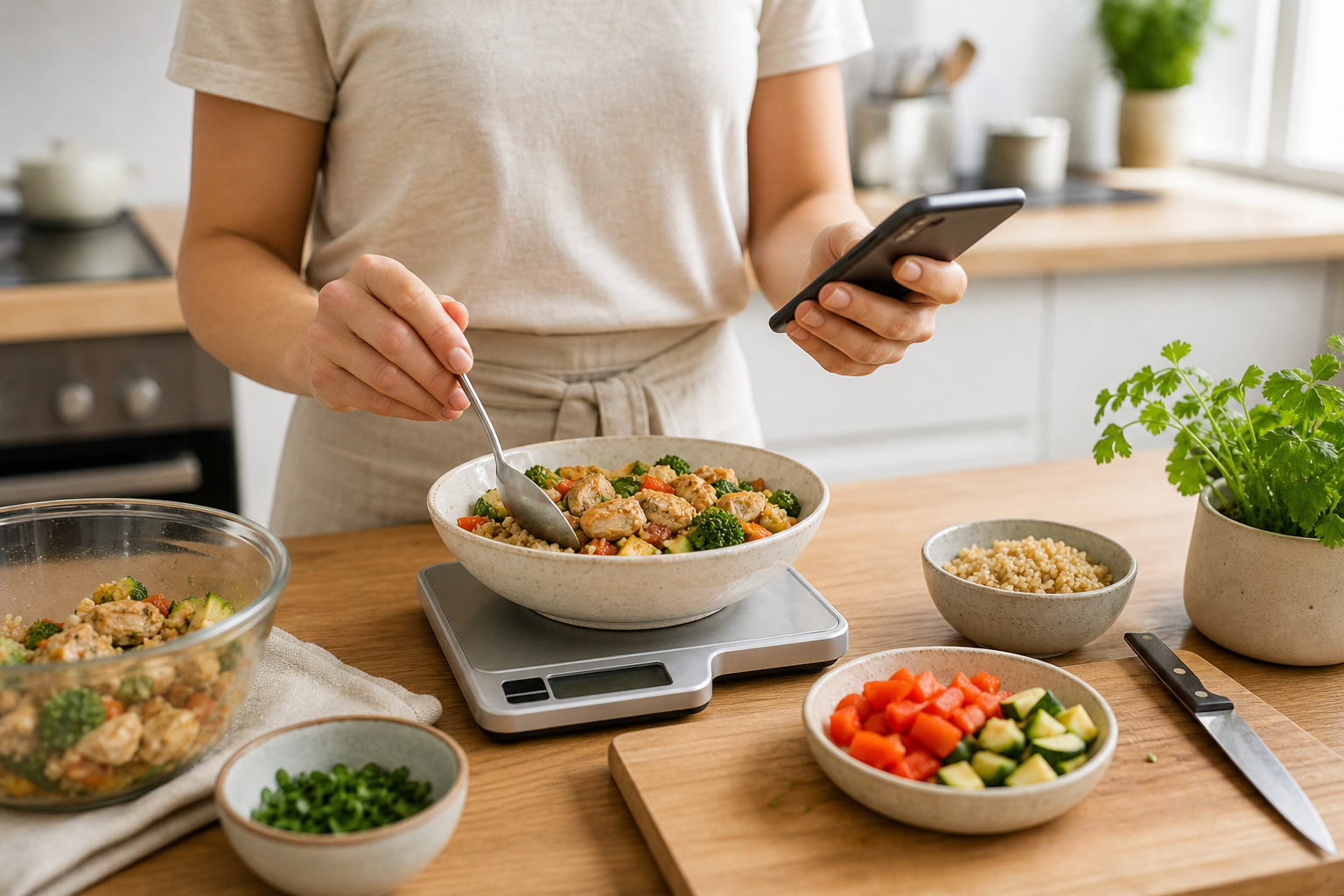
Packaged food is easy to log. It has a barcode and a label. A pot of chili has neither, and that’s where most food logs go soft. The usual move is to find something close in the database, call your bowl one serving, and hope. The number you get is a guess wearing a decimal point.
The fix takes a scale and about two extra minutes per batch. It works in every calorie app with a diary, free or paid, because it doesn’t depend on the app’s database for the dish. It only depends on the database for the raw ingredients, which is where databases are most reliable.
The short answer
- Weigh every raw ingredient in grams, oil and butter included.
- Log each one against a raw or dry entry.
- Weigh the empty pot before you start.
- Weigh the pot again when the dish is done, and subtract the pot.
- Save the recipe by its cooked weight, or as a custom food per 100 g.
- Log your portion in grams of the cooked dish.
That’s the whole method. The rest of this guide is why each step matters and where the number breaks if you skip one.
Step 1: weigh raw, log raw
Weigh each ingredient before it cooks, in grams, and log it against an entry that says raw or dry. Raw weights don’t depend on how long you cooked anything, so they’re the same every time you make the dish.
Match the state of the food to the state of the entry. Log 100 g of dry rice against a cooked entry and you record 130 calories for food that holds 365. Log 100 g of raw chicken breast against a roasted entry and you record 165 for food that holds 120. Our guide to weighing food raw or cooked covers why, and the raw to cooked weight conversion table has the factors if you only have one of the two weights.
If the recipe is written in cups, convert to grams once and write the grams on the recipe. Our cups to grams chart has the USDA weights. A cup of uncooked long-grain rice is 185 g; a cup of cooked rice is 158 g. Same cup, very different food.
Step 2: count the fat that goes in the pot
Oil and butter are the ingredients people forget, and they’re the densest ones in the pot. USDA FoodData Central lists a tablespoon of olive oil at 13.5 g and 119 calories, canola oil at 124, and butter at 102. Two tablespoons of olive oil add 238 calories to the batch whether you log them or not.
Weigh oil on the scale, or use a level spoon. A free pour or a heaped spoon runs past a level one, and the difference ends up in your bowl. Our hidden calories per tablespoon chart lists the common fats, sauces and spreads.
Water and ice add weight and no calories. Log them at zero, or leave them out. They change the cooked weight, which you’ll measure anyway.
Step 3: weigh the finished dish
Weigh the empty pot before you start and write the number down. When the dish is done, weigh the pot again and subtract. That figure, the cooked weight, is the number that turns the recipe into calories per gram.
It also takes care of everything cooking does to the water. Beans and rice absorb it. Meat loses it. Some of it boils off. You don’t need to estimate any of that. The calories are in the pot; only the weight changed, and you just measured it.
A worked example
A beef and bean pot, with rice on the side. Calories are from USDA FoodData Central.
| Ingredient | Grams | Calories per unit | Calories |
|---|---|---|---|
| Ground beef 85/15, raw | 500 | 215 per 100 g | 1,075 |
| Black beans, dry | 250 | 341 per 100 g | 853 |
| Olive oil, 2 level tbsp | 27 | 119 per tbsp | 238 |
| Water | 1,200 | 0 | 0 |
| Whole pot | 2,166 | ||
| Cooked weight, pot subtracted | 1,650 | ||
| Per 100 g of cooked dish | 100 | 131 | |
| A 350 g bowl | 350 | 459 | |
| Long-grain rice, dry, logged separately | 75 | 365 per 100 g | 274 |
The cooked weight here is an example. Yours will differ, which is the point of weighing it. Divide 2,166 calories by 1,650 g and you get 1.31 calories per gram, or 131 per 100 g. A 350 g bowl is 459 calories.
The rice is logged on its own, by dry weight: 75 g is 274 calories. If you’d rather weigh it cooked, use a cooked entry: USDA’s figures imply 75 g of dry rice ends up near 211 g cooked, at 130 calories per 100 g, which comes back to about 274.
One caveat on the beef. Ground beef 85/15 renders fat as it cooks. If you leave the fat in the pot, the raw entry is right, because those calories are still in the dish. If you pour it off, the raw entry counts calories that went down the drain, and your number runs a little high. FoodData Central has cooked entries for ground beef, but because the fat loss depends on how you cook and drain, the honest answer is the same as everywhere else in this guide: weigh it.
Step 4: save it the way your app allows
If your app has a recipe builder, add each raw ingredient with its grams, then set the recipe’s total to the cooked weight in grams, if the app lets you. Then you log your portion in grams, and the app does the division. If the builder only accepts a number of servings, set the servings to the cooked weight, 1,650 in the example, and log one serving per gram you eat: 350 servings for a 350 g bowl. It looks odd. It’s accurate.
If your app has no recipe builder, do the sum yourself and create a custom food: 131 calories per 100 g, in the example. If you want macros, add each ingredient’s protein, fat and carbohydrate the same way, divide by the cooked weight and multiply by 100. Log grams of the custom food each time you eat it.
Either way, name it with the date or the batch. Next week’s chili won’t weigh the same, and it shouldn’t share an entry with this one.
Step 5: portion and freeze by weight
If you cook in batches, weigh the portions as you pack them and write the grams and the date on each container. The entry is done before the food goes in the freezer. When you pull it out next month, you log the grams on the lid.
Weigh before you freeze, not after you thaw. Thawed food loses some liquid, and the thawed weight won’t match what you logged. Our guide to freezing meal prep without freezer burn covers the packing.
What we didn’t like
These are the shortcuts that break a home-cooked log. They come from how the method works, not from a measurement of any one app.
- Servings instead of grams. Telling an app the pot makes four servings assumes four equal bowls. In the example, a quarter of the pot is 412 g and 541 calories. Ladle a bigger bowl and the log is wrong before you take a bite. Our guide to serving sizes covers the same problem on labels.
- Cups instead of grams. Volume depends on how you pack the cup. Weigh once and keep the grams.
- Cooked entries with raw weights, or the reverse. The single biggest error in a recipe log, and the easiest to miss.
- Forgetting the oil. 238 calories in two tablespoons, spread through a pot, never shows up in any single bowl you’d notice.
- Copying someone else’s recipe build. A shared recipe is only as good as the entries and weights its author used, and you can’t see their scale. FatSecret’s community recipes are a head start, but their accuracy wasn’t measured separately in our test. If you use one, check the weights against what went into your pot.
Where these numbers come from
Every calorie figure here is from USDA FoodData Central: ground beef 85/15 at 215 calories per 100 g raw, dry black beans at 341, dry long-grain rice at 365 and cooked at 130, olive oil at 119 per tablespoon and butter at 102. The cooked weight in the example is illustrative, not a measurement. The arithmetic is ours.
Which app you use for this matters less than whether you weigh. If you’re choosing one, start with what apps are actually useful for tracking calories or the best free calorie counters, and see the rest of the nutrition app guides. For the scale itself, our test of kitchen scales for calorie counting has the ones that held to the gram.
Sources
USDA Agricultural Research Service, FoodData Central, SR Legacy entries for ground beef, black beans, long-grain white rice, olive oil, canola oil and butter.
USDA FoodData Central, household measures for cups to grams.
Questions we get
How do I log a homemade recipe in a calorie app?
Weigh each raw ingredient in grams and add it to the app's recipe builder, oil and butter included. Weigh the finished dish. Save the recipe by total cooked weight, then log your portion in grams. If the app has no recipe builder, create a custom food per 100 g instead.
Should I weigh recipe ingredients raw or cooked?
Raw, and log them against raw or dry entries. Cooking moves water in and out of food, so cooked weights vary from batch to batch. Weigh the whole dish once it's cooked, and that one number takes care of the water.
How do I count calories in a recipe if my app has no recipe builder?
Add up the calories of the raw ingredients yourself, divide by the cooked weight of the dish and multiply by 100. Save that as a custom food per 100 g, then log grams of it each time you eat it.
Does cooking oil count in a recipe?
Yes, all of it that stays in the dish. A tablespoon of olive oil is 13.5 g and 119 calories in USDA FoodData Central, butter 102 calories. Weigh the oil or measure it with a level spoon.
Should everyone weigh and log their food?
No. It's a tool for people who want a precise log. If you have a history of disordered eating, are pregnant, or manage a condition such as diabetes, set any calorie target or logging routine with your clinician or a registered dietitian first.
Who stands behind this post
Cass Rivera
Tester, apps and dataTests calorie and nutrition apps. Runs the barcode and logging-time tests and keeps the weighed-menu spreadsheet.
- Posts written
- 16
- Posts reviewed
- 0
Dr. Iris Kwan, RD
Nutrition reviewerRegistered dietitian. Reviews every app post and label guide before it publishes, and signs them.
Signs: App posts and label guides
- Posts written
- 0
- Posts reviewed
- 34
Corrections. Spotted a wrong figure? Email desk@foodblogblog.com. We correct within five business days and date the change. No link on this page carries an affiliate tag yet. When a shop program opens, tagged links will be marked.