Vacuum sealer vs zip-top bags: 2% vs 31% freezer burn after 90 days
We froze food for 90 days in vacuum-sealed bags and in zip-top bags. Sealed food showed 2% freezer burn and lost 4 g of moisture, with no failed seals in 20. In zip-top bags: 31% freezer burn, 18 g lost, and 3 of 20 seals failed.
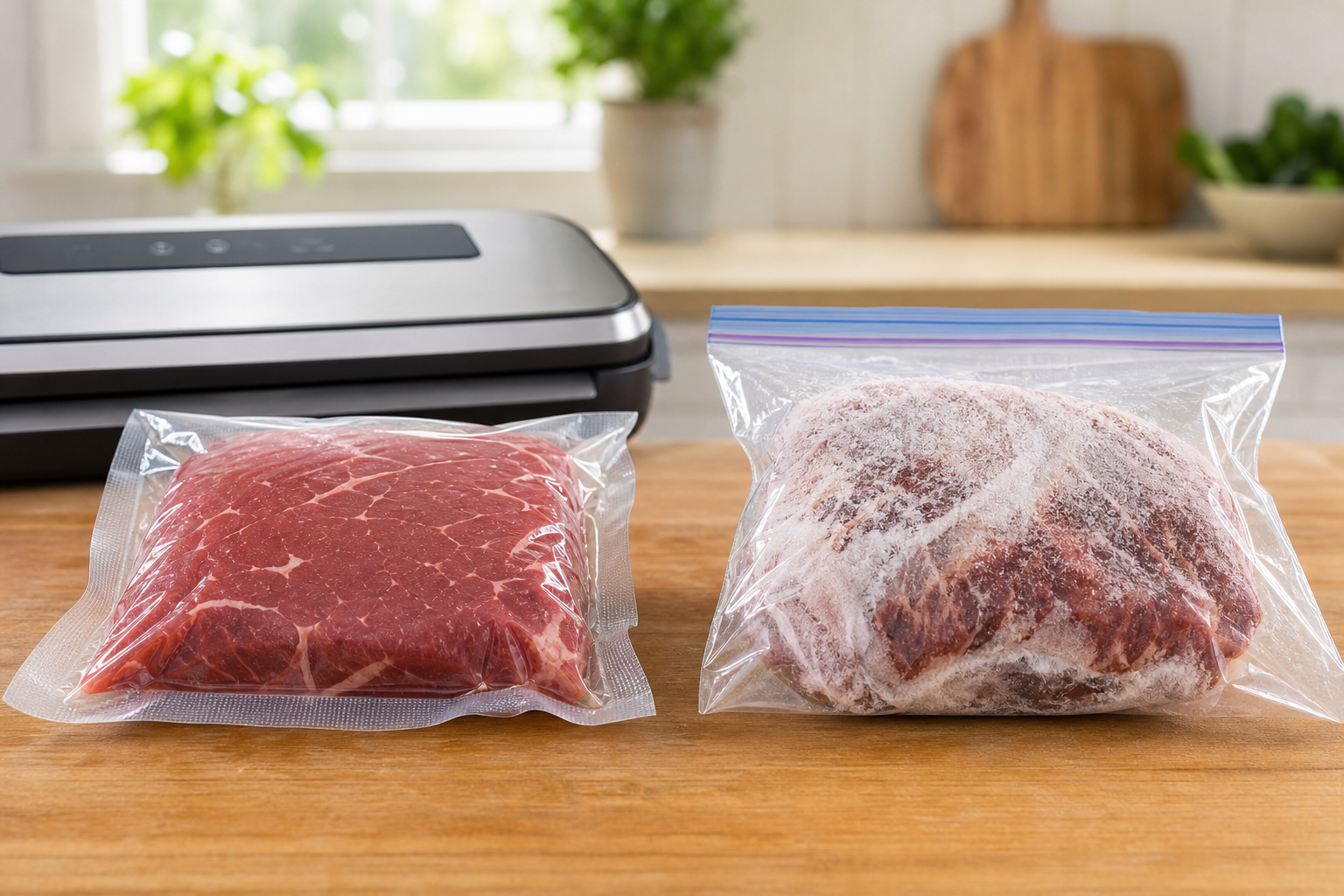
Vacuum sealer vs zip-top bags, 90 days frozen
3 of 3 specs differ
| Spec | Won all three Vacuum sealer Vacuum-sealed bags | Zip-top bag Zipped shut |
|---|---|---|
| Quality at 90 days | ||
| Freezer burn Share of the food showing freezer burn; lower is better (differs between products) | 2% | 31% |
| Moisture lost Lower is better (differs between products) | 4g | 18g |
| Seal | ||
| Seal failures Seals that opened or let air in over 90 days (differs between products) | 0of 20 | 3of 20 |
Our vacuum sealer roundup ended with a piece of advice we couldn’t back with a number: if a sealer is out of your budget, use freezer bags with the air pressed out. We said at the time that we hadn’t tested bags against sealers. This is that test.
We froze food for 90 days two ways: vacuum-sealed, and in zip-top bags. Twenty of each. At the end, we checked how much of the food showed freezer burn, weighed how much moisture it had lost, and counted the seals that had failed.
The sealer won all three, by a lot. Vacuum-sealed food showed freezer burn on 2% of it. Food in zip-top bags showed it on 31%, nearly a third. Sealed food lost 4 g of moisture; bagged food lost 18 g. None of the 20 vacuum seals failed. Three of the 20 zip-top seals did.
The short answer
- Freezing for months? Vacuum seal it. 2% freezer burn at 90 days, against 31%.
- Eating it within a few weeks? Zip-top bags are probably fine. We only checked at 90 days, so we can’t tell you how bags do at 30. Press the air out and check the zip.
- Bulk meat bought on sale? That’s the case a sealer is for. A third of the food burned is a third of the saving gone.
- Either way, the food is safe. Freezer burn is a quality problem. At 0 °F (−18 °C), frozen food stays safe indefinitely.
The results
| Packing | Days frozen | Freezer burn | Moisture lost | Seal failures |
|---|---|---|---|---|
| Vacuum sealer | 90 | 2% | 4 g | 0 of 20 |
| Zip-top bag | 90 | 31% | 18 g | 3 of 20 |
Freezer burn is the share of the food showing the dry, grayish patches where air reached the surface. Moisture lost is the weight the food gave up over the 90 days, in grams. Seal failures counts how many of the 20 seals opened or let air in.
Freezer burn: 2% against 31%
Freezer burn is air at work. Ice on the surface of frozen food turns straight to vapor, leaving dry, grayish, leathery patches. Keep air off the food and it can’t happen. Let air in and it starts.
That’s what the two numbers show. The vacuum sealer pulled the air out and kept it out: 2% of the food showed burn after 90 days. The zip-top bags left some air in, and let more in through the three seals that failed: 31% of the food showed burn. That’s more than 15 times as much.
USDA is clear that freezer-burned food is safe to eat. It’s just worse to eat. You trim the patches off or live with a dry, gray result. If the point of freezing was saving money on food bought in bulk, nearly a third of it burned is the saving going in the bin.
Put it against USDA’s quality times from the fridge and freezer storage times chart. Raw ground meat keeps its quality for 3 to 4 months frozen. Our test ran 90 days, about 3 months, the short end of that window. By then, nearly a third of the food in our zip-top bags showed burn. If you’re aiming for USDA’s longer limits, 4 to 12 months for steaks and roasts, these numbers say a zip-top bag isn’t the packaging to do it in.
Moisture: 4 g against 18 g
Moisture loss is the same process measured by weight. Water leaves the food as vapor and doesn’t come back. The vacuum-sealed food lost 4 g over 90 days. The bagged food lost 18 g, 4.5 times as much.
You’ll notice it after cooking. Food that lost water in the freezer comes out drier, and meat that dried at the surface cooks up tougher at the edges.
If you log calories, there’s a smaller effect too. Lost water means the food weighs less when it comes out than when it went in, with the same calories. Weigh portions before you freeze them, write the weight on the bag, and log that number, not a thawed weight. Our guide to freezing meal prep covers labeling portions this way.
Seals: 0 of 20 against 3 of 20
None of the 20 vacuum seals failed over 90 days. Three of the 20 zip-top seals did, 15%.
That’s the number to think about if you freeze a lot. At our rate, freeze 20 bags of food a month and expect about 3 seals to fail. Some failures you’ll spot: a bag that has puffed up or has ice crystals inside. Others you won’t, until you open the bag and find the food dry and gray.
A zip is a mechanical seal. It works when it’s clean, fully pressed and not stressed. Freezers are hard on all three. Bags get stacked, shoved, dropped, and flexed as the food freezes and expands. A melted vacuum seal has no track to work loose.
When zip-top bags are enough
Bags lost on every measure, but the test was 90 days. For plenty of freezing, that’s longer than the food stays in.
Zip-top bags are a reasonable choice when:
- You’ll eat it within a few weeks. Meal prep in a weekly rotation, a loaf of bread, leftovers for next week. We didn’t test shorter stays, so we can’t put a number on it, but freezer burn builds with time.
- The food is going into a sauce or a soup. Some surface drying matters less when the food is cooked in liquid.
- You’re freezing liquids. Soups and stews freeze well flat in a bag, and a sealer pulls liquid toward the seal bar. If you seal liquids, freeze them first.
- You freeze a little, rarely. The sealers in our roundup cost $45 to $150, plus bags. If you freeze twice a month, that’s a lot of machine for little food.
Getting more out of zip-top bags
None of these were part of our test. They’re ways to get closer to the sealer’s result with what you have.
- Use freezer bags, not storage bags. Freezer bags are thicker. Check the box.
- Press the air out from the bottom up. Then seal the last inch. Or use water: lower the filled bag into a bowl of water, seal it just above the waterline, and the water pushes the air out. Our meal prep freezing guide walks through it.
- Cool food first. Hot food in a bag fogs up and leaves ice inside. Cool it in the fridge, within the 2-hour limit; our guide to storing leftovers has the cooling rules.
- Freeze flat. Flat bags freeze faster, stack without crushing each other, and flex the zip less.
- Check the zip before you trust it. Run your fingers along it. A zip with food in the track won’t close.
- Date the bag and eat bagged food first. If it’s in a zip-top bag, it goes to the front.
What neither one does
Neither a sealer nor a bag makes perishable food shelf-stable. Sealed or bagged, meat, fish, poultry and cooked food go in the freezer or the fridge. Removing air doesn’t stop every bacterium; the one behind botulism grows without oxygen.
Neither one changes how you thaw. Thaw in the fridge, in cold water in a leak-proof bag, or in the microwave, never on the counter. For vacuum-packed fish, extension guidance is to open or remove the bag before thawing it in the fridge. Our guide to thawing meat safely has the times.
And neither one makes a warm freezer safe. Keep it at 0 °F (−18 °C) and check it with an appliance thermometer.
What we didn’t like
- Zip-top bags: 31% freezer burn at 90 days. Nearly a third of the food showed burn. That’s 15 times the sealer’s 2%.
- Zip-top bags: 3 of 20 seals failed. A 15% failure rate, and not every failure is visible from outside the bag.
- Zip-top bags: 18 g of moisture lost. 4.5 times the sealer’s 4 g, and drier food after cooking.
- Vacuum sealer: the cost and the space. A machine to buy and store, and bags you’ll keep buying. We didn’t log bag prices for this test; our sealer roundup works through what bags cost over a year.
- Vacuum sealer: still 2%. Not zero. A sealer slows freezer burn to almost nothing over 90 days. It doesn’t make freezer time unlimited for quality.
Which one for which freezer
You buy meat in bulk and freeze it for months
Vacuum seal it. This is the case our numbers speak to directly: 2% freezer burn at 90 days against 31%. Our vacuum sealer roundup ranks four machines; the two with the strongest seals showed no freezer burn in that test.
You meal-prep for the week ahead
Zip-top bags, or containers, are probably enough for food that’s eaten within days or a couple of weeks. Our test didn’t cover stays that short, so treat that as reasoning, not a result. Label every bag with the date and the grams.
You freeze soups, stews and sauces
Bags, frozen flat. Liquids are awkward in a sealer unless you freeze them first, and a little surface drying matters less in something you’ll simmer.
You freeze a bit of everything and forget about it
Then the bag is the problem, not the food. Either seal what you know will sit for months, or put the zip-top bags at the front and eat them first. Nearly a third of the food burned by day 90 is what happens to the bag at the back.
How we tested
Forty packs of food, all frozen for 90 days: 20 vacuum-sealed, 20 in zip-top bags. Bags and the sealer were bought at retail. After 90 days, we checked each pack for freezer burn and recorded the share of the food affected, weighed the food to get the moisture lost, and counted the seals that had opened or let air in. Every reading was photographed. This post compares two methods rather than ranking products, so it carries no score. Testing ended September 16, 2026. The full method is on How we test. Our product roundups are on the kitchen gear comparisons hub.
Sources
USDA Food Safety and Inspection Service, Freezing and Food Safety.
USDA Food Safety and Inspection Service, Cold Food Storage Chart, via FoodSafety.gov.
USDA Food Safety and Inspection Service, The Big Thaw: Safe Defrosting Methods.
Michigan State University Extension, Vacuum-sealed food: What are the food safety concerns?
Centers for Disease Control and Prevention, Botulism.
Questions we get
Do zip-top bags prevent freezer burn?
Not over 90 days, in our test. Food frozen in zip-top bags showed freezer burn on 31% of it, against 2% for vacuum-sealed food, and 3 of 20 zip-top seals failed. For shorter freezer stays, bags may do better; we only checked at 90 days.
Is freezer-burned food safe to eat?
Yes. USDA treats freezer burn as a quality problem, not a safety one. The dry, grayish patches are where air dried the surface. Cut them off, or accept a drier result.
How long can food stay frozen in a zip-top bag?
At 0 °F, frozen food stays safe indefinitely, in any bag. The limit is quality. USDA's quality times run from 1 month for bacon to a year for a whole raw chicken or turkey. In our test, zip-top bags had 31% freezer burn by 90 days, so we'd eat bagged food well before USDA's longer limits.
Is a vacuum sealer worth it?
If you freeze food for months, yes: 2% freezer burn at 90 days against 31% in zip-top bags, and no failed seals in 20. If everything you freeze is eaten within a few weeks, zip-top bags with the air pressed out may be enough. We didn't test shorter stays.
Can I reuse zip-top freezer bags?
For dry or low-risk food, wash and reuse them if the zip still closes cleanly. We don't reuse bags that held raw meat, poultry or fish. A worn zip is one more way for a seal to fail, and 3 of 20 new zip-top seals failed in our test.
Who stands behind this post
Dev Patel
Tester, kitchen gearTests scales, thermometers, air fryers and storage gear. Former restaurant equipment buyer.
- Posts written
- 17
- Posts reviewed
- 0
Mara Ellison
EditorEdits the desk: every test plan, every post, every correction. Twelve years in food and tech journalism.
- Posts written
- 12
- Posts reviewed
- 11
Corrections. Spotted a wrong figure? Email desk@foodblogblog.com. We correct within five business days and date the change. No link on this page carries an affiliate tag yet. When a shop program opens, tagged links will be marked.