Air fryer vs convection oven: 210 vs 540 seconds to 190 °C, 0.42 vs 0.96 kWh a batch
We ran the same 500 g batch through a 5-liter basket air fryer and a convection oven. The fryer reached 190 °C in 210 s against 540, cooked 88% even against 74%, used 0.42 kWh against 0.96 and lost 11% of the weight to moisture against 19%.
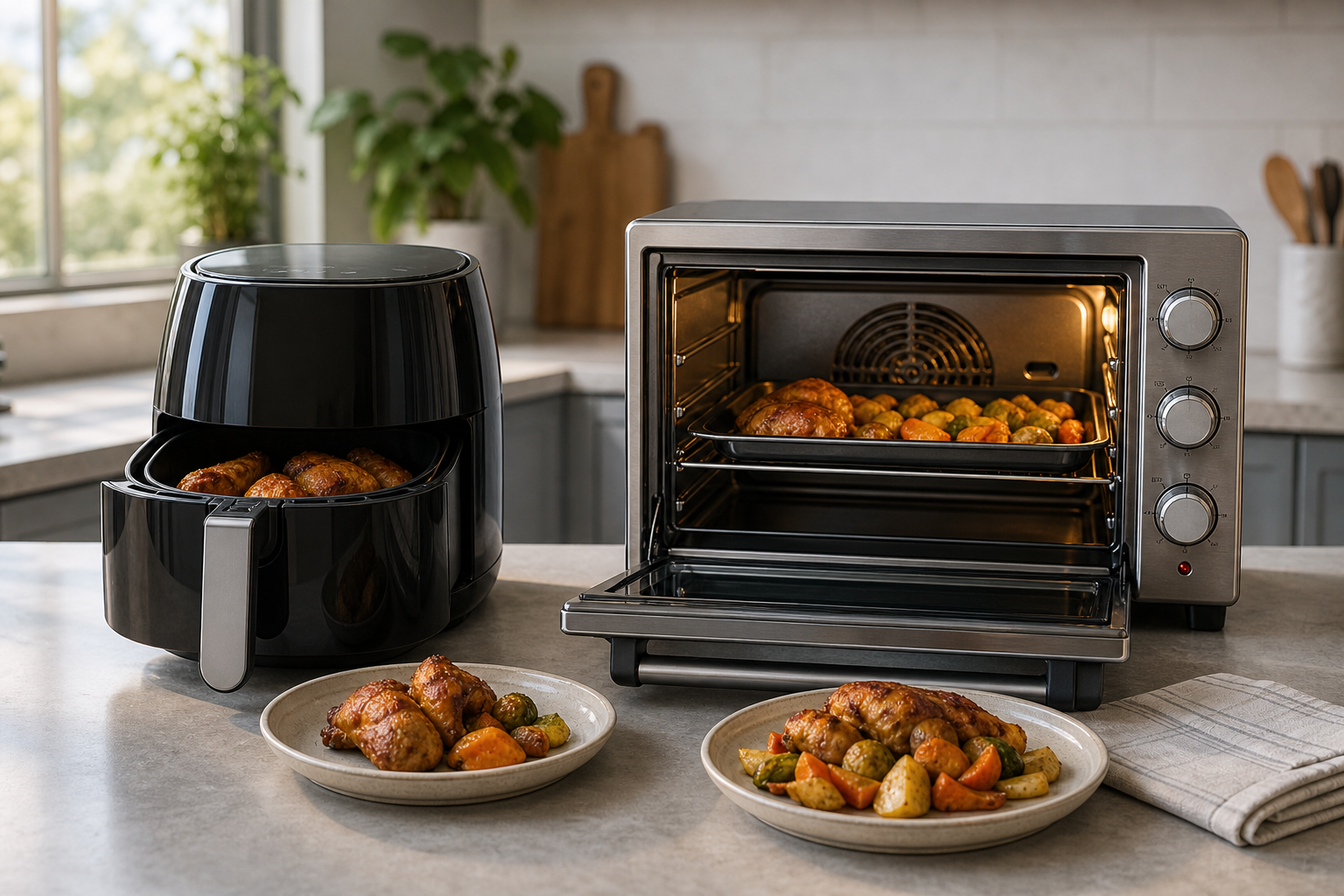
Air fryer vs convection oven, same 500 g batch
4 of 4 specs differ
| Spec | Won all four Air fryer 5-liter basket | Convection oven Convection setting |
|---|---|---|
| Speed | ||
| Time to 190 °C From cold, seconds to reach 190 °C (differs between products) | 210s | 540s |
| Result | ||
| Evenness How evenly the batch cooked; higher is better (differs between products) | 88% | 74% |
| Moisture loss Share of the batch weight lost in cooking; lower is better (differs between products) | 11% | 19% |
| Energy | ||
| Energy per batch Measured per 500 g batch (differs between products) | 0.42kWh | 0.96kWh |
An air fryer is a small convection oven with a basket. Both blow hot air over food. So the question isn’t whether an air fryer can do something your oven can’t. It’s whether doing it in a smaller box is faster, more even and cheaper enough to earn the counter space.
When we tested five air fryers for our air fryer roundup, we said we hadn’t run an oven through the same test and couldn’t put a number on the difference. This is that number. We put the same 500 g batch through a 5-liter basket air fryer and a convection oven, both set to 190 °C, and measured four things: how long each took to reach temperature, how evenly the batch cooked, how much electricity it used, and how much weight the food lost to moisture.
The air fryer won all four. It reached 190 °C in 210 seconds against 540. It cooked 88% even against 74%. It used 0.42 kWh against 0.96. And the food lost 11% of its weight against 19%. The one thing it can’t do is hold more than its basket, and we didn’t measure what happens when the batch gets bigger.
The short answer
- For a batch that fits the basket, use the air fryer. It was hot 5.5 minutes sooner, used 44% of the oven’s energy, and cooked more evenly.
- For a batch that doesn’t fit, use the oven. One oven load is easier than three rounds in a basket, and we didn’t test whether the energy advantage holds across repeated rounds.
- If you log calories, weigh raw. The two methods lost different amounts of water, so the same food weighed differently afterwards.
- If you’re deciding whether to buy a fryer at all, count how often you’d use it. Several times a week, the time and energy add up. Twice a month, they don’t.
The results
| Method | Time to 190 °C | Evenness | Energy per 500 g batch | Moisture loss |
|---|---|---|---|---|
| Air fryer, 5 L basket | 210 s (3.5 min) | 88% | 0.42 kWh | 11% |
| Convection oven | 540 s (9 min) | 74% | 0.96 kWh | 19% |
Time to 190 °C is from cold. Evenness is how evenly the batch cooked across the basket or tray, as a percentage; higher is better. Energy is what each used for a 500 g batch. Moisture loss is the share of the batch’s weight lost in cooking; lower means juicier food and a heavier result.
Heat-up: 3.5 minutes against 9
The air fryer reached 190 °C in 210 seconds. The convection oven took 540. That’s 5.5 minutes of difference before any food goes in.
The reason is volume. A 5-liter basket is a small space to heat. An oven cavity is many times bigger, with more metal and glass to warm up. The fan helps the oven, but it can’t make the box smaller.
Five and a half minutes matters most on the days you’re least likely to cook. A weeknight dinner for one, reheating leftovers, a tray of vegetables at 7 p.m.: the shorter the cook, the bigger the preheat is as a share of the total. If the food itself takes 15 minutes, the oven’s preheat adds 60% to the job. The fryer’s adds 23%.
Evenness: 88% against 74%
Evenness is where the fryer’s small box pays off a second time. Hot air has less distance to travel, and the fan pushes it over every piece in the basket. The fryer cooked the batch 88% even. The oven managed 74%, 14 points lower.
In practice, 74% means some pieces were done while others needed more time. You either pull the tray and turn everything halfway, or you accept a mix of overdone edges and pale middles. The 88% batch still isn’t perfect. Shaking the basket halfway through is still worth doing.
For context, 88% is the same evenness the Crisp 5 managed in our air fryer roundup, where the five fryers ran from 71% to 91%. That spread matters: a poor air fryer at 71% is worse than this oven’s 74%. The appliance type doesn’t guarantee the result; the specific machine does.
Energy: what 0.54 kWh a batch adds up to
The fryer used 0.42 kWh for a 500 g batch. The oven used 0.96 kWh, about 2.3 times as much. The difference is 0.54 kWh per batch.
Here’s what that costs. Say you pay 17 cents per kWh; check the rate on your bill, because it varies a lot by state and by plan. At that rate:
| Per batch | 3 batches a week, one year | |
|---|---|---|
| Air fryer | 7.1 cents | 65.5 kWh, $11.14 |
| Convection oven | 16.3 cents | 149.8 kWh, $25.46 |
| Difference | 9.2 cents | 84.2 kWh, $14.32 |
Fourteen dollars a year doesn’t pay for an air fryer quickly. It’s a real saving, not a reason to buy one. If your rate is higher, scale it up: at 34 cents per kWh, the yearly gap doubles to about $28.64.
The energy gap likely comes from the same place as the heat-up gap. Much of an oven’s energy goes into heating the cavity and its walls. The fryer has less box to heat.
Moisture loss, and why it matters for your food log
The fryer batch lost 11% of its weight in cooking. The oven batch lost 19%. On 500 g of food, that’s 55 g of water against 95 g. The fryer batch came out at 445 g, the oven batch at 405 g.
For eating, less moisture loss usually means juicier food. We didn’t measure why the oven batch lost more, so we won’t pin it on one cause.
For a calorie log, the numbers change what a gram means. Cooking moves water, not calories. The calories that went into the oven in 500 g of food come out in 405 g; from the fryer, in 445 g. Per 100 g cooked, the oven batch is about 10% more calorie-dense.
Put numbers on it with a food from USDA FoodData Central. These percentages come from our batches, not from chicken, but they show the effect. Raw skinless chicken breast is 120 calories per 100 g, so 500 g raw is 600 calories. At 11% loss you’d have 445 g cooked, 135 calories per 100 g. At 19% loss, 405 g, 148 calories per 100 g. USDA’s roasted entry is 165 per 100 g, which implies a bigger loss than either.
That’s why the cooked entry in your app is only right if your cooking matched the one USDA measured. Weigh raw and log the raw entry, and the method stops mattering. Our guide to weighing food raw or cooked explains why, and the raw to cooked weight conversion table has the factors when you can’t.
Where the oven still wins
The oven holds more. A 5-liter basket held our 500 g batch; an oven tray or two holds more food than that. If you’re cooking for four, the fryer means two or three rounds, and the first round is cooling while the last one cooks.
We didn’t measure what happens to the energy math across repeated rounds. Reasoning from our numbers: the fryer’s advantage per batch is large, 0.54 kWh, but an oven running two trays at once doesn’t use twice the energy of one tray. At some batch size the oven likely catches up. We don’t know where, and we won’t guess.
The oven also handles things that don’t fit a basket: a sheet of cookies, a casserole dish, a large roast. And you probably already own it.
Whatever you cook in, check doneness with a thermometer, not the timer. USDA’s safe minimum is 165 °F (74 °C) for all poultry and 160 °F (71 °C) for ground meat; our chart of safe internal cooking temperatures has the full list, and our roundup of instant-read thermometers has one that reads fast enough to use with the basket out.
If you’re keeping the oven
You don’t need a fryer to close some of the gap. None of this was part of our test; it’s how to work around the three numbers the oven lost on.
- Turn it on first. Start the preheat before you chop anything. Nine minutes disappears into prep that you’d do anyway.
- Turn the tray halfway. At 74% evenness, some pieces lag. Rotating the tray, or flipping the food, spreads the heat the fan didn’t.
- Give the food room. Crowded pieces steam each other. Use two trays rather than one packed tray.
- Pull it at temperature. The oven batch lost 19% of its weight to moisture. Every minute past done takes more. A thermometer tells you when to stop, which a timer can’t.
- Use it for the big batches. If the oven is on anyway, fill it. A full oven spreads its 9-minute preheat over more food.
What we didn’t like
- Convection oven: 9 minutes to temperature. 540 seconds of preheat before any food goes in, 5.5 minutes longer than the fryer.
- Convection oven: uneven. 74% evenness means turning the tray halfway or accepting a mixed result.
- Convection oven: drier food. 19% of the batch weight lost to moisture against 11%.
- Convection oven: 0.96 kWh per batch. About 2.3 times the fryer’s energy for the same 500 g.
- Air fryer: capacity. One 5 L basket. Cooking for a family means rounds, and we didn’t measure the energy across them.
- Air fryer: counter space. It’s another appliance to store. If your counter is already full, read our Instant Pot test before you add a second appliance.
Which one for which kitchen
You cook for one or two, most nights
The air fryer. Small batches are where its 5.5-minute head start and 0.54 kWh saving per batch show up every day.
You cook for four or more
The oven, for most meals. Use a fryer, if you have one, for sides and reheating.
You’re deciding whether to buy a fryer
Count the batches. Several times a week, a good fryer earns its space. Twice a month, use the oven. If you buy, buy one that cooks evenly: our roundup ranks five, from 71% to 91% evenness. All our equipment comparisons are on the kitchen gear comparisons hub.
How we tested
One 5-liter basket air fryer and one convection oven, both bought at retail. Each started cold and was set to 190 °C; we timed how long each took to reach it. We cooked the same 500 g batch in each, measured how evenly it cooked, read the energy used at the plug, and weighed the food before and after to get the moisture loss. Every reading was photographed. This post compares two methods rather than ranking products, so it carries no score. Testing ended August 19, 2026. The full method is on How we test, and our product reviews are on the kitchen gear reviews hub.
Sources
USDA FoodData Central, chicken breast, skinless, raw and roasted.
USDA Food Safety and Inspection Service, Safe Minimum Internal Temperature Chart, via FoodSafety.gov.
Questions we get
Is an air fryer just a small convection oven?
In principle, yes: a heating element and a fan in a small box with a basket. The size is what changes the numbers. In our test, the 5-liter air fryer reached 190 °C in 210 seconds; the convection oven took 540.
Does an air fryer use less electricity than an oven?
For a batch that fits the basket, yes. Our air fryer used 0.42 kWh per 500 g batch and the convection oven 0.96, about 2.3 times as much. At an example rate of 17 cents per kWh, that's about 7 cents against 16 cents a batch. Check the rate on your bill.
Does air-fried food have fewer calories than oven-baked food?
Not because of the appliance. Cooking moves water, not calories. The oven batch lost 19% of its weight to moisture and the fryer batch 11%, so the same calories sat in fewer grams after the oven. Weigh raw if you log calories.
How do I convert oven recipes to an air fryer?
Cook to temperature, not to the clock. The fryer heated faster and lost less moisture in our test, so oven times won't transfer exactly. Check meat with an instant-read thermometer against USDA's safe minimums: 165 °F (74 °C) for poultry, 160 °F (71 °C) for ground meat.
Should I buy an air fryer if I already have a convection oven?
If you cook small batches several times a week, the fryer saves time and energy: 5.5 minutes of heat-up and 0.54 kWh per 500 g batch in our test. If you cook for a crowd or twice a month, the oven you own does the job.
Who stands behind this post
Dev Patel
Tester, kitchen gearTests scales, thermometers, air fryers and storage gear. Former restaurant equipment buyer.
- Posts written
- 17
- Posts reviewed
- 0
Mara Ellison
EditorEdits the desk: every test plan, every post, every correction. Twelve years in food and tech journalism.
- Posts written
- 12
- Posts reviewed
- 11
Corrections. Spotted a wrong figure? Email desk@foodblogblog.com. We correct within five business days and date the change. No link on this page carries an affiliate tag yet. When a shop program opens, tagged links will be marked.