Is an Instant Pot worth it? 3 models tested: beans in 37 to 44 minutes, one lost its seal
We tested three Instant Pots on dried beans and on holding a seal. The $89 Duo 6QT cooked beans in 38 minutes, held its seal and scored 8.4. The $129 Pro 8QT was a minute faster and bigger. The $59 Rio 6QT lost its seal after one cycle.
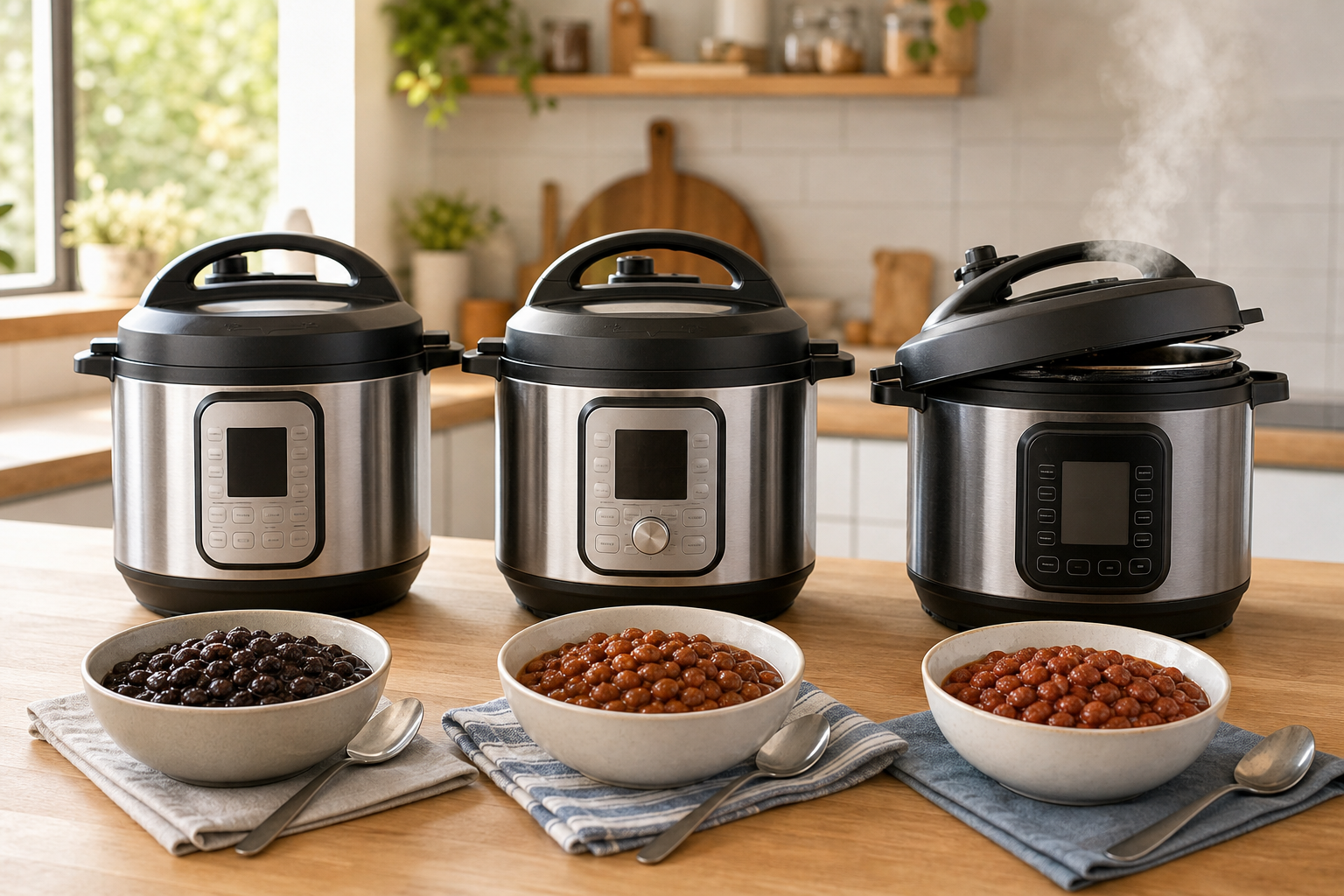
An Instant Pot is an electric pressure cooker with a few other settings bolted on. The pressure part is the reason to buy one. Sealed, it cooks food above the temperature of boiling water. That’s how it cooked dried beans in well under an hour in our test, and why it shortens stock, stews and tough cuts, without anyone standing at the stove. The question “is it worth it” comes down to two things: how much of your cooking is that kind of cooking, and whether the pot you buy can hold a seal.
So that’s what we tested. We cooked dried beans in three Instant Pots, timed them, and logged whether each pot held its seal. The Duo 6QT cooked beans in 38 minutes, held its seal and scored 8.4. It costs $89. The Pro 8QT took 37 minutes and held its seal, in a bigger pot, for $129. The Rio 6QT, at $59, took 44 minutes and lost its seal after one cycle.
The short answer: yes, if you cook beans, grains or stews every week, and the Duo 6QT is the one to buy. Below is what each pot did, who should skip the whole category, and the food-safety rules that matter more with a pressure cooker than with a pan.
The numbers
| Model | Price | Time to cooked beans | Seal | Score |
|---|---|---|---|---|
| Duo 6QT | $89 | 38 min | Held, no seal loss | 8.4 |
| Pro 8QT | $129 | 37 min | Held, no seal loss | 8.2 |
| Rio 6QT | $59 | 44 min | Lost after 1 cycle | 7.3 |
Bean time is how long each pot took to deliver cooked dried beans. The seal column is whether the pot held its seal across our cycles. Price is what we paid at retail.
What the numbers mean
The Duo and the Pro are the same pot, for cooking purposes. One minute separates them on beans, 38 against 37, and neither lost its seal. What you pay for in the Pro is capacity: 8 quarts against 6, about 7.6 liters against 5.7. That’s a third more pot for $40 more.
The Rio is slower and less reliable. Beans took 44 minutes, 6 minutes more than the Duo, or about 16% longer. On a weeknight, 6 minutes is a small thing. The seal is not. A pressure cooker works by holding pressure, and it holds pressure by holding its seal. The Rio lost its seal after one cycle. When that happens, the pot stops building pressure, the cooking times in your recipe stop applying, and you find out when you open the lid on undercooked beans.
Consistency is the quiet feature. The pro at the top of the Duo’s log is one word: consistent. With a pressure cooker, you can’t look in or taste as you go. You set a time, seal the lid and trust it. A pot that does the same thing every cycle is one whose recipe times you can learn and reuse. A pot that loses its seal, as the Rio did after its first cycle, turns every batch into a check.
The price gaps buy different things. The $30 from the Rio to the Duo buys a pot that held its seal and cooked beans 6 minutes faster. The $40 from the Duo to the Pro buys a minute and 2 quarts. The first is the step worth paying for. The second is worth it only if you need the space.
The three models
Duo 6QT, $89, 8.4
The one we’d buy. Beans in 38 minutes, no seal loss, and consistent from cycle to cycle, which is the pro at the top of our log. It’s also the cheaper of the two pots that held their seal, $40 under the Pro.
It’s big. That’s the con: 6 quarts of pot plus a lid and a base takes a corner of the counter or a deep cupboard shelf. If you’ll put it away after every use, check where it goes before you buy.
What worked: consistent results; beans in 38 minutes; no seal loss; cheap for what it does.
What failed: big.
Buy it if you cook for one to four and want a pressure cooker you can rely on.
Pro 8QT, $129, 8.2
The same result in a larger pot. Beans in 37 minutes, a minute faster than the Duo, and no seal loss. The extra 2 quarts are the point: a bigger batch of stock, a whole pot of chili for the week, beans for the freezer.
It’s very big, and that’s the con in our log, a step past the Duo’s “big”. At $129, it’s $40 more than the Duo for a minute and the capacity. It scored a little lower than the Duo, 8.2 to 8.4, on the desk’s fixed weights for performance, build and value. Same performance, higher price.
What worked: larger; same result as the Duo; no seal loss.
What failed: very big; $40 more than the Duo.
Buy it if you cook for five or more, or you batch-cook in amounts that overflow a 6-quart pot.
Rio 6QT, $59, 7.3
The cheapest of the three, which is its only pro. Beans took 44 minutes, the slowest of the three.
And it lost its seal after one cycle. That’s the failure that decides it. A pressure cooker you can’t trust to seal isn’t a cheaper pressure cooker. It’s a pot you can’t plan around. If you buy one and it won’t seal, return it while you can.
What worked: cheapest.
What failed: lost its seal after 1 cycle; beans 6 minutes slower than the Duo.
Skip it. The $30 to the Duo 6QT buys the thing you’re paying for: a seal that holds.
Who should buy one, and who shouldn’t
An Instant Pot earns its counter space on long-cooking food: dried beans, lentils, chickpeas, stock, stews, braises, tough cuts like shoulder and shank, and big batches of grains. Those are jobs that take hours of simmering on a stove, and a pressure cooker does them sealed, unattended, in one pot. Our 38-minute bean time is the Duo doing exactly that.
It earns much less on quick food. Eggs, pasta, stir-fries, steaks, fish and vegetables cook fast on a stove already. The pot still needs time to come up to pressure and come back down, so for food that only needs minutes, it doesn’t save time and it adds a pot to wash.
Buy one if:
- You cook dried beans or lentils most weeks, instead of opening cans.
- You batch-cook stews, chili or stock for the week or the freezer.
- You want dinner to cook without you watching it.
- You have the counter or cupboard space for something big.
Skip it if:
- Most of your cooking is quick: eggs, pasta, stir-fries, grilled meat.
- Your kitchen has no room for a 6-quart pot that lives out or a shelf deep enough to hide it.
- You already own a stovetop pressure cooker you use. An electric one adds convenience, not capability.
The cost, per use
The Duo 6QT costs $89. Whether that’s a lot depends on how often it comes out.
Use it once a week and that’s 52 uses in the first year, about $1.71 a use. Over three years, 156 uses, about 57 cents. Use it twice a week and the three-year figure halves, to about 29 cents. Use it once a month and it’s $7.42 a use in the first year, which is the honest price of a gadget that lives in the cupboard.
The Pro 8QT, at $129, is about 83 cents a use over three years of weekly cooking. The extra 26 cents a use buys 2 quarts. The Rio 6QT looks cheapest, at $59, until you count the seal: a pot that has to be returned or replaced costs more than the one that worked.
Which size
6 quarts suits most kitchens. It holds a batch of beans, a pot of chili or a stew for four with leftovers. The Duo 6QT and the Rio 6QT are both this size.
8 quarts is for big households and people who cook for the freezer. The Pro 8QT gave the same result as the Duo, so the only reason to buy it is volume. The cost is a pot our log calls very big, which needs more counter and a deeper cupboard.
A bigger pot isn’t better for small batches. A pressure cooker needs a minimum amount of liquid to build steam, and the manual sets it. In a larger pot, that minimum is more liquid than a small batch may want.
Pressure cooking for a calorie log
A pressure cooker suits calorie counting better than it looks, because it makes batches, and batches are easy to log once.
Weigh the inner pot empty. Write the weight on a strip of tape on the base or in your phone. When the batch is cooked, weigh the pot full, subtract the empty weight, and you have the cooked weight of the whole batch. Divide by your portion and you have grams per serving. Our guide to the best kitchen scales for calorie counting covers the scale. The KitchenAid Dual Platform had the best big-weight result there, 0.3 g off at 5 kg. Check your scale’s capacity against a full pot before you rely on it.
Log beans dry, or use your own factor. Beans take on water as they cook. By USDA figures, 100 g of dry black beans comes out at about 258 g boiled. Log the dry weight against a dry entry and the cooked weight stops mattering. Or weigh your own batch once, dry and cooked, and use your own factor, as our raw to cooked weight conversion table explains. A pressure cooker’s factor won’t match a pot on the stove exactly, because less water boils off.
Watch the oil in the sauté step. Most Instant Pot recipes start by browning onions or meat in oil. A level tablespoon of olive oil is 119 calories, and it’s in the whole batch. Weigh it into the pot instead of pouring.
Food safety with a pressure cooker
Three rules matter more with an Instant Pot than with a saucepan.
Kidney beans: pressure, not slow cook
Raw red kidney beans contain a natural toxin, phytohaemagglutinin, and a handful of undercooked beans can make you sick. FDA’s guidance is to soak dried kidney beans for at least 5 hours, drain them, and boil them in fresh water for at least 30 minutes. Pressure cooking takes them hotter than boiling, so the pressure setting does that job.
The risk is the slow-cook setting. A slow cooker may never bring beans to a boil, and illnesses have been linked to kidney beans cooked in slow cookers. On an Instant Pot, use the pressure setting for dried kidney beans. If you want them in a slow-cooked dish, cook them first and add them cooked.
No canning
Some electric multicookers have a canning button. The National Center for Home Food Preservation doesn’t recommend pressure canning in any electric multicooker, because the research to back safe processing times in them hasn’t been done. Low-acid foods like beans, meat and most vegetables need a stovetop pressure canner and a tested recipe. An Instant Pot is for cooking, not preserving.
Keep warm and cooling down
Hot food needs to stay at 140 °F (60 °C) or above to stay out of the danger zone. If you leave food on a keep-warm setting, check it with a thermometer the first few times: our guide to the best instant-read thermometers has one for $9 that was within 0.6 °F.
When you’re done, don’t let a full pot cool on the counter. A 6-quart batch of stew cools slowly, and the 2-hour limit applies from when it comes off the heat. Split it into shallow containers and get them in the fridge, as our guide to storing leftovers explains. For the freezer, see freezing meal prep.
Look after the sealing ring
The silicone ring in the lid is what makes the seal on an Instant Pot, and it’s the part that wears. Take it out and wash it after cooking anything strongly flavored, because silicone holds smells. Let it dry before you put it back. Check it every few weeks for cracks, tears or stretching, and replace it when it no longer sits snugly in its track. Many cooks keep a spare.
If your pot won’t seal
Whatever pot you buy, it’s worth knowing the checks for a seal that won’t hold. They’re general, not a diagnosis of the Rio.
- The sealing ring. It has to sit fully in its track, all the way round. Take it out, check it for cracks or stretching, and push it back in.
- The valve. Make sure it’s set to sealing, not venting.
- The lid rim and the pot rim. Food on either breaks the seal.
- The float valve. It should move freely. Food stuck around it stops the pot sealing.
- Enough liquid. A pressure cooker needs liquid to make steam. Too little and it won’t reach pressure. Use at least what the manual calls for.
If a new pot still won’t seal after those checks, it’s faulty. Return it.
How we tested
Three Instant Pots, all bought at retail. Each cooked dried beans, and Dev timed each pot from start to cooked beans and logged whether the pot held its seal across our cycles. Every result was photographed. Size and handling come from Dev’s notes in use. The score uses the desk’s fixed weights for performance, build and value, and the cons are printed for every model, the winner included. We didn’t measure pressure, temperature inside the pot, energy use or other recipes, and we haven’t printed figures we didn’t log. Testing ended July 14, 2026. The full method is on How we test. Mara Ellison edited this post.
Sources
U.S. Food and Drug Administration, Natural Toxins in Food.
National Center for Home Food Preservation, Canning in Electric Multi-Cookers.
USDA Food Safety and Inspection Service, Leftovers and Food Safety.
USDA Food Safety and Inspection Service, Safe Minimum Internal Temperature Chart.
USDA Agricultural Research Service, FoodData Central.
Questions we get
Is an Instant Pot worth it?
If you cook dried beans, grains, stews or tough cuts most weeks, yes. The Duo 6QT cooked beans in 38 minutes without being watched, held its seal and costs $89. If you mostly cook quick things like eggs, pasta and stir-fries, it will take up counter space for little gain.
Which Instant Pot should I buy?
The Duo 6QT. It scored highest of the three, 8.4: beans in 38 minutes, no seal loss, $89. The Pro 8QT was a minute faster and holds more, for $40 more. The Rio 6QT was cheapest at $59 and lost its seal after one cycle.
Is the 8-quart worth it over the 6-quart?
Only if you cook for a big household or batch-cook in large amounts. In our test, the Pro 8QT gave the same result as the Duo 6QT, beans in 37 minutes against 38, and it's very big on the counter. For most kitchens, 6 quarts is enough.
Can I cook dried kidney beans in an Instant Pot?
On the pressure setting, yes. Don't use the slow-cook setting for dried red kidney beans. Raw kidney beans contain a natural toxin, and FDA's guidance is to soak them for at least 5 hours and boil them in fresh water for at least 30 minutes. A slow cooker may never bring them to a boil.
Can I use an Instant Pot for pressure canning?
No. The National Center for Home Food Preservation doesn't recommend electric multicookers for pressure canning, even models with a canning button, because the research to back safe canning times in them hasn't been done. Use a stovetop pressure canner and a tested recipe.
What should I do if my Instant Pot won't seal?
Check that the sealing ring is seated all the way round, the valve is set to sealing, and the lid rim is clean. If a new pot still loses its seal, as our Rio 6QT did after one cycle, return or replace it. A pressure cooker that can't hold its seal can't hold pressure.
Who stands behind this post
Dev Patel
Tester, kitchen gearTests scales, thermometers, air fryers and storage gear. Former restaurant equipment buyer.
- Posts written
- 17
- Posts reviewed
- 0
Mara Ellison
EditorEdits the desk: every test plan, every post, every correction. Twelve years in food and tech journalism.
- Posts written
- 12
- Posts reviewed
- 11
Corrections. Spotted a wrong figure? Email desk@foodblogblog.com. We correct within five business days and date the change. No link on this page carries an affiliate tag yet. When a shop program opens, tagged links will be marked.