Nonstick vs ceramic vs carbon steel: 50 cycles, 18 µm vs 9 µm of coating lost, 92% of the seasoning held
We ran a nonstick, a ceramic and a carbon-steel pan through the same 50 cycles. Nonstick released best, 9.0 out of 10, and lost 18 µm of coating. Ceramic lost 9 µm and released at 8.4. Carbon steel had no coating to lose and kept 92% of its seasoning.
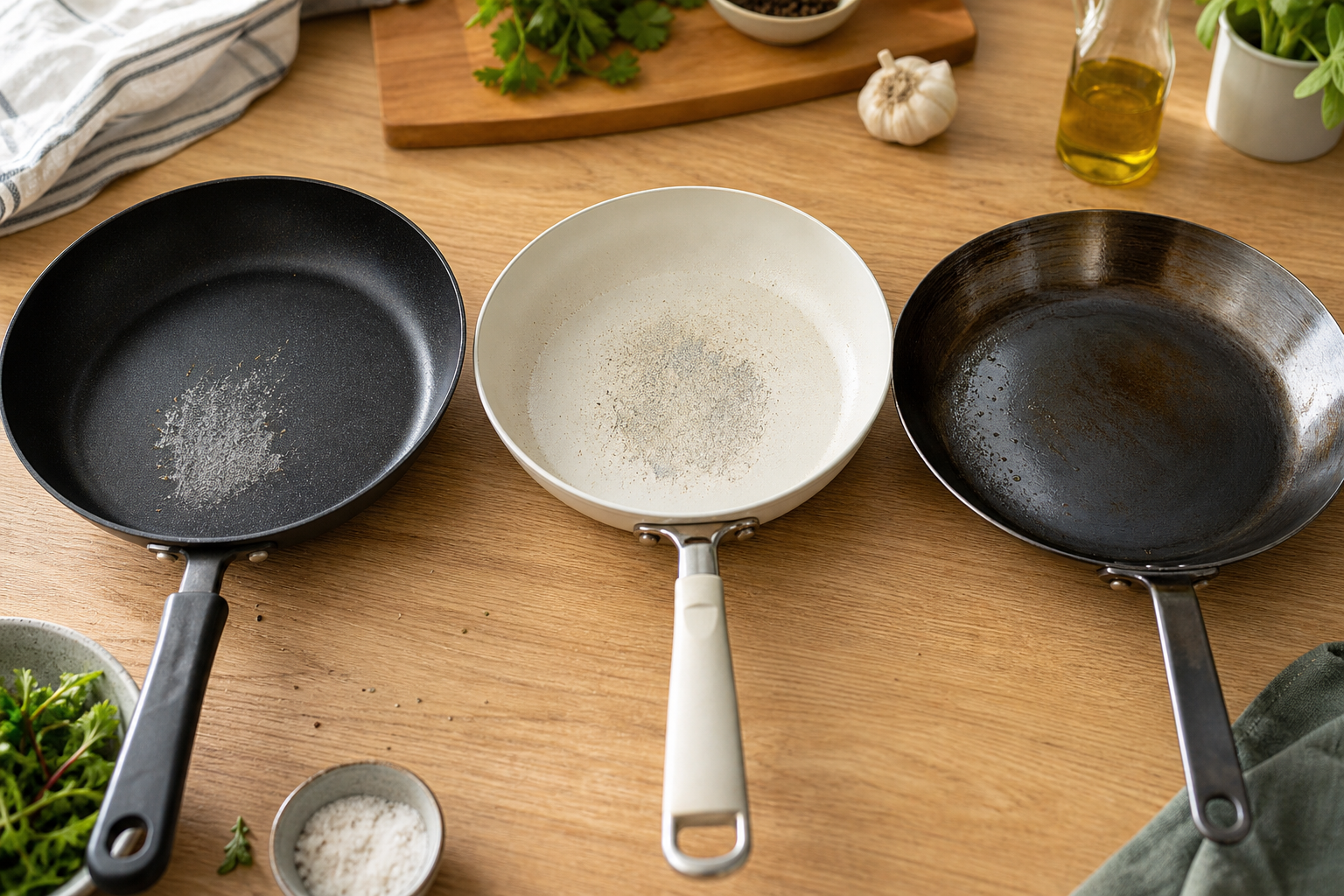
Nonstick vs ceramic vs carbon steel after 50 cycles
4 of 5 specs differ
| Spec | Nonstick PTFE coating | Ceramic Sol-gel coating | No coating to lose Carbon steel Seasoned, no coating | |||
|---|---|---|---|---|---|---|
| Release | ||||||
| Release after 50 cycles Release score out of 10, measured after the 50th cycle (differs between products) | 9/10 | 8.4/10 | 8.9/10 | |||
| Wear | ||||||
| Coating worn away Microns of coating lost over 50 cycles (differs between products) | 18µm | 9µm | 0µm | |||
| Seasoning held Share of the seasoning still on the pan after 50 cycles (differs between products) | n/a | n/a | 92% | |||
| How it wears (differs between products) | Release falls first | Even wear, then sudden failure | Seasoning held; no coating to lose | |||
| Test | ||||||
| Cycles | 50 All products | 50 | 50 | 50 | ||
Three materials cover most of the frying pans people buy. PTFE nonstick, the classic slick coating. Ceramic, a sol-gel coating sold as the PTFE-free option. And carbon steel, bare metal that turns nonstick as you build up a layer of seasoning. Each fails in its own way, so the useful question isn’t which one is best on day one. It’s what each one loses as you use it.
We put one pan of each through the same 50 cycles and measured three things at the end: how well it released, how much coating it lost, and, for the carbon steel, how much seasoning it kept. The nonstick released best, 9.0 out of 10, and lost the most coating, 18 µm. The ceramic lost half that, 9 µm, and released worst, 8.4. The carbon steel had no coating to lose, kept 92% of its seasoning and released at 8.9.
For the year-long view, five nonstick pans in daily use for 12 months, read the best nonstick pans after a year. Every gear comparison is on the kitchen gear hub.
The short answer
- Carbon steel if you’ll season it and cook with a film of oil. 8.9 release after 50 cycles, a tenth behind nonstick, and nothing to wear off.
- Nonstick if you want eggs and fish out whole with the least fat. Best release, 9.0, but it lost 18 µm of coating in 50 cycles, and release is the first thing to fall.
- Ceramic if you want no PTFE. Half the nonstick’s wear, 9 µm, but the lowest release, 8.4, and it wears evenly until it fails suddenly.
The results: 50 cycles
| Pan | Cycles | Release after 50 cycles | Coating worn away | Seasoning held | How it wore |
|---|---|---|---|---|---|
| Nonstick | 50 | 9.0 | 18 µm | n/a | Release falls first |
| Ceramic | 50 | 8.4 | 9 µm | n/a | Wears evenly until it fails suddenly |
| Carbon steel | 50 | 8.9 | 0 µm | 92% | Seasoning held; no coating to lose |
Release is a score out of 10, measured after the 50th cycle. Coating worn away is how many microns of coating the pan lost over the test. Seasoning held is the share of the carbon steel’s seasoning still on the pan at the end; the coated pans have no seasoning layer, so the column doesn’t apply. How it wore is the note from our log.
A micron is a thousandth of a millimeter. 18 µm is 0.018 mm, too thin to see. That’s the point: a coating goes without you watching it go, and the first sign is food that sticks.
Nonstick: best release, most wear
After 50 cycles, the nonstick still released better than either rival, 9.0 out of 10. If release were the only number, it would win.
It isn’t the only number. The nonstick lost 18 µm of coating, twice the ceramic’s 9 µm, and our log notes that release is what falls first. That fits our 12-month test: the pan that lost the least coating over a year also released best at month 12, and the pan that lost the most, 14%, was bare at the rim by month ten. On coated pans, release follows the coating down.
So the nonstick’s 9.0 is a score at a point in time, on a pan that’s using itself up. The question is how fast, and in our year-long test that ranged from 4% coating loss in the best pan to 14% in the worst. Buy a good one, keep the heat at medium, and use wood or silicone.
The other limit is heat. PTFE makers advise against heating above about 260 °C, or 500 °F. Badly overheated PTFE can give off fumes that cause flu-like symptoms in people and can kill pet birds. Don’t preheat an empty nonstick pan on high, and don’t use it for a hard sear.
Ceramic: even wear, sudden failure
The ceramic lost 9 µm of coating in 50 cycles, half the nonstick’s 18. On wear alone, it’s the more durable coating.
Release tells a different story. It scored 8.4 after 50 cycles, the lowest of the three, 0.6 behind the nonstick and 0.5 behind the carbon steel. And our log describes how it wears: evenly, until it fails suddenly. On the nonstick, release is the first thing to fade, so sticking gives you notice. A ceramic pan can work fine one morning and stick the next.
That matches the ceramic pan in our 12-month test. The Greenpan Ceramic held its coat for six months, then release fell off. Treat a ceramic pan as one with a good first half and a short notice period.
The reason to buy one is what it doesn’t contain. Ceramic sol-gel coatings have no PTFE, so the 260 °C limit and the fume question don’t apply in the same way. If that’s what you’re paying for, it’s a fair trade. Replace it when it starts to stick, rather than adding more oil to keep it going.
Carbon steel: nothing to lose but seasoning
Carbon steel has no coating. Its nonstick surface is seasoning: oil heated until it polymerizes into a hard layer bonded to the metal. That’s why the coating column reads 0 µm. There was nothing to wear away.
What it can lose is seasoning, and over 50 cycles it kept 92%. Release came out at 8.9, a tenth behind the nonstick’s 9.0 and ahead of the ceramic. Our log sums it up: seasoning held, no coating to lose.
The difference from a coated pan is direction. A coated pan only goes one way. Seasoning can be built back: lost seasoning is a few rounds of oil and heat, not a new pan. That’s a reading of how the material works, not something our 50 cycles measured.
The cost is care. Carbon steel needs:
- Seasoning before first use, and again when it starts to look patchy.
- A film of oil every time you cook. It releases well with fat in the pan, not dry.
- Drying straight after washing. Bare spots rust.
- No long soaks and no long acid simmers. Tomato sauce, wine and vinegar strip seasoning. So does a night in the sink.
If that sounds like a chore, it is. It’s the price of a pan with nothing to wear off.
The oil question
If you count calories, this is where the materials differ on your log, not just on the stove.
Carbon steel needs a film of oil to release. A coated pan, early in its life, needs much less. A teaspoon of olive oil is about 4.5 g and 40 calories, and a tablespoon is 13.5 g and 119 calories, by USDA FoodData Central. Butter is 102 calories a tablespoon. The difference between a lightly filmed nonstick pan and an oiled carbon-steel one might be a teaspoon. Cook in it twice a day and that’s about 80 calories a day you have to log.
That’s not a reason to avoid carbon steel. It’s a reason to weigh the oil. Put the bottle on the scale, tare it, pour, and read the loss: that’s the grams to log. Our hidden calories per tablespoon chart lists oils, butters and sauces, and our guide to kitchen scales for calorie counting covers the scale.
The same logic applies to a coated pan as it wears. Our reading: as release falls, people add fat to get the egg out whole. A nonstick pan at the end of its life can cost you more oil than a well-seasoned carbon-steel one.
Which pan for which cook
You cook eggs most mornings and log every calorie
Nonstick, the best you can afford. 9.0 release after 50 cycles, and it needs the least fat while the coating is good. Our year-long nonstick test has the one that lasted best.
You sear meat and want one pan for years
Carbon steel. It takes heat a coated pan shouldn’t, there’s no coating to lose, and it kept 92% of its seasoning over 50 cycles. Check doneness with a probe rather than by eye; our safe internal cooking temperatures chart has the targets.
You want no PTFE and low effort
Ceramic. No seasoning to maintain, no PTFE. Replace it when it sticks.
You want one pan for everything
Carbon steel, if you’ll keep up the care. If you won’t, a good nonstick for eggs and fish plus any uncoated pan for searing covers more than one ceramic pan does.
What we didn’t like
- Nonstick: 18 µm of coating gone in 50 cycles, the most in the test, and release is the first thing to go. Hard heat is off limits.
- Ceramic: the lowest release, 8.4, and it wears evenly until it fails suddenly, so you get little warning.
- Carbon steel: it needs seasoning, drying and a film of oil every time, and acid or a long soak strips the seasoning.
What we didn’t measure
Our numbers are release after 50 cycles, coating worn away and seasoning held. We didn’t measure heat-up time, weight, warp or how each pan did on induction. We tested one pan of each material, so these are results for three pans, not every pan made of each material. Fifty cycles is a short life. We can’t tell you how many cycles any of these pans has left, and we haven’t guessed. For coated pans over a longer run, see the 12-month results in our nonstick pan roundup.
How we tested
One nonstick, one ceramic and one carbon-steel pan, bought at retail. Each went through the same 50 cycles. After the 50th, we scored release out of 10, measured the coating worn away in microns, and, for the carbon steel, measured how much of the seasoning it held. Every reading was photographed. There’s no overall score on this page: the three pans are materials compared, and our fixed weights score products against their own class. Testing ended September 2, 2026. The full method is on How we test.
Sources
U.S. Environmental Protection Agency, PFOA Stewardship Program (2010/2015).
Chemours, Teflon nonstick coatings: use and care guidance.
Merck Veterinary Manual, Toxicoses in pet birds: polytetrafluoroethylene.
USDA FoodData Central, SR Legacy: olive oil and butter, per tablespoon.
Questions we get
Which pan is the most nonstick?
After 50 cycles in our test, the PTFE nonstick: 9.0 out of 10 for release. Carbon steel scored 8.9 and ceramic 8.4. The nonstick also lost the most coating, 18 µm, and release is the first thing to go.
Does ceramic last longer than nonstick?
It wore half as fast over our 50 cycles, 9 µm of coating against 18. But ceramic wears evenly until it fails suddenly, so you get less warning. In our separate 12-month test, the Greenpan Ceramic's release fell off after month six.
Is carbon steel hard to look after?
It's more work than a coated pan. Dry it straight after washing, keep a thin film of oil on it, and don't simmer acidic sauces in it or leave it to soak, because acid and long soaks strip the seasoning. Ours kept 92% of its seasoning over 50 cycles.
Which pan needs the least oil?
A coated pan. Carbon steel needs a film of fat to release well. A teaspoon of olive oil is about 40 calories and a tablespoon 119, by USDA FoodData Central, so if you count calories, weigh the oil and log it.
Are ceramic pans safer than nonstick?
Ceramic sol-gel coatings contain no PTFE, so overheating can't produce PTFE fumes. PTFE nonstick is fine used as the makers say: below about 260 °C (500 °F), never preheated empty on high. Carbon steel has no coating at all.
Who stands behind this post
Dev Patel
Tester, kitchen gearTests scales, thermometers, air fryers and storage gear. Former restaurant equipment buyer.
- Posts written
- 17
- Posts reviewed
- 0
Mara Ellison
EditorEdits the desk: every test plan, every post, every correction. Twelve years in food and tech journalism.
- Posts written
- 12
- Posts reviewed
- 11
Corrections. Spotted a wrong figure? Email desk@foodblogblog.com. We correct within five business days and date the change. No link on this page carries an affiliate tag yet. When a shop program opens, tagged links will be marked.