Best nonstick pans after a year of daily use: 5 tested, 4% to 14% of the coating gone
We cooked in five 10-inch nonstick pans every day for 12 months. The $45 Steelcore Pro lost 4% of its coating, still released eggs at 9.2 out of 10 and scored 8.7. The $24 Teflon Everyday lost 14% and was bare at the rim by month ten.
Every nonstick pan works on the day you unwrap it. The coating is new, the base is flat, and an egg slides across it with no fat at all. The question worth asking is what’s left after a year of being used every day, scrubbed, stacked and heated past where the box says to stop. So that’s what we measured.
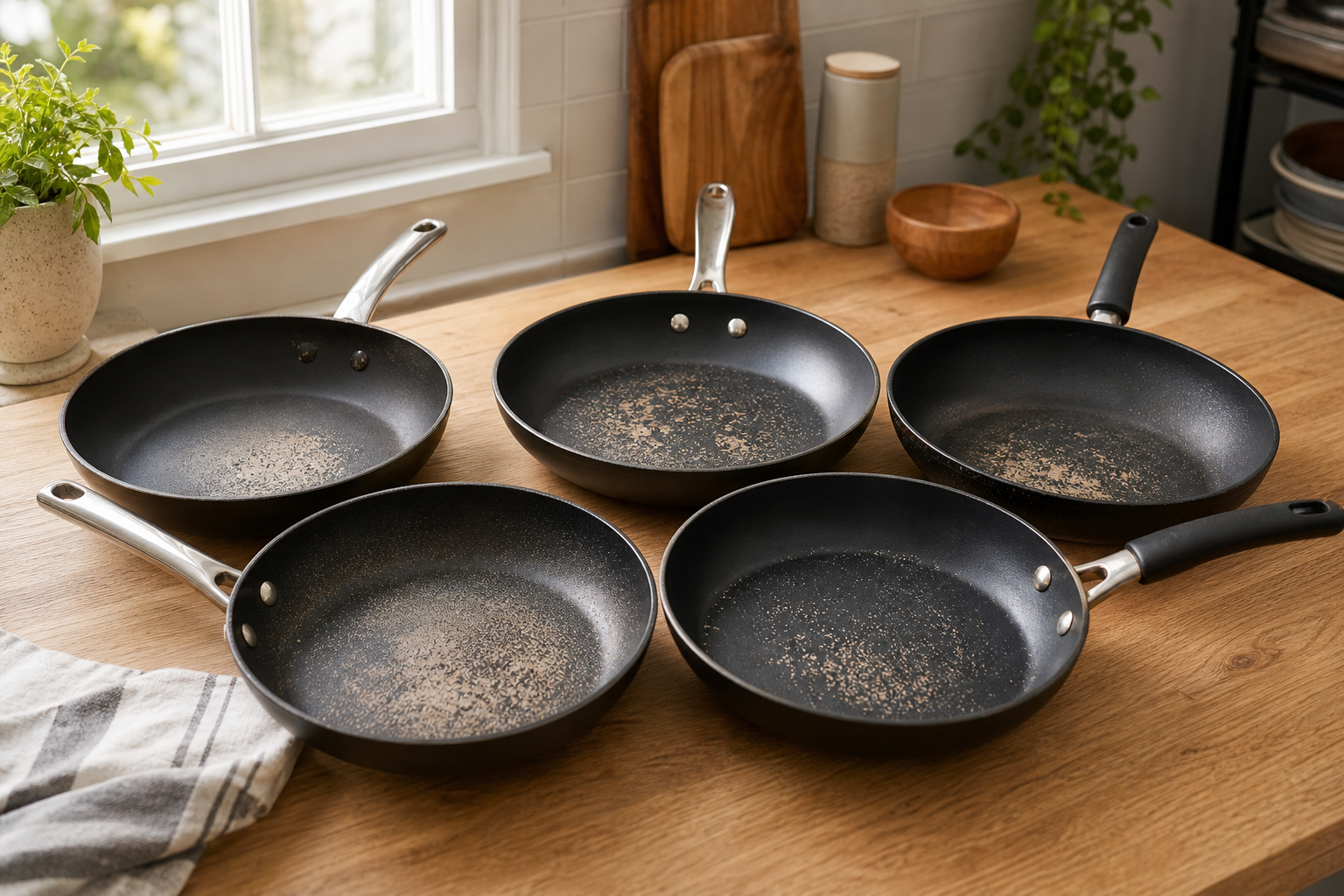
Five 10-inch pans went into daily use for 12 months. At the end we measured how much coating each had lost, scored how well it released an egg, and heated each one to 220 °C to see how far its base bowed. The spread was wide. The Steelcore Pro lost 4% of its coating and still released at 9.2 out of 10. The Teflon Everyday lost 14%, released at 6.8, and was bare at the rim by month ten.
Below are the numbers, the five pans ranked, what a year in each one costs, and how to make the one you own last. If you’re still choosing a material, read our nonstick vs ceramic vs carbon steel test first. Every other gear test is on the kitchen gear comparison hub.
The short answer
- Best overall: Steelcore Pro 10in, $45, 8.7. Least coating lost, 4%. Best egg release at month 12, 9.2. Flattest base, 0.4 mm of warp. It’s heavy, and it needs a long handle.
- Best on a budget: Greenpan Ceramic 10in, $38, 7.8. The ceramic coat held for six months. After that, release fell off, and it finished the year at 8.6.
- Cheapest worth buying: Granite Rock 10in, $32, 7.4. Light and cheap. The coating had dulled by month eight.
- Skip: Copperline 10in, $55, 7.1. The most expensive pan here, it warped 1.3 mm and lost 11% of its coating.
- Skip: Teflon Everyday 10in, $24, 6.6. The cheapest, and the worst on every measure. Bare at the rim by month ten.
The results: five pans, 12 months
| Pan | Price | Coating lost in 12 months | Egg release at month 12 | Warp at 220 °C | Score |
|---|---|---|---|---|---|
| Steelcore Pro 10in | $45 | 4% | 9.2 | 0.4 mm | 8.7 |
| Greenpan Ceramic 10in | $38 | 7% | 8.6 | 0.6 mm | 7.8 |
| Granite Rock 10in | $32 | 9% | 8.1 | 0.9 mm | 7.4 |
| Copperline 10in | $55 | 11% | 7.4 | 1.3 mm | 7.1 |
| Teflon Everyday 10in | $24 | 14% | 6.8 | 1.6 mm | 6.6 |
Coating lost is the share of the coating gone after 12 months of daily use. Egg release is a score out of 10, measured at month 12. Warp is how far the base bowed, in millimeters, with the pan heated to 220 °C. Price is what we paid at retail. The score uses the desk’s fixed weights for performance, build and value.
What the numbers mean
The first thing to notice is the order. Sort the table by coating lost, by egg release, by warp or by score, and you get the same five pans in the same sequence every time. The Steelcore Pro is best on all three measurements. The Teflon Everyday is worst on all three. A pan that kept its coating also kept its release and its shape. A pan that lost one lost the others.
Price is the only column that breaks the pattern, and it breaks it in one place: the Copperline. At $55 it cost $10 more than the winner and finished fourth. Take it out and price tracks the ranking, from $45 at the top to $24 at the bottom.
Coating lost: 4% to 14%
A coating doesn’t fail all at once. It thins where the spatula goes most, along the base and up the curve to the rim, until bare metal shows. The Teflon Everyday lost 14% of its coating in a year, three and a half times the Steelcore Pro’s 4%. Its cons note in our log is specific: the coating was gone at the rim by month ten.
The middle three lost 7%, 9% and 11%. Our log flags the Copperline’s 11% as the highest loss among the mid-priced pans.
Egg release: 9.2 to 6.8
Egg release is the job you bought the pan for. At month 12, the Steelcore Pro scored 9.2 out of 10 and the Teflon Everyday 6.8, a gap of 2.4 points. The Greenpan Ceramic’s 8.6 hides a timeline: our log says its release fell off after month six. If we’d scored it at month five, it would have sat closer to the top.
What a lower release score means at the stove is more fat. A pan that releases at 6.8 asks you to add oil or butter to get the same egg out whole. That’s our reading, not a measurement, but it matters if you count calories. A teaspoon of olive oil is about 40 calories, and a tablespoon 119, by USDA FoodData Central. One extra teaspoon a day is about 14,500 calories over a year. Our hidden calories per tablespoon chart has the other fats.
Warp at 220 °C: 0.4 mm to 1.6 mm
We heated each pan to 220 °C, about 428 °F, and measured how far its base bowed. The Steelcore Pro moved 0.4 mm. The Teflon Everyday moved 1.6 mm, four times as far.
Here’s why a millimeter matters. A flat cooktop, glass-ceramic or induction, only heats well where the pan touches it. A base that bows touches it on less of its surface, so the pan heats unevenly, and oil runs off the high spot to the low side. On a gas grate you’ll notice it less. On a flat top, a pan that rocks when you press the rim is one you’ll fight every morning.
The five pans, ranked
1. Steelcore Pro 10in, $45, 8.7
The best pan in the test on every measurement we took. It lost 4% of its coating in 12 months, scored 9.2 on egg release at month 12, and bowed 0.4 mm at 220 °C. Our log notes it was the pan with the best release at month 12 and the least coating loss.
The con is weight. It’s heavy, and our notes say it needs a long handle to manage. If you flip food with a flick of the wrist, or your wrists complain, pick it up in the shop before you pay.
What worked: least coating loss; best release at month 12; flattest base.
What failed: heavy; needs a long handle.
Buy it if you cook in a nonstick pan most days and want one that’s still nonstick in a year.
2. Greenpan Ceramic 10in, $38, 7.8
The only ceramic coating in the test. It held well for six months. After month six, release fell off, and by month 12 it scored 8.6, 0.6 points behind the Steelcore Pro. It lost 7% of its coating and bowed 0.6 mm, both second best.
Ceramic coatings contain no PTFE. If that’s the reason you’re shopping, this is the pan to buy, with the timeline in mind: the first six months are the good ones. For how ceramic wears against PTFE and carbon steel over 50 cycles, see our material comparison.
What worked: ceramic coat held for six months; second least warp.
What failed: release fell off after month six.
Buy it if you want a PTFE-free coating and will replace it sooner than the Steelcore Pro.
3. Granite Rock 10in, $32, 7.4
Cheap and light, which is a fair case. It lost 9% of its coating and released at 8.1 at month 12. Our log says the coating had dulled by month eight. It bowed 0.9 mm at 220 °C, more than twice the Steelcore Pro.
It’s $13 less than the winner. Over a year that’s about $1.08 a month for a pan that released 1.1 points worse and lost more than twice the coating.
What worked: cheap; light.
What failed: coating dulled by month eight.
Buy it if weight is the deciding factor and you accept replacing it sooner.
4. Copperline 10in, $55, 7.1
The most expensive pan in the test, and fourth of five. Our log credits it with fast heat. That’s the only thing it did better than the pans below it on price. It lost 11% of its coating, the highest of the mid set, released at 7.4 and bowed 1.3 mm at 220 °C, the second-worst warp in the test.
At $55, it costs $10 more than the Steelcore Pro, which beat it by 1.6 points on score, 1.8 on egg release, 7 points of coating loss and 0.9 mm of warp.
What worked: fast heat.
What failed: warped 1.3 mm; 11% coating loss; highest price.
Skip it. The Steelcore Pro is cheaper and better on everything we measured.
5. Teflon Everyday 10in, $24, 6.6
The cheapest pan, and last on every measure: 14% coating loss, 6.8 egg release, 1.6 mm warp. By month ten, the coating was gone at the rim.
$24 is $21 less than the Steelcore Pro. If you replace it every ten months, the point at which it stopped being a nonstick pan in our test, two years costs about $58. That’s more than one Steelcore Pro, though we haven’t tested whether the Steelcore Pro reaches two years.
What worked: cheapest.
What failed: coating gone at the rim by month ten; worst release, worst warp.
Skip it unless you need a pan for a few months and nothing longer.
What a year costs
The sticker price tells you what you pay today. Spread over the 12 months we tested, here’s what each pan cost per month, and per point of egg release at month 12.
| Pan | Price | Cost per month over 12 months | Cost per point of release |
|---|---|---|---|
| Steelcore Pro 10in | $45 | $3.75 | $4.89 |
| Greenpan Ceramic 10in | $38 | $3.17 | $4.42 |
| Granite Rock 10in | $32 | $2.67 | $3.95 |
| Copperline 10in | $55 | $4.58 | $7.43 |
| Teflon Everyday 10in | $24 | $2.00 | $3.53 |
The cheap pans look good on this table, and that’s the trap. Cost per point treats a 6.8 release as worth 74% of a 9.2 release, and it isn’t. Our reading: below about 8, you start adding fat to get eggs out cleanly, and a pan that’s bare at the rim by month ten has a shorter year than the table assumes. The one row that’s plainly bad on every column is the Copperline: highest cost per month, highest cost per point.
The difference between the winner and the cheapest pan is $1.75 a month. For the pan you use every day, that’s the cheapest upgrade in the kitchen.
How to make a nonstick pan last a year
None of this was measured separately. It’s the standard care advice, and it’s what a year of daily use punishes you for skipping.
Keep the heat at medium. Most of what you cook in nonstick, eggs, fish, pancakes, doesn’t need more. High heat wears coatings faster, and an empty pan on a high burner gets hot quickly. Preheat on medium with a little fat in the pan.
Use a little fat anyway. Even a pan that releases at 9.2 does better with a film of oil or butter, and the coating takes less abuse. Measure it if you’re logging: our guide to weighing food for a calorie app covers weighing the oil along with the food.
Skip aerosol cooking sprays. The standard advice is that they leave a sticky residue that builds up on the coating. Pour or brush oil instead.
Use wood, silicone or nylon. Metal spatulas and whisks cut the coating where it’s thinnest, and the rim is where the Teflon Everyday went bare first.
Let it cool before you wash it. Cold water on a hot pan is hard on the base. A pan that has warped once doesn’t go back.
Wash by hand, with a soft sponge. Abrasive pads take coating off a little at a time. Check your pan’s care instructions for the dishwasher; we didn’t test it.
Is nonstick safe?
Used the way the makers say, yes. Two facts cover most of the worry.
PFOA is gone. PFOA was the chemical behind most of the old concern about nonstick cookware. US makers eliminated it from production under the EPA’s PFOA Stewardship Program, which set 2010 and 2015 targets. Pans sold as PFOA-free are the norm, not a premium feature.
Overheating is the real risk. PTFE, the coating in most nonstick pans, is stable at normal cooking heat. Makers advise against heating it above about 260 °C, or 500 °F. Badly overheated PTFE can give off fumes that cause flu-like symptoms in people, known as polymer fume fever, and can kill pet birds, whose lungs are far more sensitive. Our warp test ran at 220 °C, below that limit. An empty pan left on a high burner can pass it. If you keep birds, keep them out of the kitchen.
Ceramic coatings like the Greenpan’s contain no PTFE. If you’d rather not think about the 260 °C limit at all, that’s the reason to pick one, and the cost is release that fades sooner.
If you’re unsure how hot your pan is getting, an infrared thermometer reads the surface. We haven’t tested those. For food temperatures, our instant-read thermometer test covers the probe kind.
When to replace a nonstick pan
Replace it when any of these happens:
- Eggs stick where they used to slide, with the same fat and heat as before. Release is the job; when it goes, the pan is a frying pan.
- You can see bare metal, usually at the rim or in the center. That’s what happened to the Teflon Everyday by month ten.
- The base rocks on a flat burner. Press down on the rim. If it spins or tips, it will heat unevenly from here on.
- The surface is deeply scratched or flaking. Flakes in your food are the end of the pan, whatever the release score.
A coated pan is a consumable. The question isn’t whether it wears out, it’s how long it takes. In our test, the best pan was still working at 12 months and the worst wasn’t.
What we didn’t like
- Steelcore Pro: heavy, and it needs a long handle. The best results in the test come with the most weight in your hand.
- Greenpan Ceramic: release fell off after month six. Half the year was good.
- Granite Rock: the coating had dulled by month eight, and the base bowed 0.9 mm.
- Copperline: the highest price, $55, for fourth place, 1.3 mm of warp and 11% coating loss.
- Teflon Everyday: last on every measurement, and bare at the rim by month ten.
What we didn’t measure
Our numbers are coating lost over 12 months, egg release at month 12, and warp at 220 °C. We didn’t time how fast each pan heated, beyond the note in our log that the Copperline heats fast. We didn’t test dishwasher cycles, oven use or induction compatibility, and we didn’t weigh the pans; “heavy” and “light” come from Dev’s notes in use. We didn’t score release monthly, so the timelines for the Greenpan Ceramic, the Granite Rock and the Teflon Everyday come from the notes in our log. Nothing here tells you how any pan does past 12 months.
Which pan for which cook
You cook eggs every morning
The Steelcore Pro. 9.2 at month 12 was the best release in the test, and its coating lost 4%.
You want no PTFE
The Greenpan Ceramic, and plan to replace it once release goes, which for us was after month six. Or skip coatings altogether: carbon steel has no coating to lose, and it kept 92% of its seasoning in our 50-cycle material test.
You have a glass or induction cooktop
The Steelcore Pro, with 0.4 mm of warp at 220 °C. We didn’t test induction compatibility, so check the box says induction-ready. Avoid the Copperline and the Teflon Everyday, which bowed 1.3 mm and 1.6 mm.
You want light
The Granite Rock, at $32. Expect the coating to dull before the year is out.
You need the cheapest pan
The Granite Rock, $8 more than the Teflon Everyday, beat it on every measurement.
How we tested
Five 10-inch nonstick pans, bought at retail. Each went into daily use for 12 months. At the end we measured the share of coating lost, scored egg release out of 10 at month 12, and heated each pan to 220 °C to measure how far its base bowed. Dev kept notes on handling, weight and heat in use, and every reading was photographed. The score uses the desk’s fixed weights for performance, build and value, and the cons are printed for every pan, the winner included. Testing ended March 10, 2026. The full method is on How we test. For our other tests of everyday kitchen kit, start at the kitchen gear reviews, or see our air fryer vs convection oven test.
Sources
U.S. Environmental Protection Agency, PFOA Stewardship Program (2010/2015).
Chemours, Teflon nonstick coatings: use and care guidance.
Merck Veterinary Manual, Toxicoses in pet birds: polytetrafluoroethylene.
USDA FoodData Central, SR Legacy: olive oil and butter, per tablespoon.
Questions we get
How long should a nonstick pan last?
On our numbers, the best of five lasted the year in good shape. The Steelcore Pro lost 4% of its coating in 12 months of daily use and still released eggs at 9.2 out of 10. The worst, the Teflon Everyday, was bare at the rim by month ten. We can't vouch for any pan past 12 months.
Is a ceramic pan better than a regular nonstick pan?
Not on release over a year. The Greenpan Ceramic held its coat for six months, then release fell off, and it scored 8.6 at month 12 against 9.2 for the Steelcore Pro. Ceramic coatings contain no PTFE, which is the reason to choose one.
Is nonstick cookware safe?
Used the way the makers say, yes. PTFE makers advise against heating above about 260 °C (500 °F). Overheated PTFE can give off fumes that cause flu-like symptoms in people and can kill pet birds, so never preheat an empty pan on high. US makers eliminated PFOA under an EPA stewardship program that ended in 2015.
When should I replace a nonstick pan?
When eggs stick where they used to slide, when you can see bare metal, or when the base rocks on a flat burner. In our test, the Teflon Everyday reached bare metal at the rim by month ten.
Does a warped pan matter?
On a flat cooktop it does. A base that bows touches glass or induction on less of its surface, so it heats unevenly and oil runs to the low side. The Teflon Everyday bowed 1.6 mm at 220 °C, four times the Steelcore Pro's 0.4 mm.
Who stands behind this post
Dev Patel
Tester, kitchen gearTests scales, thermometers, air fryers and storage gear. Former restaurant equipment buyer.
- Posts written
- 17
- Posts reviewed
- 0
Mara Ellison
EditorEdits the desk: every test plan, every post, every correction. Twelve years in food and tech journalism.
- Posts written
- 12
- Posts reviewed
- 11
Corrections. Spotted a wrong figure? Email desk@foodblogblog.com. We correct within five business days and date the change. No link on this page carries an affiliate tag yet. When a shop program opens, tagged links will be marked.