Best air fryers: 5 tested over 40 batches, 71% to 91% even
We ran 40 batches through five air fryers with a probe in the food. The $179 Halo XL cooked most evenly, 91%, with the hottest basket, 200 °C, and scored 8.7. The $120 Crisp 5 hit 88% for $59 less. The $69 Fry Mini burned edges.
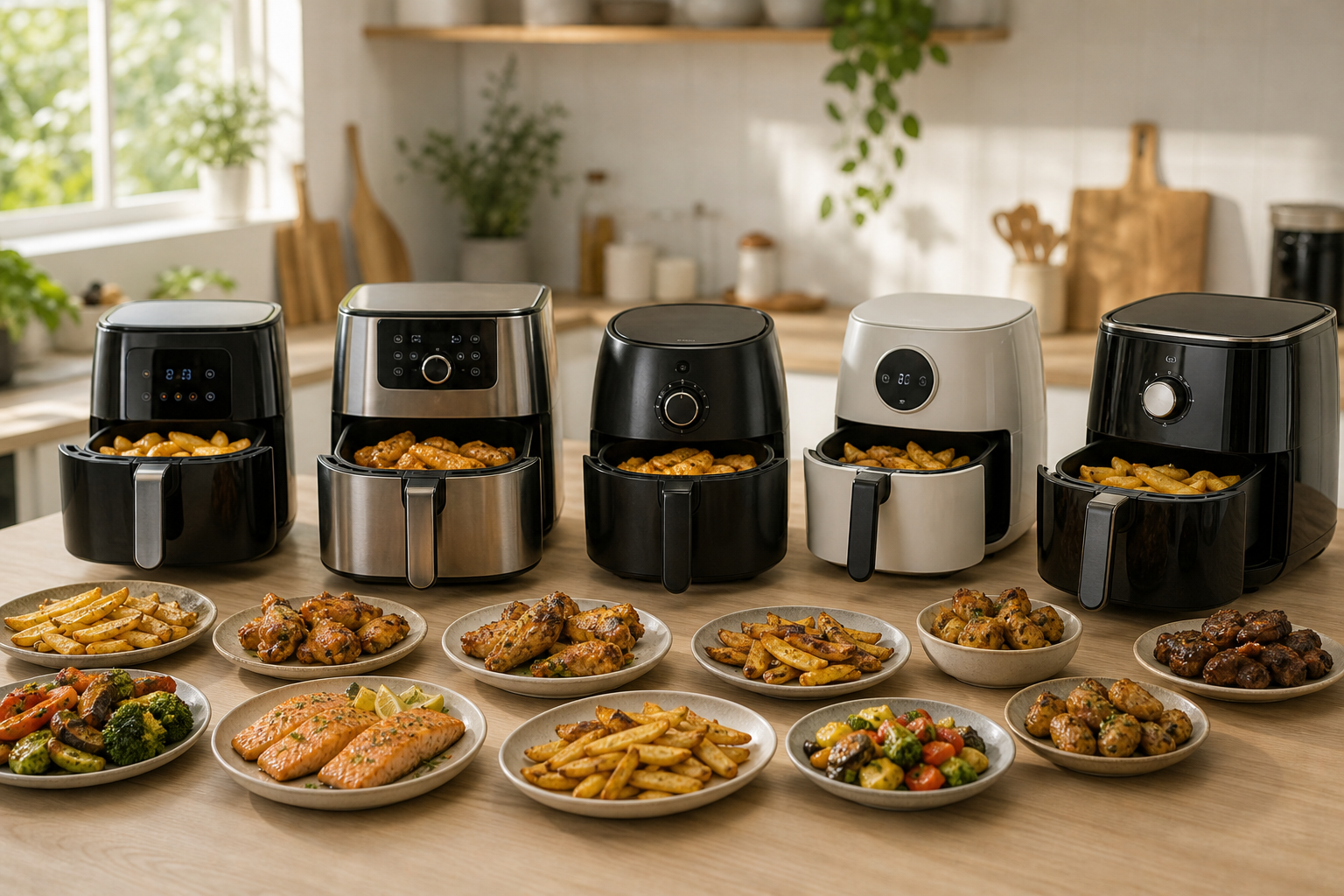
An air fryer is a small convection oven with a basket. What separates a good one from a bad one is whether the heat reaches every piece in the basket, not just the ones on top or in the middle. So that’s what we measured. We ran 40 batches through five air fryers, with a probe in the food, and logged how evenly each batch cooked and how hot each basket ran.
Evenness ran from 71% to 91%, and basket temperature from 181 °C (358 °F) to 200 °C (392 °F). The Halo XL topped both and scored 8.7. It’s $179 and big. The Crisp 5 was three points behind on evenness, 88%, for $120, and it’s loud. The Fry Mini, at $69, ran the coolest basket and still burned edges.
One pattern ran through the whole test: the order by basket temperature was the same as the order by evenness, top to bottom. Below are the numbers, what they mean on a plate, and what an air fryer does and doesn’t do to your calorie log.
The short answer
- Best overall: Halo XL, $179, 8.7. 91% evenness, 200 °C basket, a large basket. The footprint is big, and it’s the most expensive here.
- Best for most kitchens: Crisp 5, $120, 8.3. 88% evenness, 196 °C, an easy basket. Loud.
- Two foods at once: Nova Dual, $149, 7.9. Two baskets, 84% evenness. Confusing controls.
- Quiet and cheap: Aria 4L, $99, 7.6. Quiet, 79% evenness. The corners cooked unevenly.
- Skip: Fry Mini, $69, 6.9. Small and cheap, 71% evenness, burned edges.
The results: five fryers, 40 batches
| Air fryer | Price | Batch evenness | Basket temperature | Score |
|---|---|---|---|---|
| Halo XL | $179 | 91% | 200 °C (392 °F) | 8.7 |
| Crisp 5 | $120 | 88% | 196 °C (385 °F) | 8.3 |
| Nova Dual | $149 | 84% | 192 °C (378 °F) | 7.9 |
| Aria 4L | $99 | 79% | 188 °C (370 °F) | 7.6 |
| Fry Mini | $69 | 71% | 181 °C (358 °F) | 6.9 |
Batch evenness is how uniformly a batch came out, as a percentage, where 100% would be every piece cooked the same. It’s the figure across the batches each fryer ran. Basket temperature is the temperature we measured in the basket. Price is what we paid at retail. Fahrenheit figures are rounded to the nearest degree.
What evenness and basket temperature tell you
Start with the evenness column. Twenty points separate the Halo XL from the Fry Mini. On a plate, that’s the difference between a batch you serve as it comes out and a batch you sort: the browned pieces on one side, the pale ones back in for another few minutes, the burnt corners in the bin.
The top three were within seven points of each other, 84% to 91%. Below that, the drop gets steeper: 79% for the Aria 4L, whose corners cooked unevenly, and 71% for the Fry Mini, whose edges burned.
Now the temperature column. The hottest basket, the Halo XL’s, ran 19 °C (34 °F) hotter than the coolest, the Fry Mini’s. And the ranking by temperature matches the ranking by evenness exactly: 200 °C and 91%, 196 °C and 88%, 192 °C and 84%, 188 °C and 79%, 181 °C and 71%.
Five fryers aren’t enough to call that a rule, and a hot basket isn’t the same thing as an even one. But the pattern is worth remembering. A fryer that runs cool tends to have less heat to spread around, and in our test the cooler fryers were also the ones that spread it worse. The Fry Mini is the clearest case: the coolest basket in the test, and it still burned edges. The heat that was there didn’t reach the food evenly.
The five air fryers, ranked
1. Halo XL, $179, 8.7
The best on both measurements: 91% evenness and 200 °C in the basket. The basket is large, which makes it easier to keep a full batch in one layer.
The cost is space and money. “Big footprint” is the con in our log, and you’ll need a clear stretch of counter with room above and behind it for the air to vent. At $179, it’s the most expensive fryer here, $59 more than the Crisp 5.
What worked: best evenness in the test; hottest basket; large basket.
What failed: big footprint; highest price.
Buy it if you cook for three or more, run the fryer most days, and have the counter for it.
2. Crisp 5, $120, 8.3
88% evenness and 196 °C, three points and 4 °C behind the Halo XL. The browning was even, and the basket was easy to use.
It’s loud. Our log says so in one word, and it’s the con you’ll notice every time you use it. If your kitchen is open to the living room, that matters.
What worked: even browning; easy basket; second on both measurements for $59 less than the winner.
What failed: loud.
Buy it if you want close to the best result in the test at a price most kitchens can justify.
3. Nova Dual, $149, 7.9
84% evenness and 192 °C. The pro is the two baskets: protein in one, vegetables in the other, both done at once.
The controls were the most confusing in the test, which is a real cost on a machine with two baskets to set. And it’s $29 more than the Crisp 5, which was four points more even.
What worked: two baskets.
What failed: confusing controls; less even than the cheaper Crisp 5.
Buy it if you cook two things at once most nights and you’re willing to learn the panel.
4. Aria 4L, $99, 7.6
79% evenness and 188 °C. Cheap and quiet, the opposite of the Crisp 5 on noise.
The corners cooked unevenly. In practice, that means turning or shaking the batch more often, or keeping food out of the corners.
What worked: cheap; quiet.
What failed: uneven corners; 79% evenness.
Buy it if noise matters more to you than browning, or $99 is the ceiling.
5. Fry Mini, $69, 6.9
71% evenness and 181 °C, the lowest on both. It’s small and it’s cheap, and those are its two pros.
It burned edges, and at 71% evenness, you’ll be sorting most batches. Thirty dollars more buys the Aria 4L, eight points more even.
What worked: small; cheap.
What failed: burned edges; 71% evenness; coolest basket.
Skip it unless counter space or $69 is a hard limit, and plan to shake every batch.
What each step up in price buys
Line the fryers up by price and the value is uneven, in a way the scores alone don’t show.
| Step | Extra cost | Evenness gained | Cost per point |
|---|---|---|---|
| Fry Mini to Aria 4L | $30 | 8 points | $3.75 |
| Aria 4L to Crisp 5 | $21 | 9 points | about $2.33 |
| Crisp 5 to Halo XL | $59 | 3 points | about $19.67 |
The cheapest step up is the one from the Aria 4L to the Crisp 5: $21 for nine points of evenness and 8 °C more heat in the basket. That’s why the Crisp 5 is the one we’d tell most people to buy. The step from the Crisp 5 to the Halo XL costs $59 for three more points, a large basket and the hottest basket in the test. Worth it if you cook big batches. Not worth it for two.
The Nova Dual sits off the line. It costs $29 more than the Crisp 5 and is four points less even. What you pay for there is the second basket, not better cooking, and that’s a fair trade only if you’d use both baskets most nights.
What we didn’t measure
Our numbers are evenness and basket temperature. Noise, controls, footprint and basket handling come from Dev’s notes in use, not from instruments. We didn’t measure decibels, so “loud” on the Crisp 5 and “quiet” on the Aria 4L are comparisons within this test, not figures. We didn’t measure energy use or basket capacity either, and we don’t print figures we didn’t log. The capacity in a box listing is the maker’s claim; how much food fits in one layer is what decides evenness in your kitchen.
Air fryer or oven?
We ran a convection oven against an air fryer side by side in a separate test: the fryer reached 190 °C in 210 seconds against 540 for the oven, cooked a 500 g batch at 88% evenness against 74%, and used 0.42 kWh against 0.96. What we can say is what the test shows about the fryers: the good ones brown evenly, the bad ones don’t, and the gap between them, 71% to 91%, is wide enough that a poor air fryer is not automatically better than the oven you already own. If you’re deciding whether to buy one at all, the honest question is how often it would come out of the cupboard. Several times a week, buy a good one. Twice a month, use the oven.
What an air fryer does to your calorie log
An air fryer doesn’t change the calories in food. It changes how much oil you add. That’s the whole effect, and it’s worth being exact about.
A level tablespoon of olive oil is 119 calories, by USDA FoodData Central. If the air fryer replaces one tablespoon of oil in a pan each day, that’s 119 calories a day you don’t add, or 833 a week. Against a 500-calorie daily deficit, one tablespoon a day is 24% of it, a figure we worked through in hidden calories per tablespoon.
Three things eat into that saving.
- Oil you still use. A spray or a toss in oil is still oil. Weigh the bowl before and after you toss, or count the sprays and check the can’s serving size.
- Pre-fried food. Frozen fries and breaded products often come par-fried. The oil is already in them, and the label counts it. The air fryer doesn’t remove it.
- Bigger portions. If crisp food without the pan means you make more of it, the saving goes into the second batch.
Weigh what goes into the basket, not what comes out. Water cooks off in a hot fryer, so cooked food weighs less than raw. Log against a raw entry for the raw weight, as our guide to weighing food raw or cooked explains.
Food safety: an air fryer still needs a thermometer
Browning tells you about the outside. A probe tells you about the middle. We ran every batch with a probe in the food, and you should check yours the same way, at least until you know your fryer.
The USDA minimums don’t change because the appliance did: 165 °F (74 °C) for poultry, 160 °F (71 °C) for ground meat, 145 °F (63 °C) for whole cuts and fish. Our safe internal cooking temperatures chart has the full list. For a quick, accurate probe, see the best instant-read thermometers.
Two cases need extra care. Frozen breaded chicken can look browned and done while it’s raw inside. USDA has warned about exactly that, and since 2024 it treats Salmonella in raw breaded stuffed chicken as an adulterant above a set level. Unless the package says fully cooked, treat it as raw and cook it to 165 °F. And leftovers reheated in the fryer need to reach 165 °F in the center, the same as in a microwave. Our guide to storing leftovers covers the rest.
Uneven fryers make this harder. In a batch that’s 71% even, the palest piece is the one to probe, not the one that looks done.
Browning without burning
Burned edges were the Fry Mini’s main con, and they matter for more than taste. Acrylamide forms in starchy foods like potatoes when they’re cooked at high heat, and the darker the browning, the more of it there tends to be. FDA’s advice for home cooks is to cook fries and other cut potato products to a golden yellow, not dark brown, and to avoid burnt areas.
An even fryer makes that easy, because the whole batch reaches golden at the same time. An uneven one forces a choice: pull it when the edges are dark and the middle is pale, or wait for the middle and burn the edges.
How to get a more even batch from any fryer
The fryer sets the ceiling. The load decides how close you get to it.
- One layer. Stacked food steams instead of browning. If it doesn’t fit in one layer, cook two batches.
- Space between pieces. Air has to move around each one.
- Shake or turn halfway. It evens out the top and bottom, and in the Aria 4L, it moves food out of the corners.
- Same-size pieces. A thick wedge and a thin one won’t finish together, in any fryer.
- Preheat if your model calls for it. A cold basket means the first minutes don’t count.
- Probe the palest piece. That’s your doneness check, not the darkest one.
Which air fryer for which kitchen
You cook for a family most nights
The Halo XL. The large basket keeps a full batch in one layer, and it was the most even fryer in the test.
You want the best value
The Crisp 5. 88% evenness for $120, if you can live with the noise.
You cook a protein and a side at the same time
The Nova Dual, with the warning that its controls take learning, and that the Crisp 5 was more even for less.
You cook for one or two
The Crisp 5 still, if the counter allows it. A smaller fryer is tempting, but the small fryer in this test, the Fry Mini, was also the least even, 71%, and burned edges. Small portions in a bigger basket sit in one layer with room around them, which is how any fryer browns best. If the Crisp 5 doesn’t fit your counter or your budget, the Aria 4L is the cheapest fryer here we’d still buy.
Your kitchen is small or open-plan
The Aria 4L for its quiet, if you’ll shake batches out of the corners.
You meal-prep chicken by the tray
The Halo XL or the Crisp 5, and a thermometer. Then cool and portion it the way our guide to freezing meal prep describes.
How we tested
Five air fryers, all bought at retail. The test ran 40 batches, with a probe in the food on every batch. For each fryer, we logged batch evenness and the temperature in the basket, and Dev noted noise, controls, basket handling and footprint in use. Every reading was photographed. The score uses the desk’s fixed weights for performance, build and value, and the cons are printed for every fryer, the winner included. Testing ended May 11, 2026. The full method is on How we test. Mara Ellison edited this post.
Sources
USDA Food Safety and Inspection Service, Safe Minimum Internal Temperature Chart.
USDA Food Safety and Inspection Service, Leftovers and Food Safety.
USDA Food Safety and Inspection Service, Salmonella in Not-Ready-To-Eat Breaded Stuffed Chicken Products.
U.S. Food and Drug Administration, Acrylamide Questions and Answers.
USDA Agricultural Research Service, FoodData Central.
Questions we get
Are air fryers worth it?
If you'd use one several times a week, yes, and the Crisp 5 at $120 is where we'd start: 88% evenness, three points behind the best fryer in our test for $59 less. If it would come out twice a month, your oven does the same job with more patience, as our <a href='/posts/air-fryer-vs-convection-oven/'>oven comparison</a> shows.
Do I still need a thermometer with an air fryer?
Yes. Browning on the outside tells you nothing about the middle. We ran every batch with a probe in the food. Chicken needs 165 °F (74 °C) in the thickest part, ground meat 160 °F (71 °C), whole cuts and fish 145 °F (63 °C).
Does an air fryer save calories?
Only the oil you leave out. A tablespoon of olive oil is 119 calories by USDA FoodData Central. If the fryer replaces a tablespoon of oil in a pan, that's 119 calories saved. If you spray the basket, weigh or count the spray.
Why does my air fryer cook unevenly?
Partly the fryer: evenness in our test ran from 71% for the Fry Mini to 91% for the Halo XL. Partly the load: keep food in one layer, leave space between pieces, and shake or turn it halfway through.
Is a dual-basket air fryer worth it?
Only if you cook two foods at once most nights. The Nova Dual's two baskets were its pro. It cost $29 more than the Crisp 5, was less even, 84% against 88%, and its controls were the most confusing in the test.
Can I cook frozen breaded chicken in an air fryer?
Yes, as long as you treat it as raw unless the package says it's fully cooked. USDA warns that frozen breaded chicken products can look browned and done while the inside is raw. Cook it to 165 °F (74 °C) and check with a thermometer.
Who stands behind this post
Dev Patel
Tester, kitchen gearTests scales, thermometers, air fryers and storage gear. Former restaurant equipment buyer.
- Posts written
- 17
- Posts reviewed
- 0
Mara Ellison
EditorEdits the desk: every test plan, every post, every correction. Twelve years in food and tech journalism.
- Posts written
- 12
- Posts reviewed
- 11
Corrections. Spotted a wrong figure? Email desk@foodblogblog.com. We correct within five business days and date the change. No link on this page carries an affiliate tag yet. When a shop program opens, tagged links will be marked.